Provenance
William Mayor, London (died 1874) [stamp (Lugt 2799), recto, lower right, in black]; sold, Sotheby’s, London, Mar. 17, 1882, to John Postle Heseltine, London, by 1894. Arthur Kauffman, London, 1930; sold to Dorothy Braude Edinburg, Brookline, MA., Nov. 1964; given to the Art Institute of Chicago, 2013.
Accession Number
151461
Medium
Pen and brown ink, with gray gouache, over black chalk, heightened with lead-white gouache (discolored), on blue laid paper, pieced, and laid down on ivory laid paper
Dimensions
62.3 × 29.6 cm (24 9/16 × 11 11/16 in.)
Classification
pen and ink drawings
Credit Line
Gift of Dorothy Braude Edinburg to the Harry B. and Bessie K. Braude Memorial Collection
Background & Context
Background Story
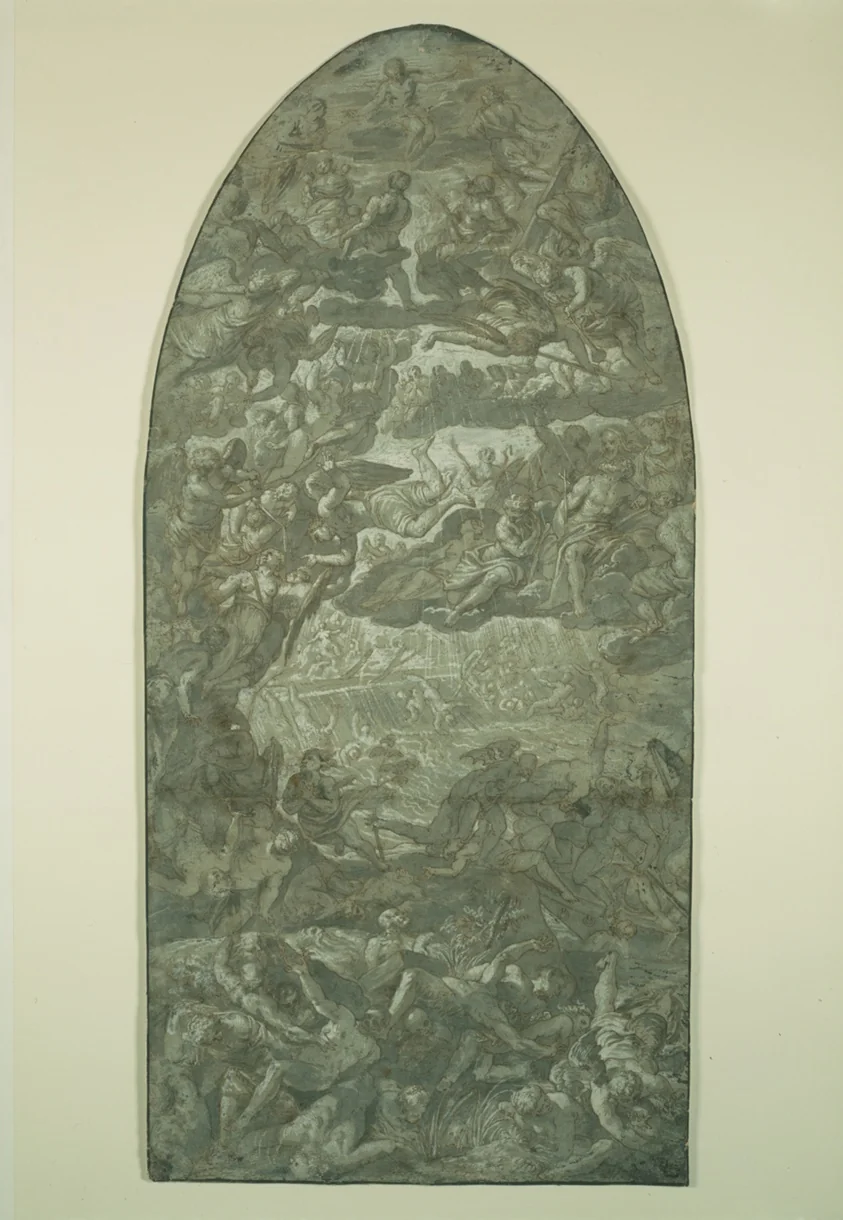
Tintoretto's The Last Judgment is a pen and brown ink drawing with gray gouache over black chalk, heightened with lead-white gouache on blue laid paper that depicts the biblical narrative of the final judgment in which Christ returns to judge the living and the dead, a subject that provided the Venetian master with the most dramatic and visually complex composition in the Christian tradition. Tintoretto, whose Last Judgment in the Scuola di San Rocco is one of the most celebrated paintings in the history of Venetian art, produced numerous studies for his Last Judgment compositions throughout his career, and this drawing demonstrates the compositional method for which his paintings are celebrated: a sweeping diagonal movement that organizes the multitude of saved and damned into a dynamic composition of extraordinary spatial complexity. The combination of pen and ink, gouache, and chalk, applied on a blue laid paper that has been pieced together from multiple sheets and laid down on ivory laid paper, reveals the working process of an artist who was constantly revising and refining his compositions, adding sheets of paper when the composition outgrew its original boundaries and layering drawing materials to create the tonal richness and atmospheric depth that distinguish his best work. The gray gouache provides the tonal modeling that gives the figures spatial presence, while the lead-white gouache highlights create the effect of divine light illuminating the saved and casting the damned into shadow. The blue laid paper, which provides a cool atmospheric ground that suggests the heavenly realm from which Christ descends, is a deliberate choice that gives the drawing a tonal range and atmospheric depth that would be difficult to achieve on white or natural paper.
Cultural Impact
Tintoretto's Last Judgment drawings are among the most accomplished works in the history of Venetian draftsmanship, and their influence on the development of dramatic religious composition extends from his contemporaries through the Baroque period. The drawing demonstrates the compositional energy, spatial complexity, and tonal sophistication that make his work the model for dramatic religious narrative.
Why It Matters
A pen and ink and gouache drawing by Tintoretto on pieced blue laid paper depicting the Last Judgment with sweeping diagonal composition and divine light, revealing his working process of revision and layering in the most dramatic and spatially complex subject of the Christian tradition.


