Winged Figure

Description

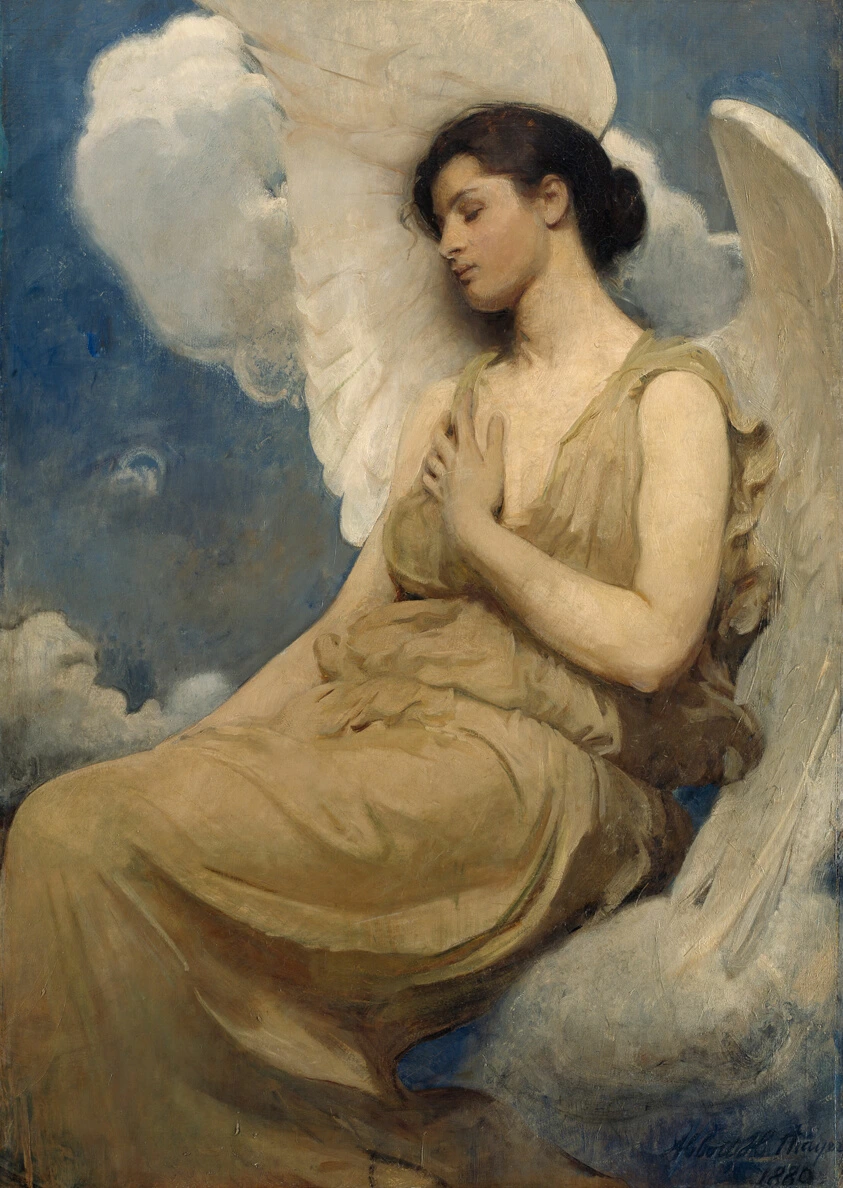
This female angel is one of many that Abbott Handerson Thayer painted during his career. Originally a painter of animals, Thayer created portraits and then allegorical figures like this example after training in Paris. The artist wrote of his seraphic subjects, “I have put on wings probably more to symbolize an exalted atmosphere . . . where one need not explain the action of his figures.” Other late 19th-century artists such as Augustus Saint-Gaudens also represented angelic female figures to personify what they perceived as the virtues of women. In Winged Figure, Thayer mixed this idealism with a level of naturalism, particularizing the woman’s features and giving her form a sense of mass and gravity.

Provenance

Hillyer Art Gallery, Smith College, Northampton, MA, 1889; Gimbel Brothers, New York, 1946; Julius H. Weitzner, New York, 1947; sold by him to the Art Institute of Chicago, 1947.

Winged Figure

Abbott Handerson Thayer

1889

Accession Number

59798

Medium

Oil on canvas

Dimensions

130.8 × 95.9 cm (51 1/2 × 37 3/4 in.)

Classification

Painting

Museum

The Art Institute of Chicago

Chicago, United States

Credit Line

Simeon B. Williams Fund

Background & Context

Background Story

Abbott Handerson Thayer's Winged Figure is one of the most ethereal works in American art of the Gilded Age, depicting an angelic female figure rendered with translucent wings and a flowing white garment that dissolves into the surrounding atmosphere. Painted in 1889, the work reflects Thayer's deep engagement with ideas of spiritual transcendence and natural beauty—themes that would later lead to his pioneering research in animal camouflage. The figure's face is modeled on Thayer's beloved daughter Mary, who served as his muse during a period of intense personal grief following the death of his wife Kate Bloede Thayer in 1881. The painting's luminous quality emerges from Thayer's technique of layering thin glazes over a white ground, allowing light to penetrate and reflect back through the paint layers, creating an effect the artist called 'spirit light.' The ambiguity between figure and background anticipates his later scientific work on concealing coloration, where he demonstrated how animals disappear into their surroundings through disruptive patterning—suggesting that even his most spiritual paintings carried the seeds of his naturalist observations.

Cultural Impact

Thayer's Winged Figure became an iconic image of American Symbolism and influenced generations of muralists and illustrators who saw in its idealized female form a visual vocabulary for spiritual aspiration. His dual identity—as both a dreamy idealist painting angels and a rigorous scientist studying camouflage—makes this work a singular bridge between art and science in American culture.

Why It Matters

A luminous Symbolist painting by Thayer that merges grief-driven spiritual vision with proto-modernist technique, embodying the artist's unique position between Romantic idealism and scientific observation.