Wittenberg Reliquary Book (Wittenberger Heiligthumsbuch)

Description

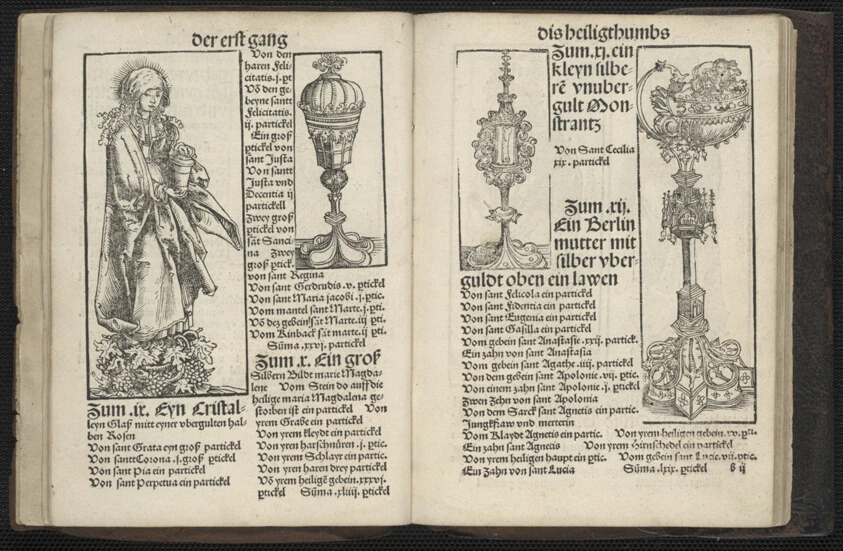
Lucas Cranach produced this souvenir catalogue to promote the prized collection of relics and reliquaries of his patron, Elector Frederick the Wise of Saxony. Copies were printed on paper and more luxurious vellum, although the paper printings are now scarcer. The sequence of woodcuts walks pilgrims through every stage of the yearly viewing; each relic offered a hundred days of indulgence. Pilgrims witnessing them all would have amassed an impressive 500,500 days (1,371 years) of respite from Purgatory. Yet Frederick’s protégé, the radical Martin Luther, would soon speak out against the practice of granting indulgences, and the relic collection would be shown for the last time in 1522. The pages visible here depict Mary Magdalene’s hair, nineteen particles of Saint Cecilia, and other relics.

Wittenberg Reliquary Book (Wittenberger Heiligthumsbuch)

Lucas Cranach the Elder

1510

Accession Number

62565

Medium

Woodcut engraving and letterpress on cream laid paper, in original limp brown goatskin with wrap-around fore-edge flap, decorated with a blind outer fillet frame with intersecting interior blind lines

Dimensions

Folio: 19.3 × 14 cm (7 5/8 × 5 9/16 in.)

Classification

book

Museum

The Art Institute of Chicago

Chicago, United States

Credit Line

Clarence Buckingham Collection
Background & Context

Background Story

Lucas Cranach the Elders Wittenberg Reliquary Book from 1510 is a woodcut engraving and letterpress book in its original limp brown goatskin binding that documents the collection of relics displayed in the Castle Church of Wittenberg, the same church where Martin Luther would post his Ninety-five Theses seven years later. The Wittenberger Heiligthumsbuch, which illustrates and describes the relics that were venerated by pilgrims to Wittenberg, is a paradoxical document: created by the court painter to the Electors of Saxony to promote the cult of relics, it would become evidence of the very abuses that Luther would attack. Cranach, who would become Luthers closest friend and most effective propagandist, illustrated the book with woodcuts of the reliquaries and their contents that demonstrate the same detailed naturalism and compositional clarity that distinguish his paintings. The woodcut technique, with its bold lines and clear contours, is well suited to the depiction of the elaborate reliquaries and the devotional scenes that accompany them, producing images that are simultaneously descriptive and devotional. The original limp brown goatskin binding with its wrap-around fore-edge flap is a rare survival of a 16th-century binding style, and its presence on this copy gives the book the physical presence of a devotional object rather than a mere document. The year 1510 places this book at the height of the relic trade that Luther would attack, making it a document of the religious culture that the Reformation would transform.

Cultural Impact

The Wittenberg Reliquary Book is one of the most significant documents of the pre-Reformation cult of relics and of Cranachs role in the visual culture of the Reformation. The book illustrates the relics that Luther would attack and demonstrates the commercial and devotional network that the Reformation would dismantle, influencing the development of Reformation propaganda and the broader history of the illustrated book.

Why It Matters

A 1510 illustrated book by Cranach documenting the Wittenberg relic collection with woodcut illustrations and letterpress text in its original goatskin binding, a paradoxical document of the pre-Reformation cult of relics created by the artist who would become Luthers propagandist.