Provenance
The artist [1903-1970]; his estate; consigned 1970 to (Marlborough Gallery, Inc., New York); transferred 1977 back to the artist's estate;[1] transferred 1979 to The Mark Rothko Foundation, Inc., New York; gift 1986 to NGA.
[1] For a detailed discussion of the transactions surrounding the Rothko estate see Lee Seldes, _Legacy of Mark Rothko_, New York, 1978.
Accession Number
1986.43.30
Medium
oil on hardboard
Dimensions
overall: 70.8 x 91.4 cm (27 7/8 x 36 in.)
Classification
Painting
Credit Line
Gift of The Mark Rothko Foundation, Inc.
Tags
Painting Early Modern (1901–1950) Oil Painting Board American
Background & Context
Background Story
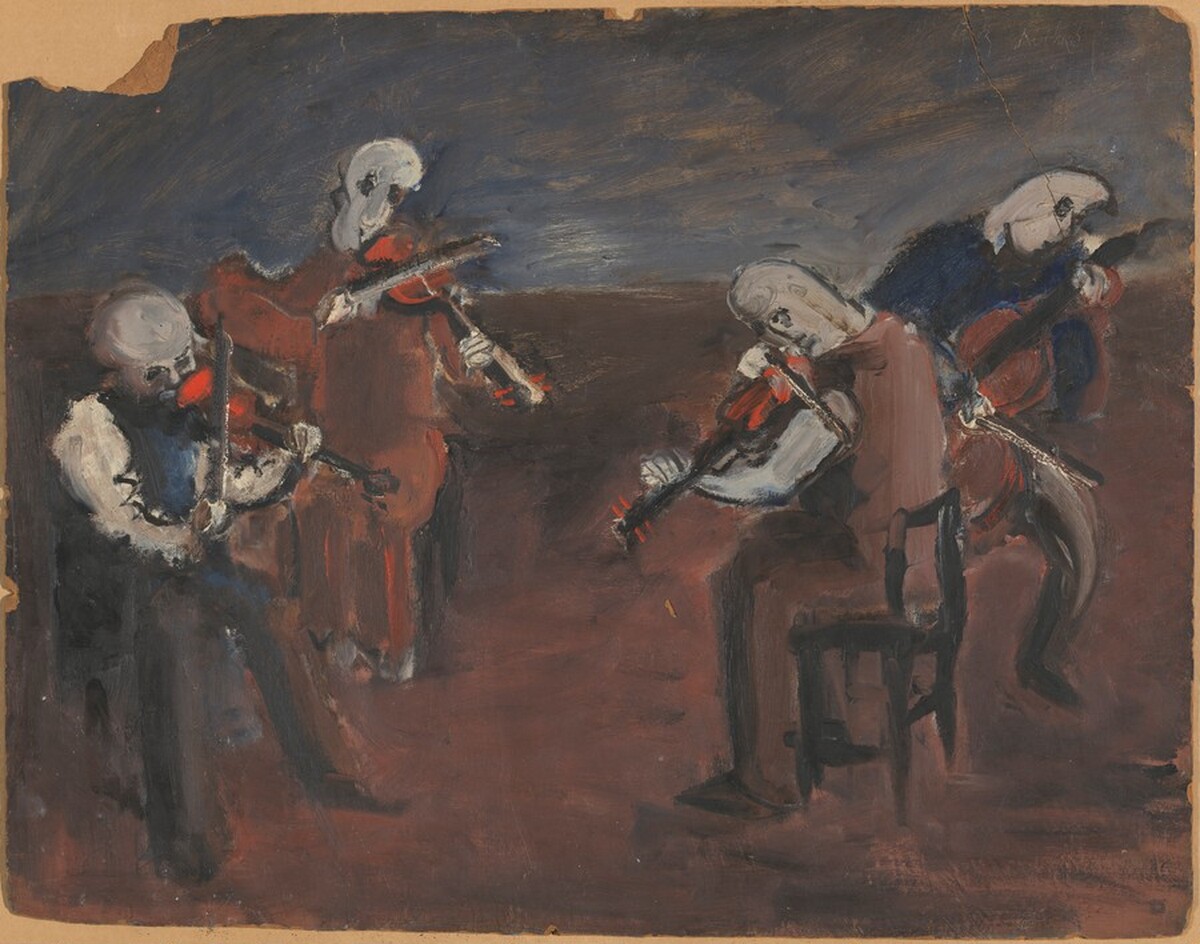
This remarkable painting from 1935 shows Rothko grappling with the relationship between music and visual art that would preoccupy him throughout his career. The four elongated figures in the composition are explicitly compared to the four instruments of a string quartet, each distinct yet harmoniously arranged. The painting predates Rothko's transition to abstraction by more than a decade, but its emphasis on vertical forms in harmonious relationship directly anticipates the stacked rectangles of his mature work. The figures are abstracted enough to be almost schematic, yet they retain their human presence.
Cultural Impact
Rothko's lifelong connection to music — particularly to Mozart and late Beethoven — is well documented. He often compared his paintings to tragic drama and music, insisting that they should be experienced rather than analyzed. The String Quartet painting is the earliest explicit statement of this analogy: four vertical presences, each with its own character, existing in harmonic relationship. This is the seed of everything that follows.
Why It Matters
The String Quartet is the Rosetta Stone of Rothko's evolution. Every mature Rothko painting is, in some sense, a string quartet — four voices (or two, or three) in harmonic dialogue. This painting makes the analogy literal.
![Fantasy at Dawn [obverse]](https://api.nga.gov/iiif/41d6b706-6a9f-461b-a8f1-a87aea16359f/full/400,/0/default.jpg)