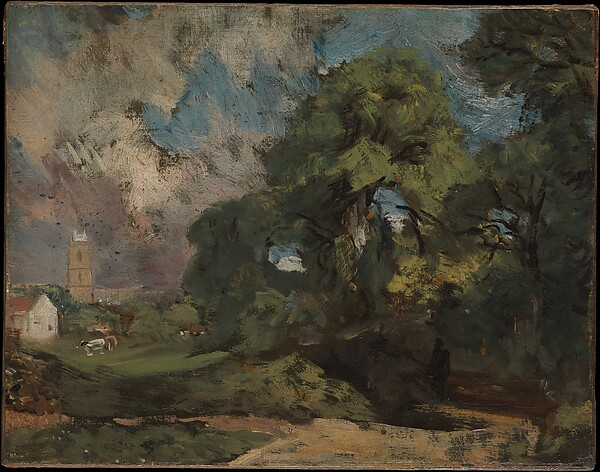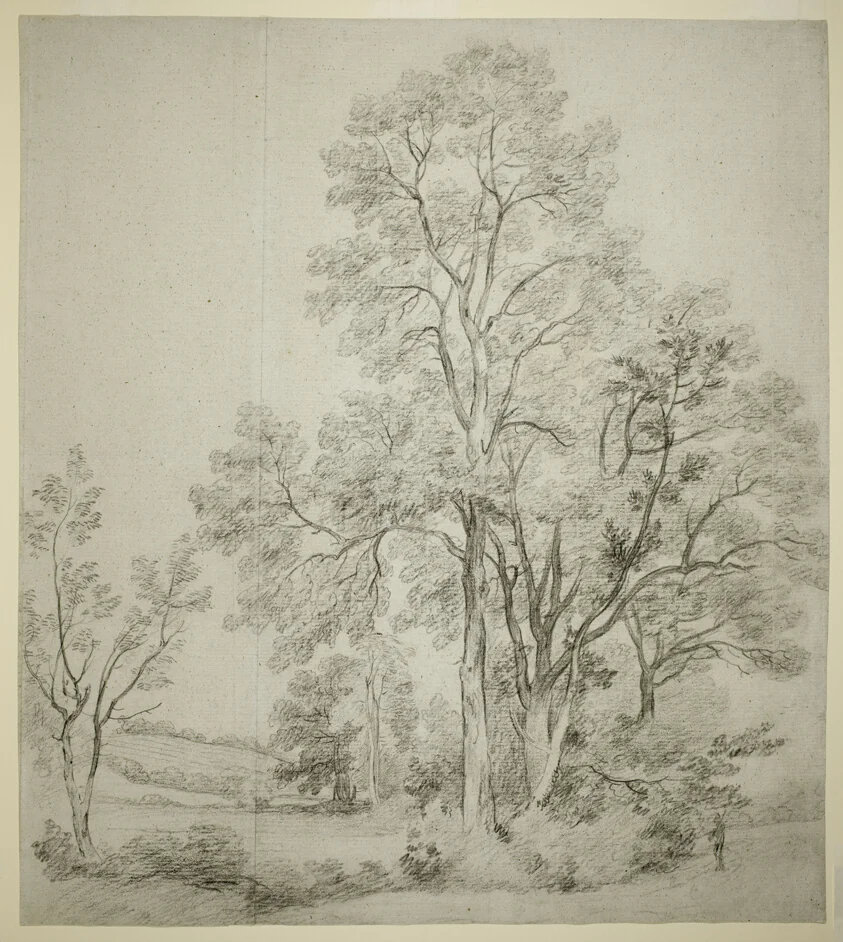
A Stand of Elm Trees (recto); A Study of East Bergholt with the Church (verso)

Description

In a time when landscape painting enjoyed unprecedented popularity in England, John Constable secured a place as a leading artist in the genre. This exploratory sketch by Constable is one of his earliest and largest studies of trees and was probably drawn in Dedham Vale, the area of rolling hills and woods surrounding his home on the border of Essex and Suffolk. Hallmarks of Constable’s technique can be observed here, especially the indistinct description of foliage contrasted with sharply delineated trunks and branches. When viewing one of Constable’s studies of trees, William Blake stated, “Why, this is no drawing, but inspiration.”

Provenance

Private collection. William Bevan, 1999. William P. Heidrich, USA, 2009. Sold by Lowell Libson to Dororthy Braude Edinburg, Brookline, MA, 2010; given to the Art Institute of Chicago, 2013.

A Stand of Elm Trees (recto); A Study of East Bergholt with the Church (verso)

John Constable

c. 1802

Accession Number

207789

Medium

Black chalk (recto) and graphite (verso) on pale gray laid paper

Dimensions

52 × 44.6 cm (20 1/2 × 17 9/16 in.)

Classification

drawings (visual works)

Museum

The Art Institute of Chicago

Chicago, United States

Credit Line

Gift of Dorothy Braude Edinburg to the Harry B. and Bessie K. Braude Memorial Collection
Background & Context

Background Story

John Constable's double-sided drawing A Stand of Elm Trees (recto) and A Study of East Bergholt with the Church (verso) (c. 1802) is a black chalk drawing on pale gray laid paper, with graphite on the verso. The recto shows a stand of elm trees, their trunks and branches rendered with the careful observation of natural forms that would distinguish Constable's entire career. The verso shows a study of East Bergholt, the Suffolk village where Constable was born, with the church visible. The double-sided nature of this early sheet is particularly valuable, showing the young artist studying both natural forms and the built landscape of his native village. The pale gray laid paper provides a neutral ground. This drawing from around 1802, when Constable was 26 and still finding his way as an artist, already shows the intense observation of nature that would make him one of the greatest landscape painters in the history of art. The elm trees and the village church are the subjects that would occupy him for the rest of his career.

Cultural Impact

Constable's early drawings document the formation of his artistic vision, showing the subjects and the approach to observation that would define his mature work.

Why It Matters

This double-sided drawing captures two of Constable's enduring subjects: the elm trees of the English countryside and the village church of his native East Bergholt, both rendered with the careful observation that would make him England's greatest landscape painter.