Accession Number
1943.3.1542
Medium
watercolor and graphite
Dimensions
overall: 13.8 x 22.9 cm (5 7/16 x 9 in.)
Classification
Drawing
Credit Line
Rosenwald Collection
Tags
Drawing Impressionist & Modern (1851–1900) Watercolor Graphite & Pencil Scottish
Background & Context
Background Story
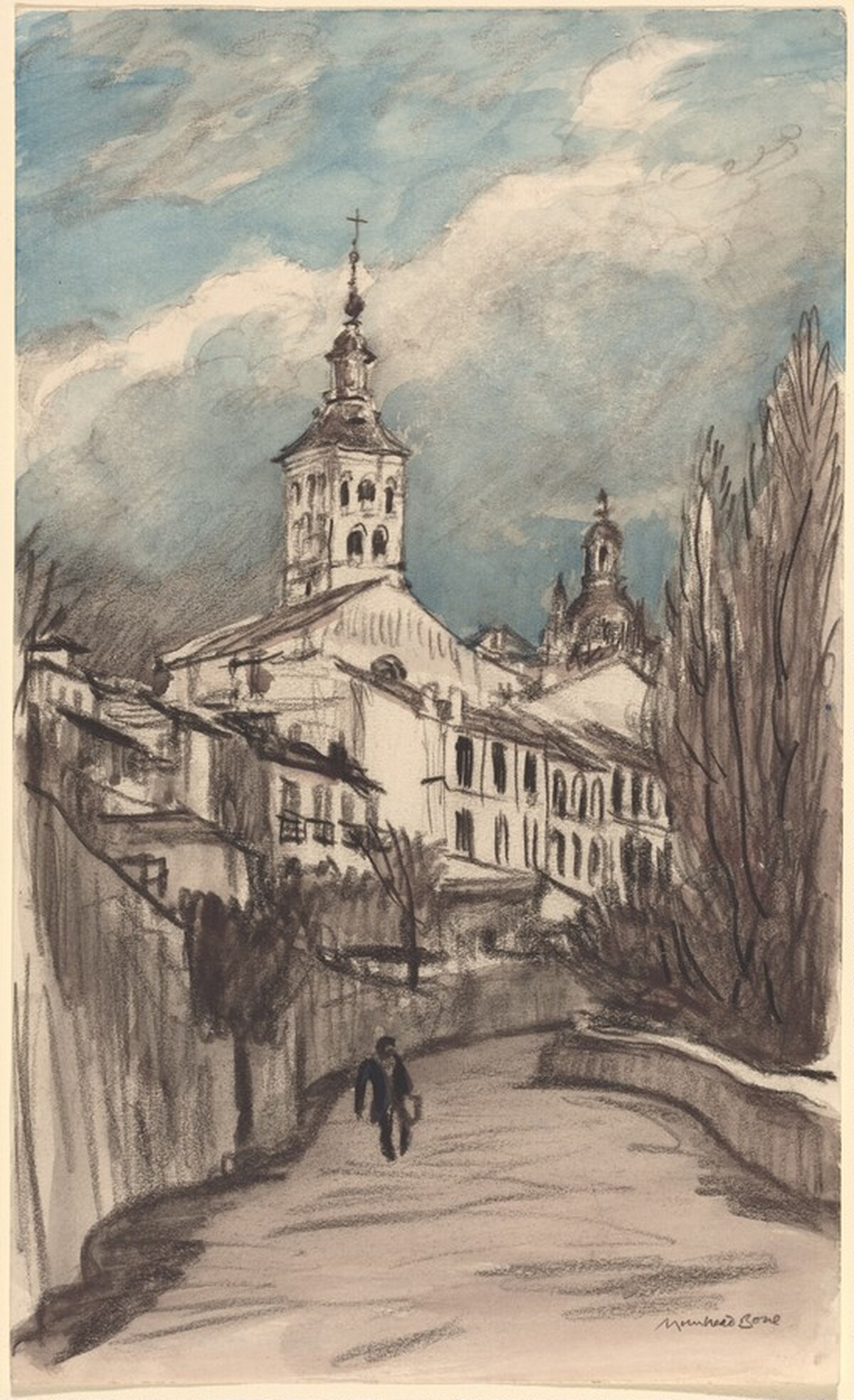
The church of San Andrés in Segovia represents the Romanesque-Gothic architecture that distinguishes Segovia from other Spanish cities, and Bone's drawing captures both the building's structural character and its relationship to the surrounding urban fabric. Segovia's architecture — Roman aqueduct, medieval churches, and the Alcázar — made it one of the most popular subjects for British artists traveling in Spain, and Bone's treatment of San Andrés shows his characteristic ability to render architectural detail without losing the atmospheric context that gives the building its sense of place.
Cultural Impact
Bone's Spanish architectural drawings belong to the British tradition of picturesque travel that stretches back to the 18th century, but his approach is fundamentally different from the picturesque artists who preceded him. Where they sought charming views and dramatic vistas, Bone sought structural clarity and atmospheric fidelity — the building as it is, not as the tourist would like it to be.
Why It Matters
Saint Andres, Segovia is Bone's architectural documentation at its most precise: a Romanesque-Gothic church rendered with the exactitude of an architect and the atmosphere of a watercolorist. The building stands complete and convincing in its spatial setting.