Provenance
Richard S. Davis, Wayzata, Minn., by 1949-at least 1956 [New York 1949; Gieure 1956]. Jacques O’Hana Gallery, London; sold, Sotheby’s, South Africa, March 4, 1975, lot 30, to Dorothy Braude Edinburg; given to the Art Institute, 1998.
Accession Number
150793
Medium
Red pastel, with smudging, erasing, and red-orange conté crayon on cream wove paper
Dimensions
49.7 × 66.8 cm (19 5/8 × 26 5/16 in.)
Classification
pastel
Credit Line
Gift of Dorothy Braude Edinburg to the Harry B. and Bessie K. Braude Memorial Collection
Background & Context
Background Story
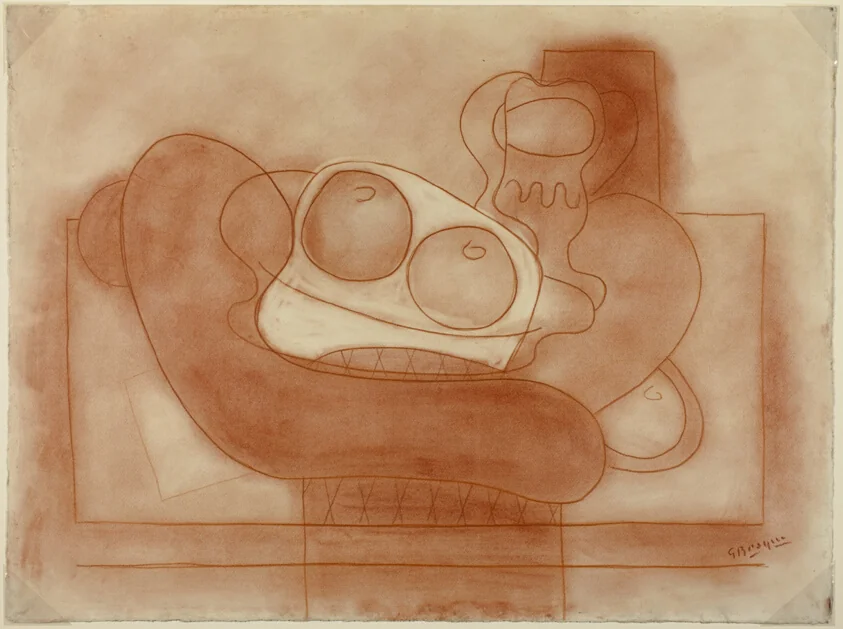
"Still Life with Apples" is a c. 1934 pastel by Georges Braque that demonstrates the French Cubist master's lifelong engagement with the still life genre, the image showing a table with apples rendered in the red pastel and smudged tones that suggest both the physical presence of the fruit and the abstract beauty of color and form. The composition is a horizontal arrangement, the table and fruit depicted with the overlapping planes and shifting perspectives that Braque had developed in his Cubist period, but the pastel medium introduces a softness and intimacy that makes the still life feel more domestic and less analytical than the painted versions. The cream wove paper provides a warm, sympathetic ground that makes the red pastel appear vibrant and appetizing, the color suggesting both the ripeness of the apples and the warmth of the domestic interior. The c. 1934 date places this work in the period of Braque's mature still life production, when he was producing drawings and pastels that explored the possibilities of the genre with a relaxed confidence that came from decades of practice. Art historians have compared this pastel to the painted still lifes of Cézanne and the drawn still lifes of Picasso, noting that Braque's treatment is more atmospheric, more focused on the interplay of color and tone than the structural geometry or the decorative pattern of these other traditions.
Cultural Impact
This c. 1934 pastel made mature still-life atmospherically domestic through red pastel apple-ripeness and cream-paper interior warmth, using horizontal overlapping plane softness to explore color-tone interplay beyond Cézanne's structural geometry.
Why It Matters
It matters because Braque drew apples on a table and made the red feel like it was still growing—proving that even a fruit bowl could be a color study if the pastel was ripe enough.


