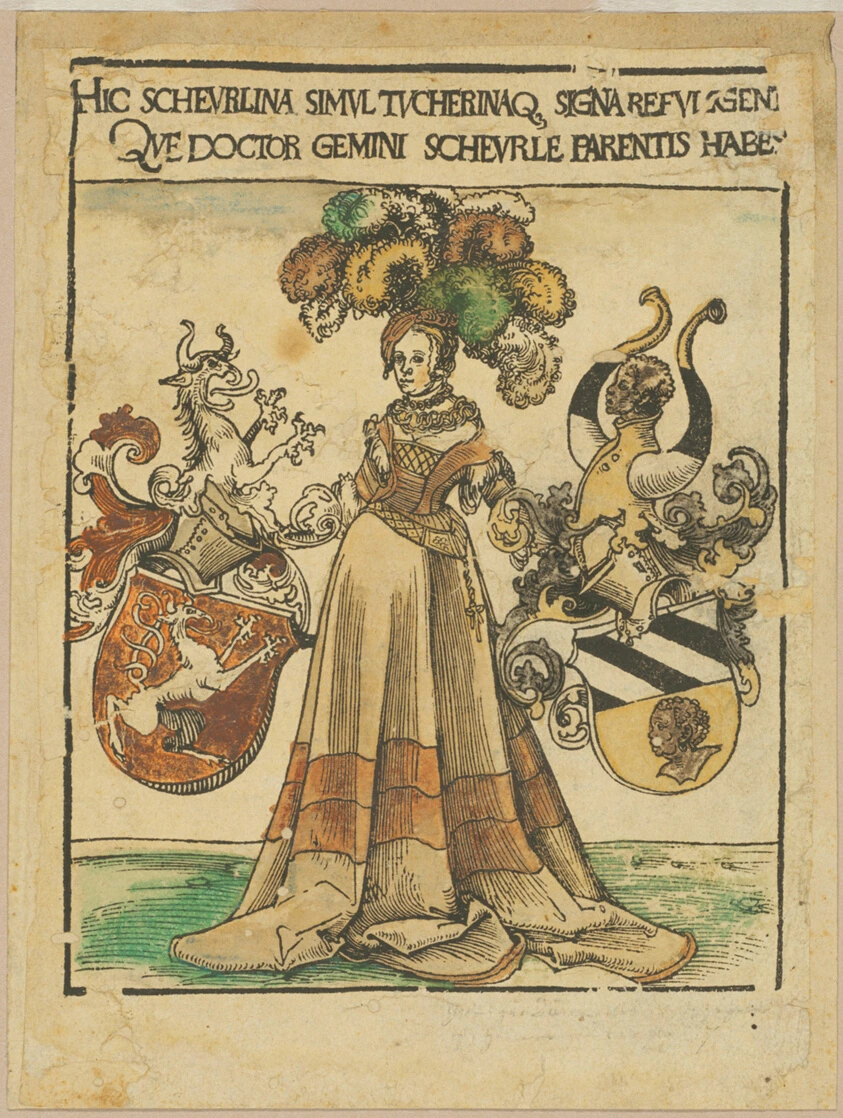
Book-Plate of Scheurl and Tucher

Description

Christoph Scheurl, a University of Wittenberg professor, owned two bookplates with his parents’ arms and the same motto, including this one on which Lucas Cranach’s shield-bearer is fashionably clothed and colored. The earliest book to contain this ex libris is a classical text printed by Wolfgang Stöckel in 1511, suggesting the woodcut dates to around 1510, before Scheurl moved back to Nuremberg. The Chicago impression is tattered around the edges, has sustained fading and loss of printed pigment throughout, and exhibits several areas of worm activity. These early wear patterns suggest it was on an interior book board, confirming its likely use as a bookplate.

Book-Plate of Scheurl and Tucher

Lucas Cranach the Elder

c. 1510

Accession Number

88902

Medium

Woodcut in black hand colored with brush and watercolor on cream laid paper, laid down on tan laid paper

Dimensions

Image: 16.5 × 12.7 cm (6 1/2 × 5 in.); Sheet: 18.8 × 13.9 cm (7 7/16 × 5 1/2 in.); Mounting sheet: 19.4 × 14.6 cm (7 11/16 × 5 3/4 in.)

Classification

book plate

Museum

The Art Institute of Chicago

Chicago, United States

Credit Line

Gift of Joseph Adams

Background & Context

Background Story

This book-plate of Scheurl and Tucher by Lucas Cranach the Elder is a c. 1510 woodcut hand-colored with brush and watercolor that demonstrates the German Renaissance master's engagement with the new medium of the printed book and the emerging culture of humanist collecting, the image showing a coat of arms or decorative emblem with the same technical skill and artistic flair that Cranach brought to his larger compositions. The composition is a small woodcut—16.5 × 12.7 centimeters—showing the arms of the Scheurl and Tucher families rendered with the bold, graphic lines of the woodblock medium and enhanced by the delicate hand-coloring that suggests both the luxury of the manuscript tradition and the accessibility of print. The hand-coloring with brush and watercolor adds a dimension of individual character and aristocratic refinement that makes each copy of the print a unique work of art. The c. 1510 date places this work in the period of Cranach's earliest printmaking activity, when he was producing the woodcuts and engravings that disseminated his compositions to the new audience of humanist scholars and wealthy merchants. Art historians have connected this book-plate to the broader tradition of the ex libris in Renaissance Europe, from the woodcut armorials of the German print shops to the engraved book-plates of the Italian humanists, noting that Cranach's treatment is more focused on the decorative beauty and the heraldic symbolism than the typographic integration or the bibliophilic refinement of these other traditions.

Cultural Impact

This c. 1510 hand-colored woodcut made armorial book-plate aristocratically unique through small 16cm bold graphic lines and delicate watercolor individualization, using early printmaking to bridge manuscript luxury with humanist collecting beyond Italian bibliophilic refinement.

Why It Matters

It matters because Cranach carved a family's pride into a book-plate and made the paper feel like it was guarding a library—proving that even a small woodcut could carry a coat of arms if the hand-coloring was proud enough.