Accession Number
1943.3.1010
Medium
pen and black ink with watercolor over graphite
Dimensions
overall: 44.2 x 33 cm (17 3/8 x 13 in.)
Classification
Drawing
Credit Line
Rosenwald Collection
Tags
Drawing Early Modern (1901–1950) Watercolor Ink Graphite & Pencil British
Background & Context
Background Story
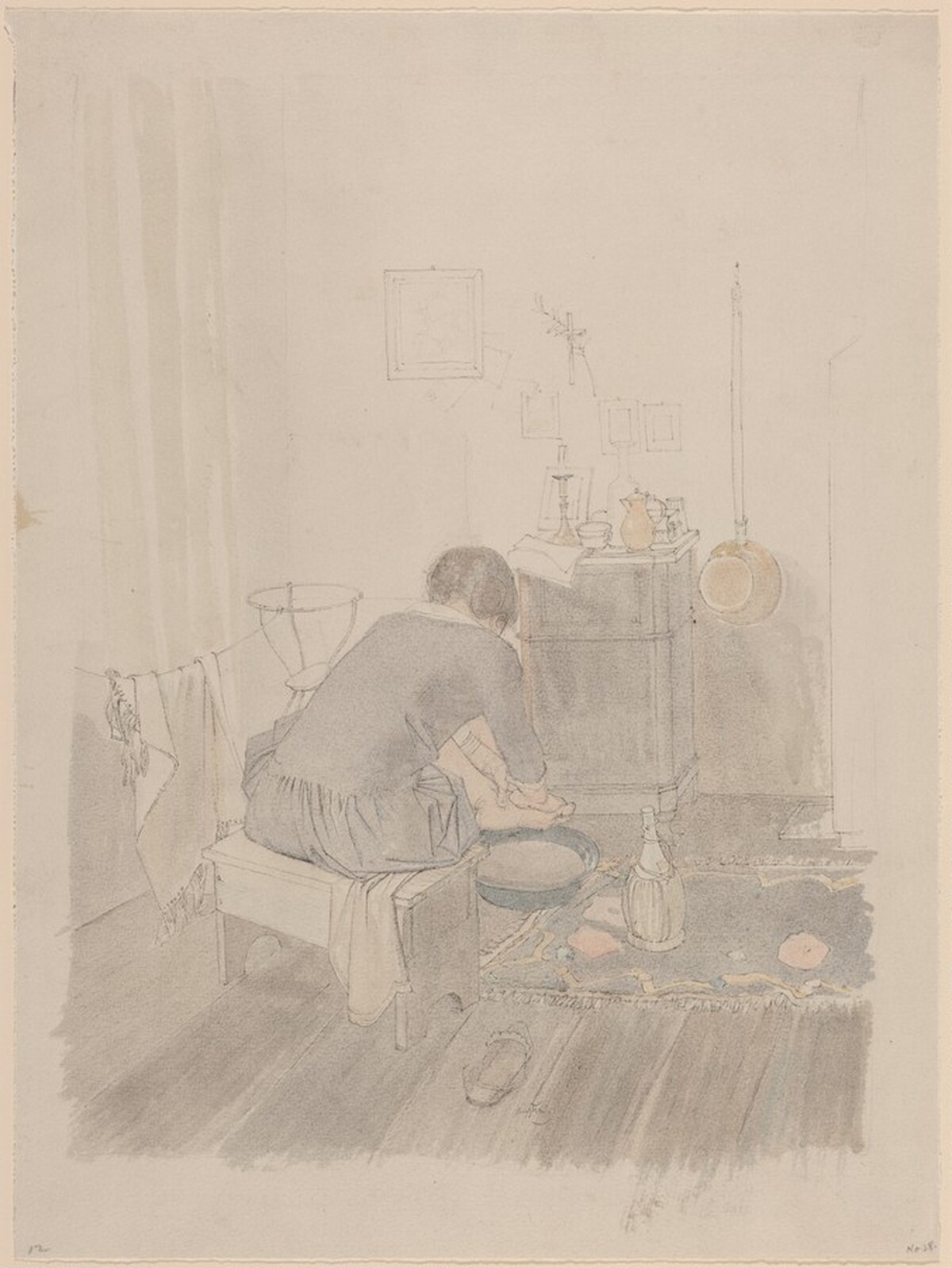
Before Mass is an etching by Robert Austin dating to approximately 1926, depicting a scene of figures preparing for or gathering before a Catholic Mass service. The work belongs to Austin's most productive early period, when he was establishing the themes and techniques that would define his distinguished career as a printmaker. The subject of a pre-Mass gathering places this work within a long tradition of religious genre scenes in European art, but Austin approaches the theme with the quiet observational precision that distinguishes his best work. Rather than depicting the drama of the Mass itself, Austin focuses on the anticipatory moments—the settling of congregants, the arrangement of sacred objects, the hushed atmosphere before ritual begins. This choice reveals Austin's characteristic interest in capturing moments of concentrated stillness and everyday devotion. The period around 1926 was significant for Austin both personally and artistically. He had recently returned from travels in Italy, where the prevalence of Catholic ritual and the visual richness of Italian religious life made a deep impression on his work. Italian scenes and Catholic subjects became recurring themes in his etchings and engravings throughout the 1920s and 1930s. The choice of etching as a medium was itself significant in this period. The British etching revival was at its height, and Austin was among its leading practitioners, celebrated for the refinement of his line and the subtlety of his tonal effects. Before Mass exemplifies the qualities that made Austin's work so admired: the precise observation of human figures, the skillful handling of light and shadow in an interior space, and the ability to convey atmosphere through the controlled variation of etched line.
Cultural Impact
Austin's religious subjects demonstrated that twentieth-century British printmaking could engage with spiritual themes without sacrificing the observational realism that defined the Etching Revival tradition. His work influenced numerous younger printmakers and helped validate etching as a medium for serious religious art during a period often associated with secular modernism.
Why It Matters
This etching matters as a significant early work by one of Britain's most important twentieth-century printmakers, capturing the intersection of religious observance, Italian cultural influence, and technical mastery that defined Robert Austin's artistic achievement.