Provenance
J. W. Nahl [stamp (Lugt 1954), verso, lower left, in blue]. Sold, Puttick & Simpson, London, Nov. 6, 1914, part of lot 264 or 267, to William F. E. Gurley (1854–1943), Chicago [stamp (Lugt 5308), recto, lower right, in black]; given to the Art Institute of Chicago for the Leonora Hall Gurley Memorial Collection, 1922 [stamp (Lugt 1230b), verso, lower center, in black].
Accession Number
85117
Medium
Brush and brown ink and brown and gray wash, over traces of graphite, on ivory wove paper, tipped on to tan laid paper with gray fibers
Dimensions
41.7 × 26.2 cm (16 7/16 × 10 3/8 in.)
Classification
ink and wash
Credit Line
The Leonora Hall Gurley Memorial Collection
Background & Context
Background Story
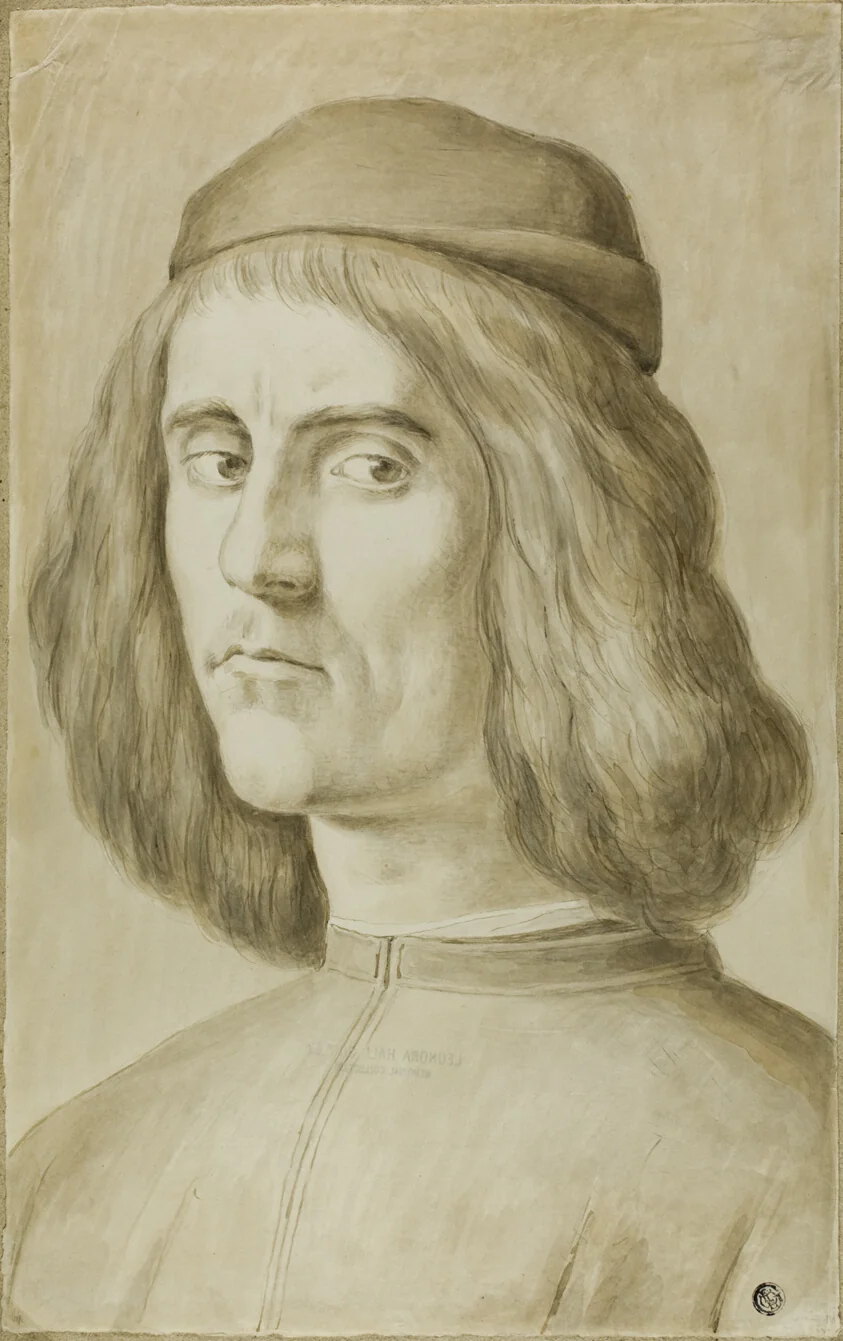
This drawing titled Portrait Bust of a Young Man and catalogued under Sandro Botticelli with a date of after 1829 is a brush and brown ink and wash drawing over graphite on ivory wove paper that represents a later copy or adaptation of a Botticelli composition rather than a work by Botticelli himself, who died in 1510. The date of after 1829 indicates that the drawing was made at some point after that year, likely in the 19th century when the revival of interest in the Italian Renaissance known as the Renaissance Revival produced numerous copies and adaptations of famous compositions. The portrait bust format, in which the sitter is depicted from the chest up in a format that derives from ancient Roman portrait sculpture, was one of the most popular formats for Renaissance portraiture, and copies after Botticellis portrait compositions were produced in large numbers during the 19th century to satisfy the demand for Renaissance-style portraiture among collectors and museums. The brush and ink and wash medium, with its capacity for both Linear definition and tonal modeling, allows the 19th-century draftsman to reproduce the refined Linear style and graceful figural proportions that distinguish Botticellis work, creating a drawing that captures the surface appearance of a Botticelli portrait without achieving the subtlety and originality of the masters own hand.
Cultural Impact
Copies after Botticelli were produced in large numbers during the 19th-century Renaissance Revival, and they are significant documents for understanding the reception of Renaissance art and the development of the art market. The Portrait Bust of a Young Man demonstrates the enduring appeal of Botticellis portrait style and the demand for Renaissance-style art among 19th-century collectors.
Why It Matters
A brush and brown ink and wash drawing dating from after 1829 that reproduces a Botticelli-style portrait bust of a young man, a 19th-century copy or adaptation that reflects the Renaissance Revival demand for Botticellis refined Linear style and graceful figural proportions.