Accession Number
83994
Medium
Pen and black ink, with brush and gray wash, on cream laid paper
Dimensions
29.7 × 38.8 cm (11 3/4 × 15 5/16 in.)
Classification
ink or chalk wash
Credit Line
The Leonora Hall Gurley Memorial Collection
Background & Context
Background Story
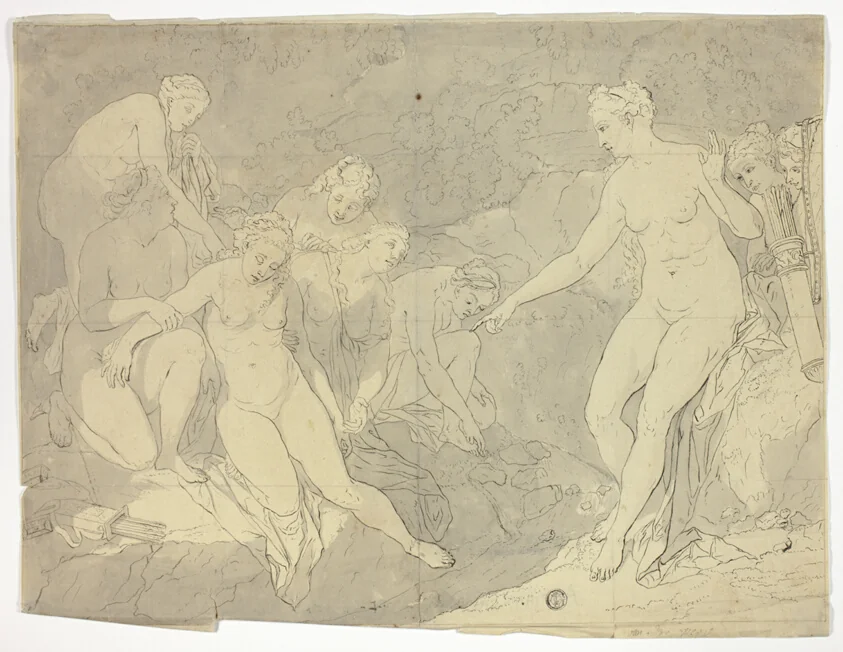
Adriaen van der Werff's drawing of Diana and Callisto illustrates the dramatic mythological moment when the goddess Diana discovers her nymph Callisto's pregnancy, revealing the secret encounter with Jupiter that had been concealed beneath the virgin huntress's guise. Van der Werff was the most celebrated Dutch painter of the late 17th and early 18th centuries, renowned for his exquisitely refined technique and the enamel-like finish of his paintings. This drawing demonstrates the same meticulous precision at a preparatory stage—the pen lines are deliberate and controlled, the gray wash applied with the subtlety of a watercolorist building tone through transparent layers. The myth of Diana and Callisto was a popular subject in European art, treated by Titian, Rubens, and others, but van der Werff brings his distinctive elegiac sensibility to the scene, casting the figures in a pastoral landscape softened by atmospheric wash. The drawing reveals the working method behind van der Werff's famously polished canvases, showing how he planned compositions with care before translating them into the high finish his patrons demanded.
Cultural Impact
Van der Werff's drawings are important documents of the late Baroque taste for refinement and classicism in Dutch art. His international fame—he was knighted by the Elector Palatine and received commissions from across Europe—helped shift Dutch collecting taste toward a more polished, Franco-Italian style that would dominate the early 18th century.
Why It Matters
A refined pen and wash drawing by van der Werff showing the mythological Diana and Callisto, revealing the preparatory process behind the artist's celebrated enamel-finish paintings and his role in bringing Continental classicism to Dutch art.


