Luther as an Augustinian Friar, with Cap

Description

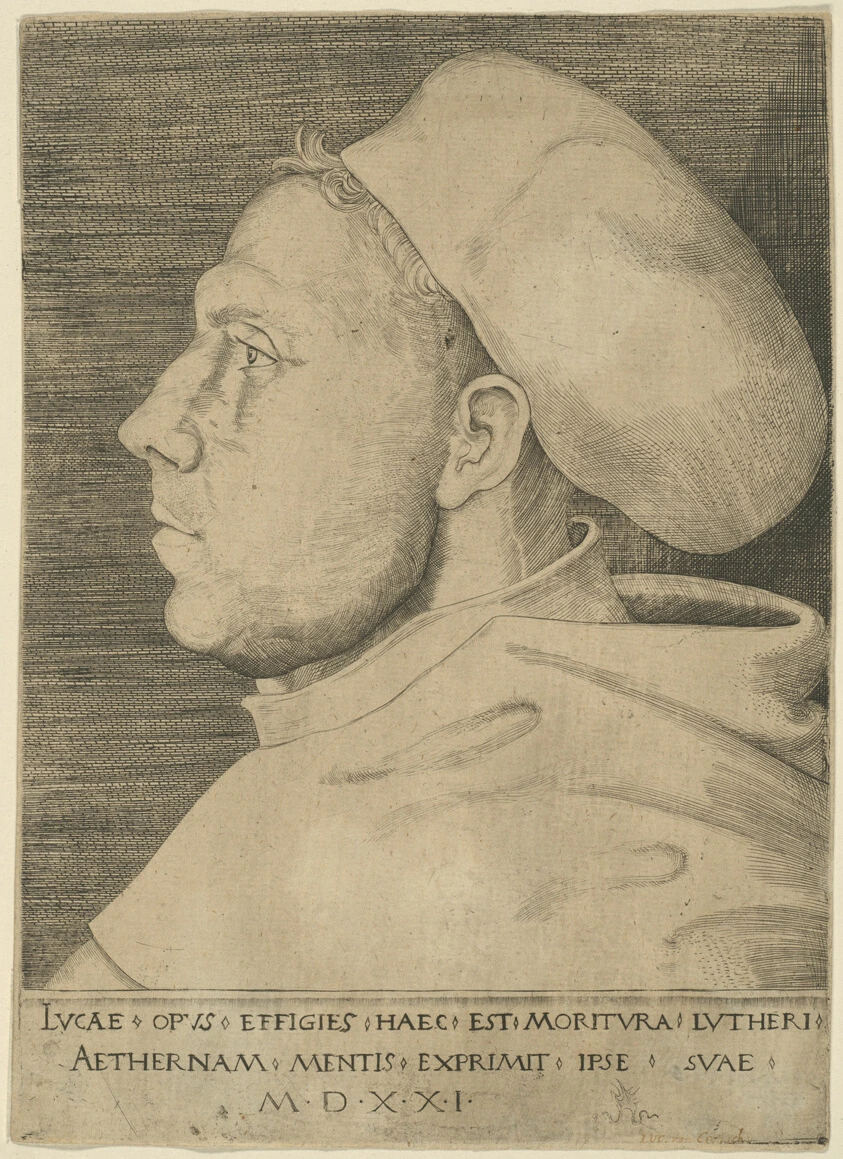
Perhaps Lucas Cranach’s most famous and most copied print, this profile portrait of Martin Luther was an accurate likeness; the artist and the Reformer were friends. Luther appears in his doctoral cap, as he taught at the University of Wittenberg. Possibly made to commemorate the scholar’s radical performance at the Diet of Worms, the print circulated when Luther was presumed dead but was actually in hiding, translating the New Testament into German. The Latin inscription translates as, “Lucas’s work is this picture of Luther’s mortal form; but he himself expressed his spirit’s eternal form,” and closes with Cranach’s flying serpent insignia.

Luther as an Augustinian Friar, with Cap

Lucas Cranach the Elder

1521

Accession Number

30275

Medium

Engraving in black on cream laid paper

Dimensions

Image/plate/sheet: 20.7 × 15 cm (8 3/16 × 5 15/16 in.)

Classification

engraving

Museum

The Art Institute of Chicago

Chicago, United States

Credit Line

Gift of Mr. Potter Palmer, Jr.
Background & Context

Background Story

This engraving of Luther as an Augustinian Friar by Lucas Cranach the Elder is one of the most important and influential portraits of the Reformation, the image showing the young Martin Luther in his monastic habit with the same attention to physiognomic detail and psychological presence that made Cranach the official portraitist of the Protestant cause. The composition is a medium-sized engraving—20.7 × 15 centimeters—showing Luther in three-quarter view with the cap and habit of the Augustinian order, the face rendered with the precision and the intensity that suggest both the historical reality of the sitter and the spiritual authority of the reformer. The engraving technique creates a surface of extraordinary clarity and tonal richness, the fine lines suggesting both the physical features of the face and the intellectual depth of the mind within. The cream laid paper provides a warm, sympathetic ground that makes the black engraved lines appear rich and substantial. The 1521 date places this work in the period of Luther's appearance before the Diet of Worms and his condemnation by the Empire, the portrait serving as a propaganda image for the Protestant cause and a personal memento for Luther's supporters. Art historians have compared this print to the painted portraits of Cranach and the woodcut images of the Reformation pamphlets, noting that Cranach's engraving is more focused on the individual character and the spiritual authority than the symbolic content or the polemical message of these other traditions.

Cultural Impact

This 1521 engraving made Luther portrait prophetically authoritative through medium 20cm physiognomic precision and cream-paper tonal warmth, using Reformation official-portrait graphic skill to convey individual spiritual authority beyond pamphlet polemical symbolism.

Why It Matters

It matters because Cranach carved Luther's face and made the paper feel like it was arguing with the Pope—proving that even a monk could change the world if the engraving was sharp enough.