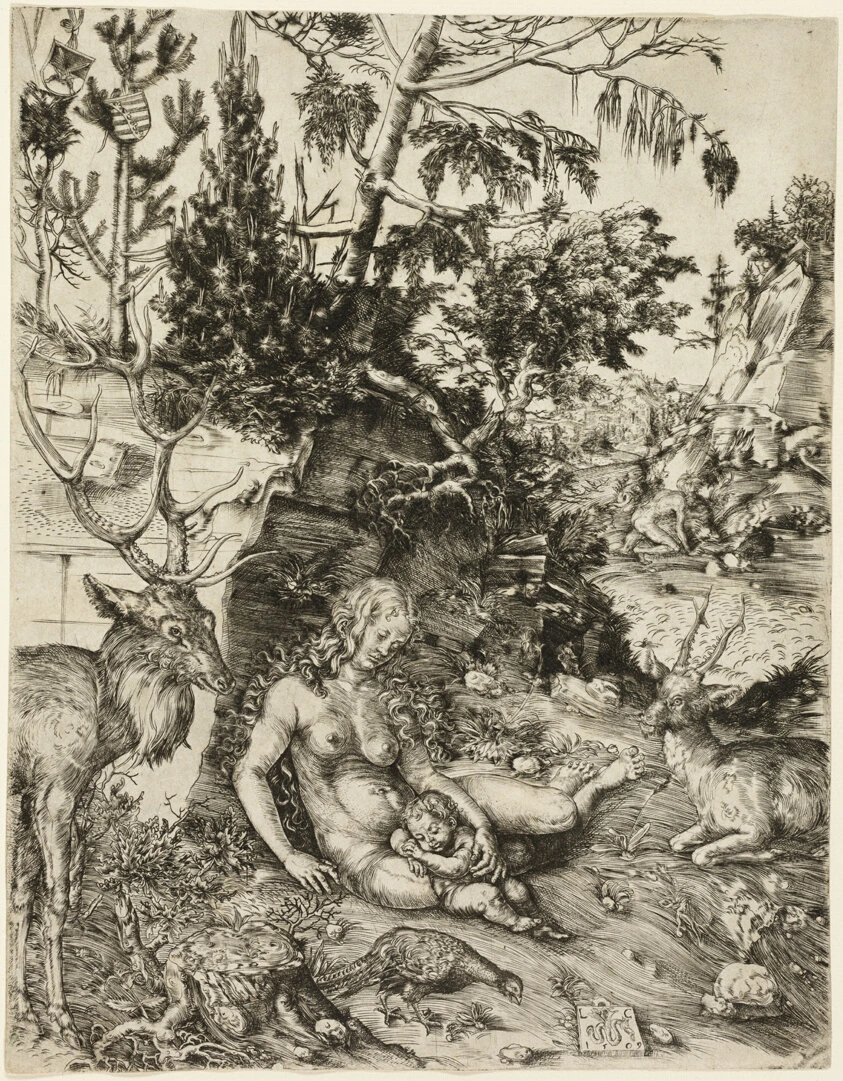
Description
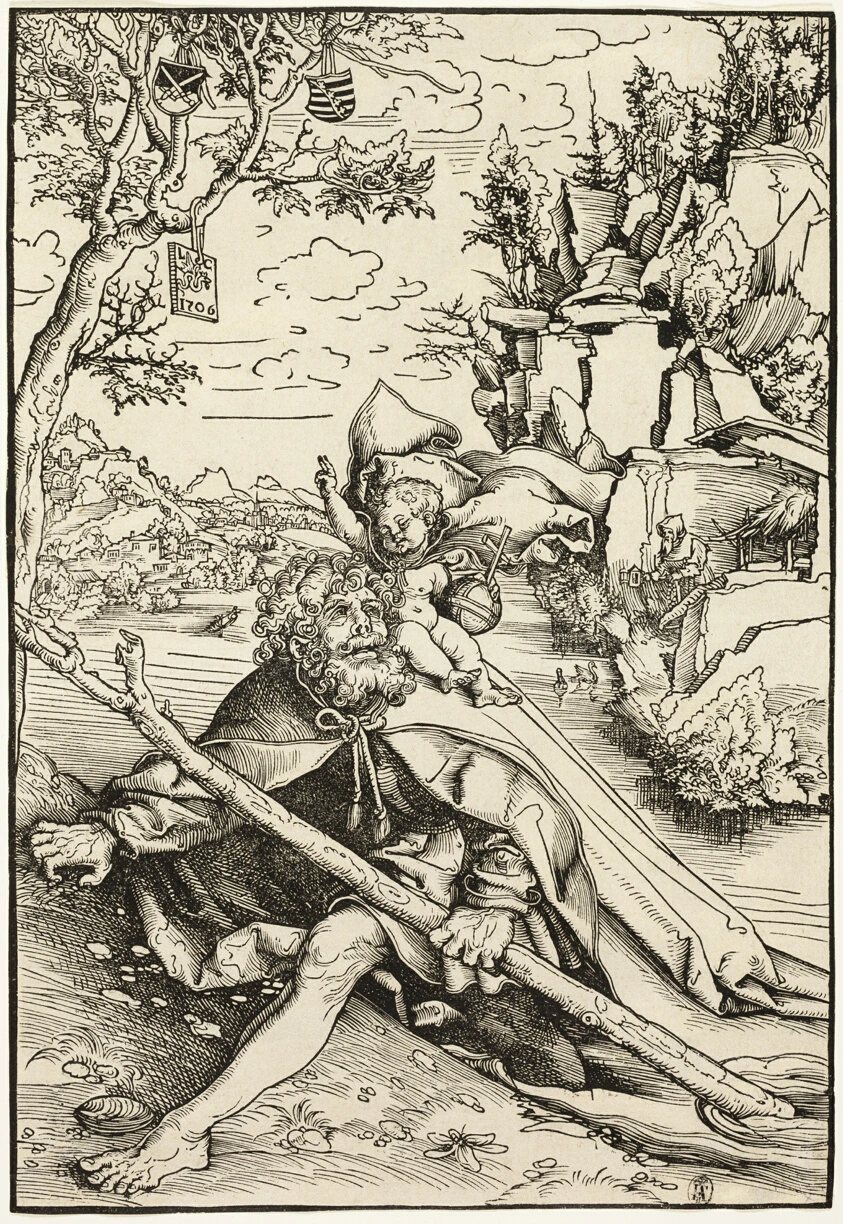
Court painter to the Duke of Saxony at Wittenberg, Cranach became a prolific designer, apothecary, political and religious counselor, and propagandist for the court. This is Cranach's most important engraving, in a rare, early impression. It depicts the legendary remorse of the great 4th-century Bishop of Constantinople, who succumbed to the attractions of the emperor's daughter and then wandered the wilderness in penitence.
Accession Number
13612
Medium
Engraving in black on ivory laid paper
Dimensions
Image/plate/sheet: 26 × 20.2 cm (10 1/4 × 8 in.)
Classification
engraving
Credit Line
Clarence Buckingham Collection
Background & Context
Background Story
Lucas Cranach the Elders The Penitence of Saint John Chrysostom from 1509 is an engraving that depicts the apocryphal story of Saint John Chrysostom, the early Church Father who, according to legend, sinned with a princess and was condemned to live as a beast in the wilderness until he was redeemed by the birth of a child. Cranach, who was the court painter to the Electors of Saxony and one of the most prolific artists of the German Renaissance, produced engravings alongside his paintings and decorative schemes, and the Penitence of Saint John Chrysostom is one of his earliest and most accomplished prints. The subject of a holy man living as a beast allowed Cranach to demonstrate his ability to depict the human body in an extreme state of physical degradation while simultaneously creating a landscape of forest and mountain that ranks among the finest landscape engravings of the early 16th century. The year 1509 places this engraving in the early period of Cranachs career, before he had developed the courtly manner and elongated figures for which he is better known, and the naturalistic treatment of the human body and the landscape suggests the influence of Albrecht Durers prints on the young artist. The engraving medium, with its capacity for fine lines and rich tonal gradations through cross-hatching, allows Cranach to create the detailed landscape setting and the textural specificity of skin and fur that give the image its disturbing physicality.
Cultural Impact
Cranachs early engravings are important documents of the German Renaissance and the development of printmaking as a medium for narrative and landscape. The Penitence of Saint John Chrysostom influenced the development of landscape engraving and the broader tradition of depicting extreme physical states in Northern European art.
Why It Matters
A 1509 engraving by Cranach depicting the apocryphal penitence of Saint John Chrysostom as a wild beast, combining naturalistic figure study with fine landscape engraving in one of the earliest and most accomplished prints of the German Renaissance.