Provenance
Recorded as from Pennsylvania. (David David Gallery, Philadelphia), by whom sold in 1964 to (Hirschl and Adler Galleries, New York), by whom sold in 1965 to Edgar William and Bernice Chrysler Garbisch; by bequest to NGA, 1980.
Accession Number
1980.61.10
Medium
oil on canvas
Dimensions
overall: 56 x 76 cm (22 1/16 x 29 15/16 in.) | framed: 64.8 x 85.1 x 6.4 cm (25 1/2 x 33 1/2 x 2 1/2 in.)
Classification
Painting
Credit Line
Gift of Edgar William and Bernice Chrysler Garbisch
Tags
Painting Early Modern (1901–1950) Oil Painting Canvas American
Background & Context
Background Story
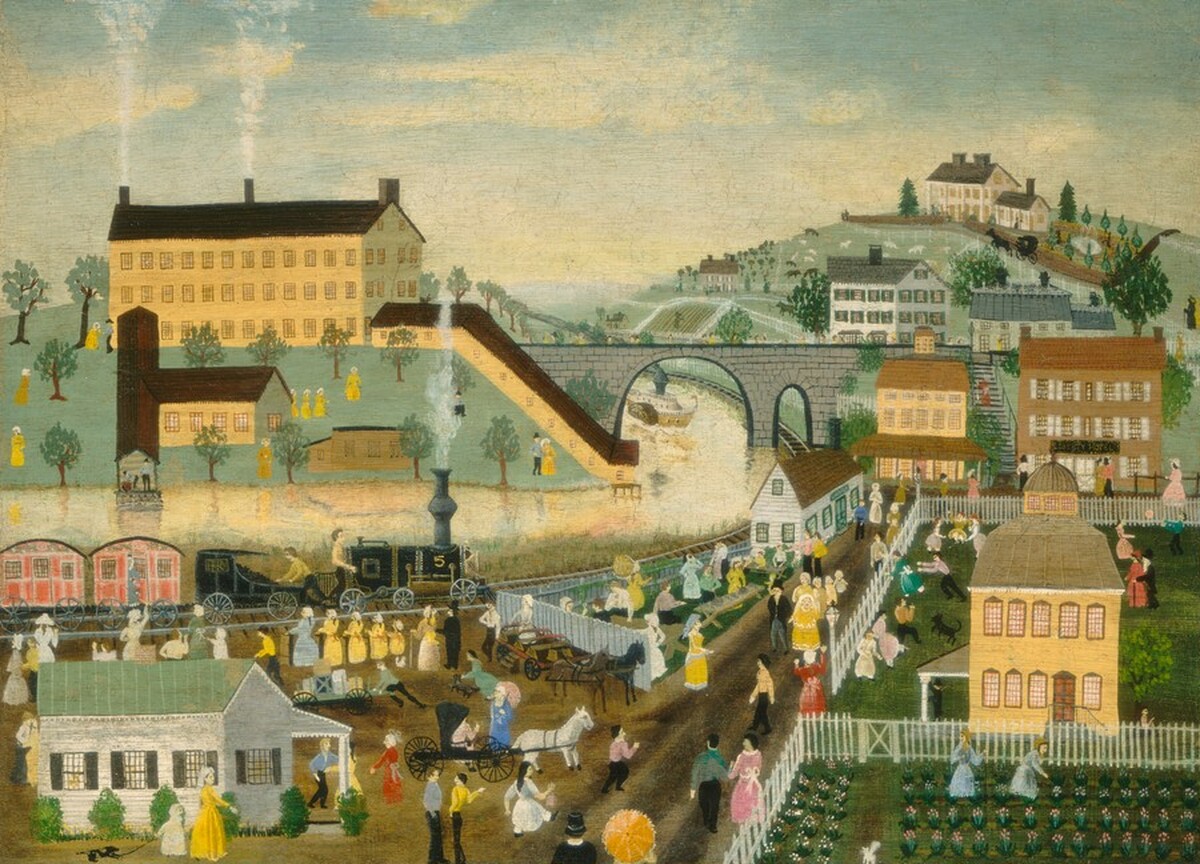
"After the Wedding in Warren, Pennsylvania" captures a moment of domestic celebration in a small Pennsylvania town, depicting the aftermath of a wedding reception with the warmth and observational detail characteristic of early twentieth-century American genre painting. The painting shows the newly married couple and their guests in a scene of post-ceremony relaxation — a moment between the formality of the wedding ritual and the return to ordinary life.
Warren, Pennsylvania, is a small city in the northwestern part of the state, situated along the Allegheny River. In the early twentieth century, it was a thriving community centered on the timber and oil industries that drove the regional economy. The painting's depiction of a Warren wedding reflects the social customs and material culture of a particular time and place — the fashions, the furnishings, the interior decoration, and the social rituals of small-town America during or just after the World War I era.
The painting belongs to the American genre tradition — a mode of painting that depicts scenes of everyday life with attention to the specific social customs, material conditions, and human interactions that define a community. This tradition extends from the colonial paintings of John Singleton Copley through the nineteenth-century work of William Sidney Mount and Eastman Johnson, to the early twentieth-century scenes of the Ashcan School. The American genre painter's subject is never merely "people doing things" — it is the specific ways in which Americans of a particular time and place live, work, celebrate, and relate to one another.
The choice to depict "after" the wedding rather than the ceremony itself is significant. The wedding ceremony is a formal, scripted event governed by ritual and tradition; the aftermath is where genuine social dynamics emerge — the relief of the couple, the animated conversations of guests, the mingling of family members who may not see each other often. By painting this liminal moment, the artist shifts attention from the universal ritual of marriage to the particular culture of Warren, Pennsylvania, in the early twentieth century.
The anonymous attribution "American 20th Century" suggests that this painting is valued more as a cultural document than as an individual artistic achievement. Its worth lies in its faithful recording of a specific time, place, and social custom — the kind of everyday scene that was too ordinary to seem worth preserving at the time, but becomes increasingly valuable as the world it records recedes into history.
Cultural Impact
American genre paintings like this one preserve the social customs and material culture of specific communities, creating visual archives of everyday life that become increasingly valuable as the worlds they document disappear.
Why It Matters
This painting captures the relaxed aftermath of a small-town Pennsylvania wedding — a genre scene that documents the social customs, fashions, and community rituals of early twentieth-century American life.