Serenade, from The Blue Guitar

Description

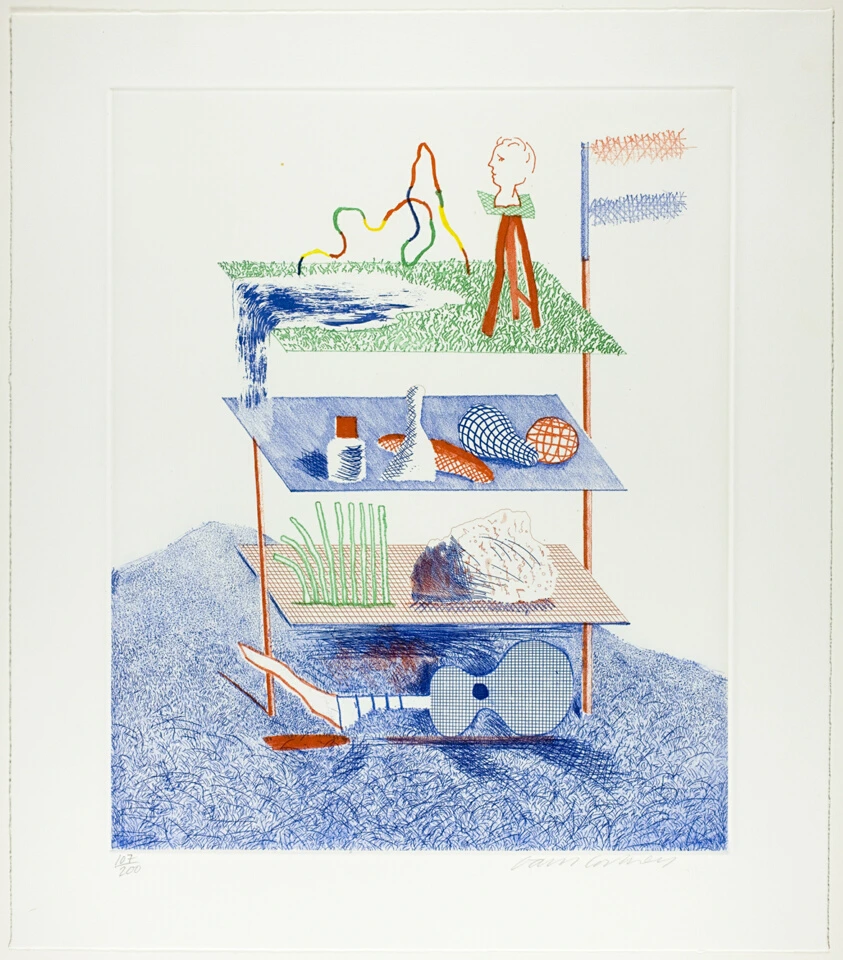
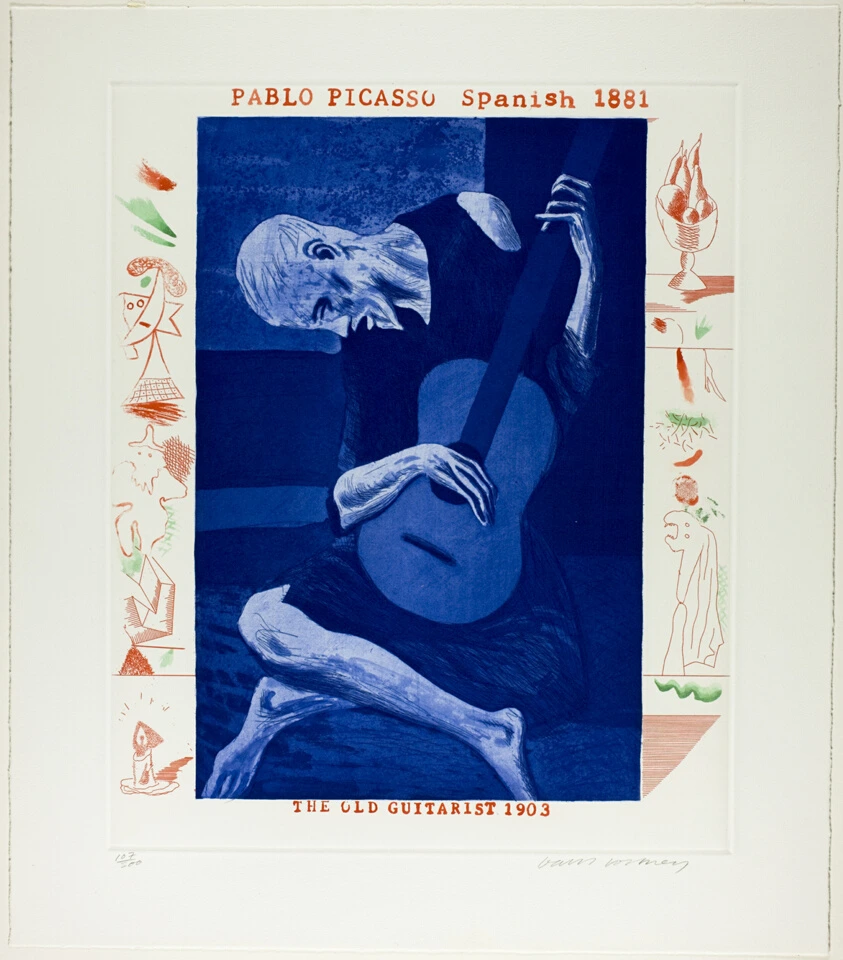
Since the early 1960s, David Hockney has sought ways to meld his modern aesthetic style with highly personalized subject matter. He started by inserting fragments of poems into his paintings, as, for example, in We Two Boys Together Clinging (1961), which integrates two lines from a Walt Whitman poem of the same title. Fifteen years later, inspired by Wallace Stevens’s “The Man with the Blue Guitar” (1937), with its themes of representation and imaginative transformation, Hockney made 10 drawings in colored inks and crayons. With the aid of master printer Aldo Crommelynck those drawings were converted into 20 mixed intaglio prints using a color-etching process initially developed for Pablo Picasso.

While not a literal illustration of Stevens’s poem, the print series The Blue Guitar interprets its themes in visual terms, and most of the images show Hockney’s love of Picasso. The print Old Guitarist juxtaposes the Art Institute’s famous painting of 1903–04 (1926.253) with later Picasso iconography. Other sheets likewise contrast Picasso’s different phases within the same image; throughout the series, Hockney distinguishes the disparate styles by using different colors.

It is perhaps Hockney’s Blue Guitar that has perpetuated the idea that Wallace Stevens was similarly inspired by Picasso’s Old Guitarist. Although Stevens was familiar with modern art and no doubt saw the painting when it was exhibited at the Wadsworth Atheneum in 1934, he insisted that no one picture inspired his famous poem.

Serenade, from The Blue Guitar

David Hockney

1976–77

Accession Number

131316

Medium

Color etching and aquatint from two copper plates on white wove paper

Dimensions

Plate: 34.5 × 42.5 cm (13 5/8 × 16 3/4 in.); Sheet: 52.5 × 46 cm (20 11/16 × 18 1/8 in.)

Classification

etching

Museum

The Art Institute of Chicago

Chicago, United States

Credit Line

Mrs. Solomon B. Smith Memorial Fund
Background & Context

Background Story

David Hockneys Serenade from The Blue Guitar suite of 1976-77 is a color etching and aquatint that translates the visual and acoustic ideas of Wallace Stevens poem The Man with the Blue Guitar into the medium of print. Stevens poem, which proposes that the musician makes things other than things as they are, became for Hockney a manifesto for an art that transforms reality through the act of rendering rather than merely reproducing it. In Serenade, Hockney depicts a figure playing a guitar in an interior space, the scene rendered in the warm tonal range and flat perspective that characterize his work of the mid-1970s. The color etching and aquatint technique, requiring two copper plates printed in registration, allows Hockney to build up rich tonal areas alongside crisp etched lines, creating an image that combines the graphic clarity of drawing with the coloristic richness of painting. The Blue Guitar suite represents Hockneys most sustained engagement with printmaking and the culmination of his technical experimentation with etching, aquatint, and color printing processes. Each print in the series illustrates a stanza or theme from Stevenss poem, creating a visual meditation on the relationship between artistic representation and reality that is both an illustration of the poem and an independent work of art.

Cultural Impact

The Blue Guitar suite is Hockneys most ambitious print series and a landmark in contemporary printmaking, demonstrating that etching and aquatint could carry the full weight of artistic and philosophical inquiry. The suite inspired a generation of artists to engage with printmaking as a primary rather than reproductive medium.

Why It Matters

A color etching and aquatint from Hockneys Blue Guitar suite that illustrates Wallace Stevenss poem on the transformative power of art, combining technical printmaking virtuosity with a visual meditation on representation and reality.