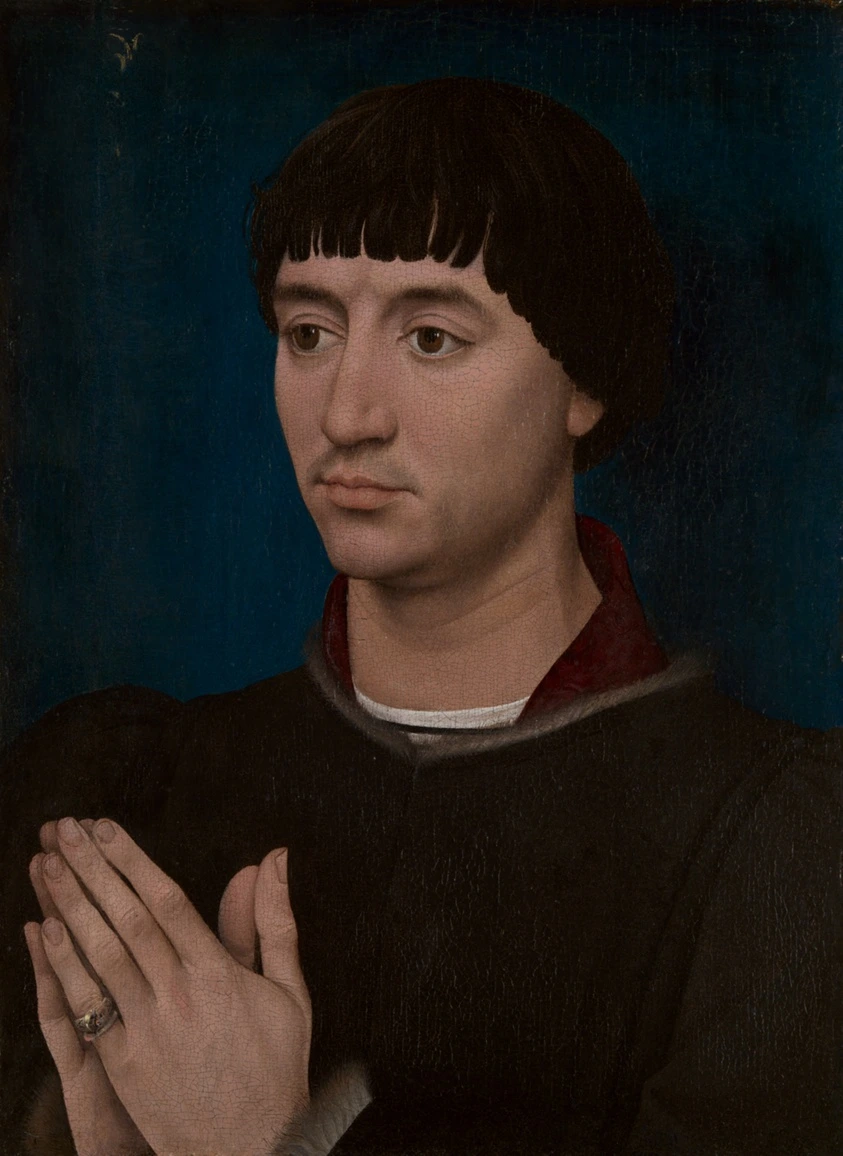
Portrait of Jean Gros (recto); Coat of Arms of Jean Gros (verso)

Description

This portrait once formed half of a folding, portable diptych. The sitter—identifiable through his coat of arms, personal motto, and initials on the back of the panel—is Jean Gros, an administrator to the future Duke of Burgundy. This portrait depicts him at the outset of a successful career, during which he amassed a large fortune and led a privileged life. Rogier van der Weyden presented the half-length figure against a plain, dark background, which accentuates his features and his expressive hands.

This gesture indicates that the sitter’s prayerful gaze was originally directed at another panel with an image of Mary and the infant Jesus, now in the Musée des Beaux-Arts in Tournai, Belgium; Gros’s coat of arms is on the back of that panel as well. This type of diptych, which was intended to suggest continuous prayer and to record the donor’s features, was probably first made for royalty around 1400, but Van der Weyden revitalized it in the mid-fifteenth century, creating similar diptychs for patrons at the highest level of the Burgundian court. In commissioning one for himself, Gros was displaying his ambition as well as his close associations with the duke and his retinue.

Provenance

Dr. Isaac Joseph de Meyer (d. 1861), Bruges, by 1859 [Weale 1859]; his son, Dr. August de Meyer, Bruges. Sold to Rodolphe Kann (d. 1905), Paris, by 1899 [according to Friedländer 1899]; his heirs; sold to Duveen, Paris and New York, 1907 [information supplied by Guy Bauman]; sold to Dowdeswell and Dowdeswell, London, Feb. 1912 [Kleinberger stock card, Department of European Painting, Metropolitan Museum of Art, New York]; sold to Kleinberger, Paris and New York, Mar. 1, 1912 [Kleinberger stock card cited above]; sold to Benjamin Altman, New York, July 3, 1912; bought back by Kleinberger, Nov. 16, 1912 [Kleinberger stock card]; sold to Martin A. Ryerson (d. 1932), Chicago, June 20, 1913 [bill of sale, Art Institute Archives]; on loan to the Art Institute from 1913; bequeathed to the Art Institute, 1933.

Portrait of Jean Gros (recto); Coat of Arms of Jean Gros (verso)

Rogier van der Weyden

1460–64

Accession Number

16298

Medium

Oil on panel

Dimensions

38.5 × 28.8 cm (15 3/16 × 11 3/8 in.); Reverse: 39 × 28.8 cm (15 3/8 × 11 3/8 in.); Framed: 43.2 × 35.6 × 7.7 cm (17 × 14 × 3 in.)

Classification

oil on panel

Museum

The Art Institute of Chicago

Chicago, United States

Credit Line

Mr. and Mrs. Martin A. Ryerson Collection
Background & Context

Background Story

Rogier van der Weydens Portrait of Jean Gros on the recto with a Coat of Arms of Jean Gros on the verso from 1460-64 is an oil on panel double-sided portrait that exemplifies the Early Netherlandish masters approach to portraiture, in which the physical presence and psychological complexity of the sitter are rendered with a precision and intensity that establish the standard for Northern European portraiture for the next two centuries. Jean Gros, who was the secretary to Philip the Good, Duke of Burgundy, is depicted with the directness and psychological penetration that distinguish Rogiers best portraits, in which the sitter seems to emerge from the dark background as a physical presence rather than a mere likeness. The coat of arms on the verso, which identifies the sitter and his family, provides the documentary function that was a standard feature of Northern European portraiture, while the portrait itself provides the representational function that makes Rogiers work exemplary of the Northern European tradition of combining likeness with social identity. The double-sided format, in which the portrait and the coat of arms are painted on opposite sides of the same panel, reflects the practice of producing portraits that could be displayed or stored depending on the occasion, with the portrait side shown when the sitter wished to be seen and the coat of arms side shown when the occasion required a more formal identification. The years 1460-64 bracket the final period of Rogiers career, when he was producing some of his most accomplished portraits, and the Portrait of Jean Gros demonstrates the combination of physical specificity and psychological depth that makes his portraiture the standard for Northern European painting.

Cultural Impact

Rogier van der Weydens portraits are among the most significant works in the history of European painting, and their influence on the development of portraiture extends from his contemporaries through the Renaissance to the present. The Portrait of Jean Gros demonstrates the combination of physical specificity and psychological depth that made his work the model for Northern European portraiture.

Why It Matters

A double-sided oil on panel portrait by Rogier van der Weyden from 1460-64 depicting Jean Gros on the recto with his coat of arms on the verso, combining physical presence and psychological depth with social identity documentation in the exemplary tradition of Early Netherlandish portraiture.