Description
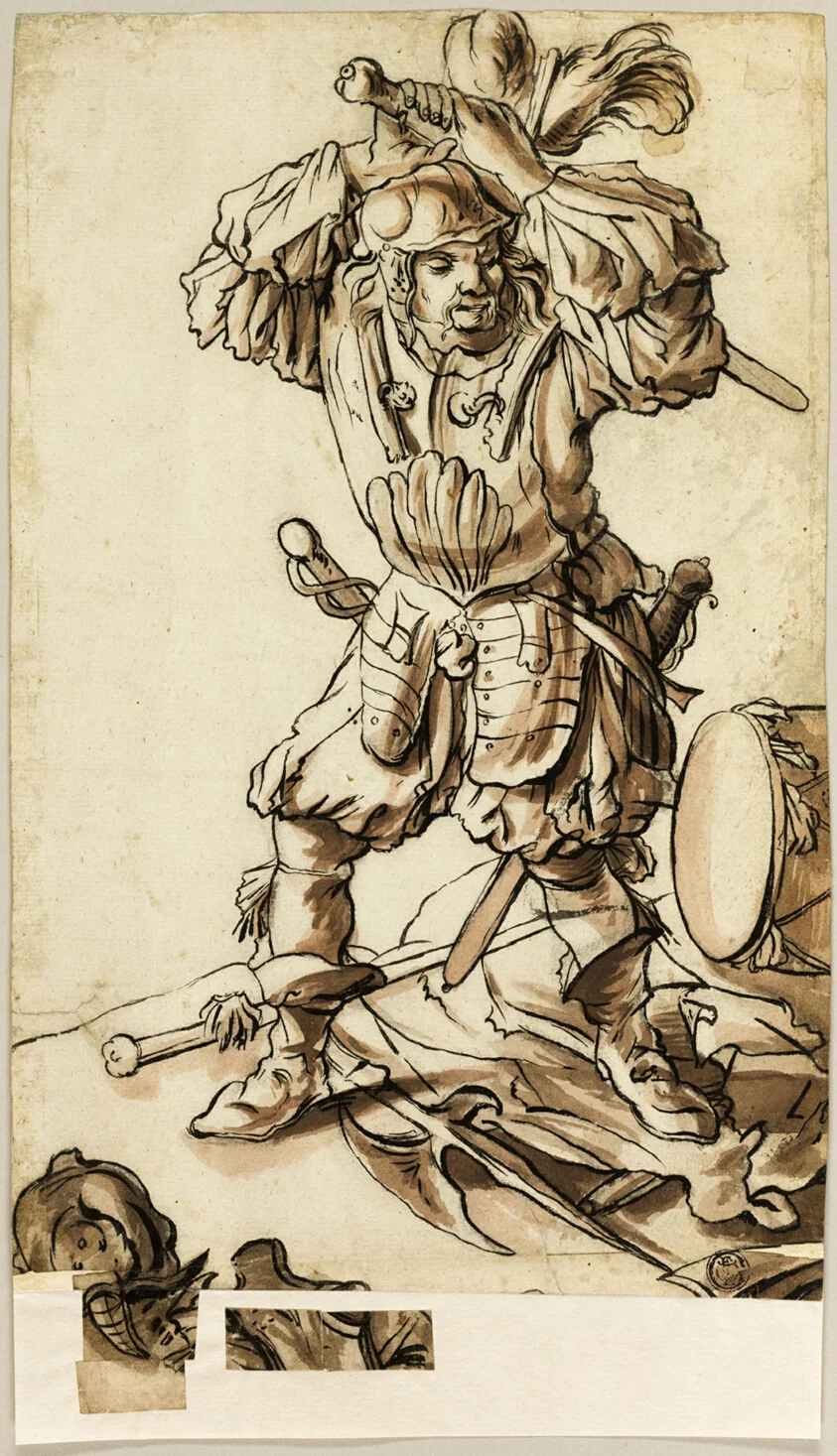
This mercenary has been depicted in the midst of battle, actively posed and ready to dispatch an enemy with his two-handed sword. The broad brushstrokes and bold shading add to the figure’s rough demeanor. The lower fragments completing the helmet and the piece of armor on the ground were reattached after being found pasted onto tears on the verso.
Accession Number
84233
Medium
Brush and black ink, with brown wash, over black chalk, on cream laid paper
Dimensions
30.7 × 19.5 cm (12 1/8 × 7 11/16 in.)
Classification
pen and ink drawings
Credit Line
The Leonora Hall Gurley Memorial Collection
Background & Context
Background Story
This drawing of a Landsknecht—one of the German mercenary soldiers who fought in the armies of early modern Europe—is a masterful study in brush and black ink with brown wash over black chalk on cream laid paper, executed by Peter Paul Rubens at an unknown date but probably during his mature period when he was producing the historical and mythological scenes that required knowledge of costume and weaponry. The Landsknecht was a distinctive type in European art: his flamboyant costume, exaggerated swagger, and professional violence made him a subject of both fascination and moral ambivalence, a figure who represented the dangerous freedom of the mercenary life. Rubens's drawing captures this ambivalence with extraordinary economy: a few bold strokes of the brush establish the figure's swaggering posture, the wash creates the shadows that suggest depth and volume, and the chalk underdrawing provides the structural framework that makes the figure feel solid and weighty. The technique is notably free for Rubens: unlike the precise pen studies of his earlier years, this drawing uses the brush with a looseness that suggests rapid observation from life or imagination, the artist's hand moving swiftly to capture a type rather than a specific individual. The cream laid paper provides a warm, neutral ground that makes the black ink appear rich and velvety, enhancing the dramatic contrast between light and shadow that gives the figure its presence. Art historians have connected this drawing to the broader tradition of military imagery in European art, from the Roman soldiers of Mantegna to the musketeers of Callot, noting that Rubens's treatment is more monumental, more focused on the physical presence of the warrior than the narrative context of battle. The work also demonstrates Rubens's versatility as a draftsman: he could shift from the delicate precision of anatomical studies to the bold swagger of military types with an adaptability that served his vast artistic ambitions.
Cultural Impact
This drawing captured Landsknecht mercenary swagger through bold brush-and-wash economy, using warm cream paper to make black ink velvety while bridging anatomical precision with military type monumentality.
Why It Matters
It matters because Rubens drew a hired soldier and made him look like he owned the world—proving that even violence could be stylish if the brush was confident enough.