Provenance
Paul Éluard (died 1952), Paris, by June 1938 [inventory of Éluard collection reproduced in Penrose 1981, fig. 420]; sold to Roland Penrose (died 1984), London, June 1938–1965 [Penrose 1981, fig. 420 and letter from Antony W. R. Penrose, January 3, 2004, in curatorial file]; given to his son, Antony W. R. Penrose, Sussex, England, by 1965–1975 [letter cited above]. Mr. and Mrs. Leigh Block, Chicago; given to the Art Institute, 1988.
Accession Number
120542
Medium
Oil and tempera on canvas
Dimensions
24.2 × 33 cm (9 1/2 × 13 in.)
Classification
Painting
Credit Line
Gift of Mary and Leigh Block
Background & Context
Background Story
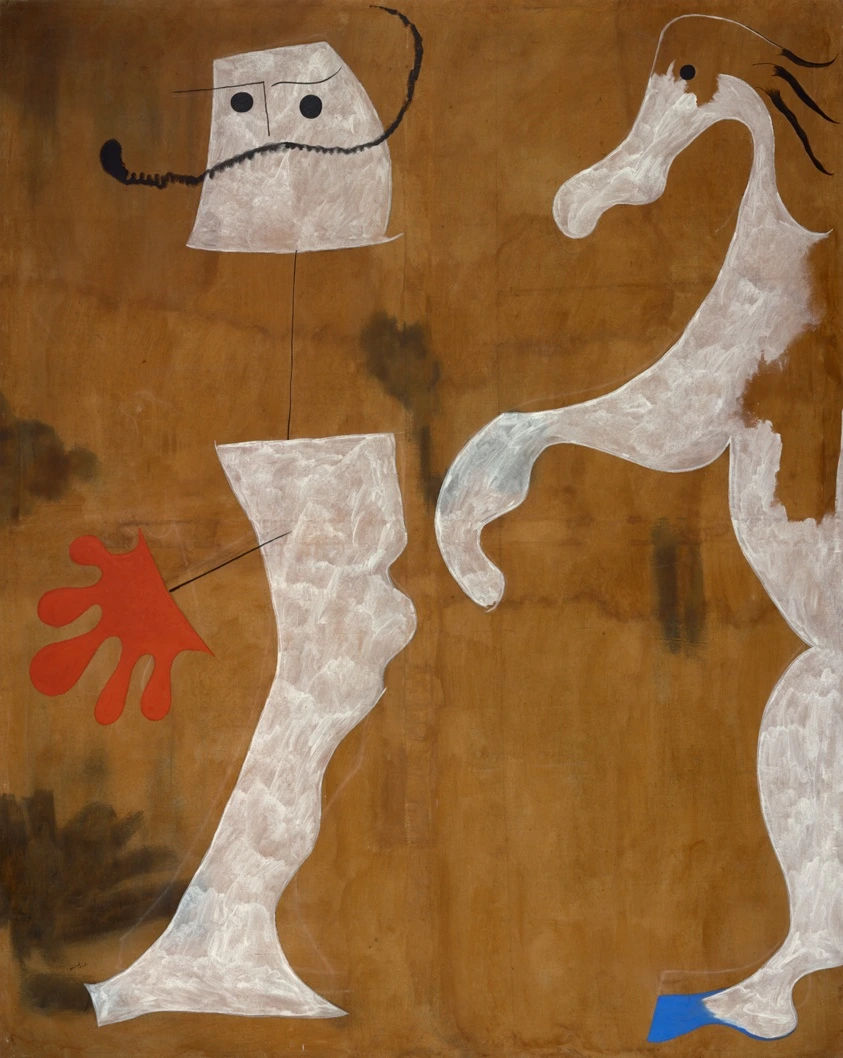
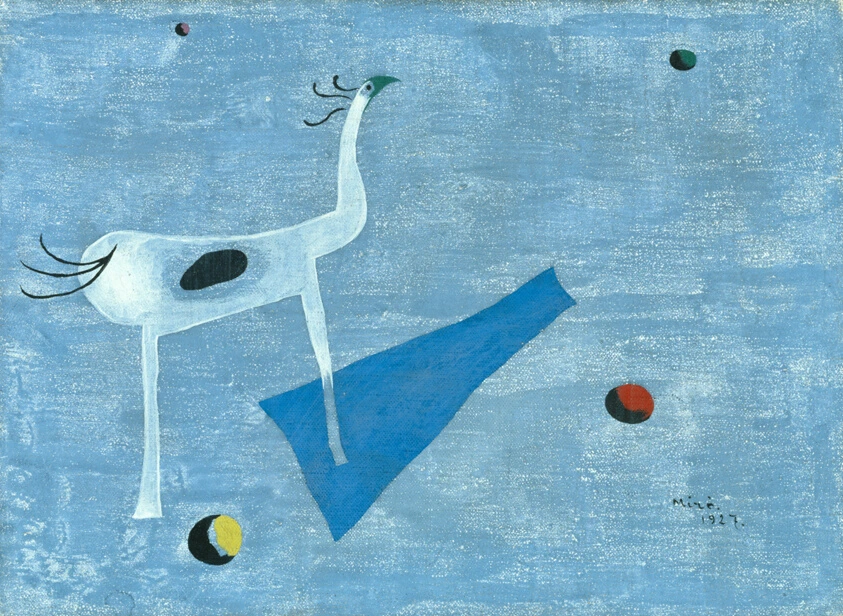
Joan Miro (1893-1983) painted Painting (The Circus Horse) in 1927, during the period when he was developing the biomorphic abstract style that would make him one of the most original painters of the 20th century. The painting depicts a circus horse in the playful, biomorphic manner that Miro developed in the 1920s—floating forms, simplified shapes, and a sense of playful spontaneity that distinguishes his best work from the more aggressive abstraction of his Surrealist colleagues. The 1927 date places this in Miro's most productive Surrealist period, when he was producing the playful, biomorphic paintings that would influence the development of abstract painting throughout the 20th century.
Cultural Impact
Painting (The Circus Horse) is important in the development of Miro's biomorphic abstraction because it shows the playful, floating forms that he was developing in the late 1920s. Miro's circus subject—the playful world of the circus rendered in simplified, biomorphic forms—represents the playful, spontaneous current in Surrealism that influenced the development of abstract painting throughout the 20th century, from Arshile Gorky to the Abstract Expressionists.
Why It Matters
Painting (The Circus Horse) is Miro's playful biomorphic Surrealism: a circus horse rendered in the floating, simplified forms and playful spontaneity that he developed in the 1920s. The 1927 painting shows the playful current in Surrealism that would influence the development of abstract painting from Arshile Gorky through the Abstract Expressionists.