Description
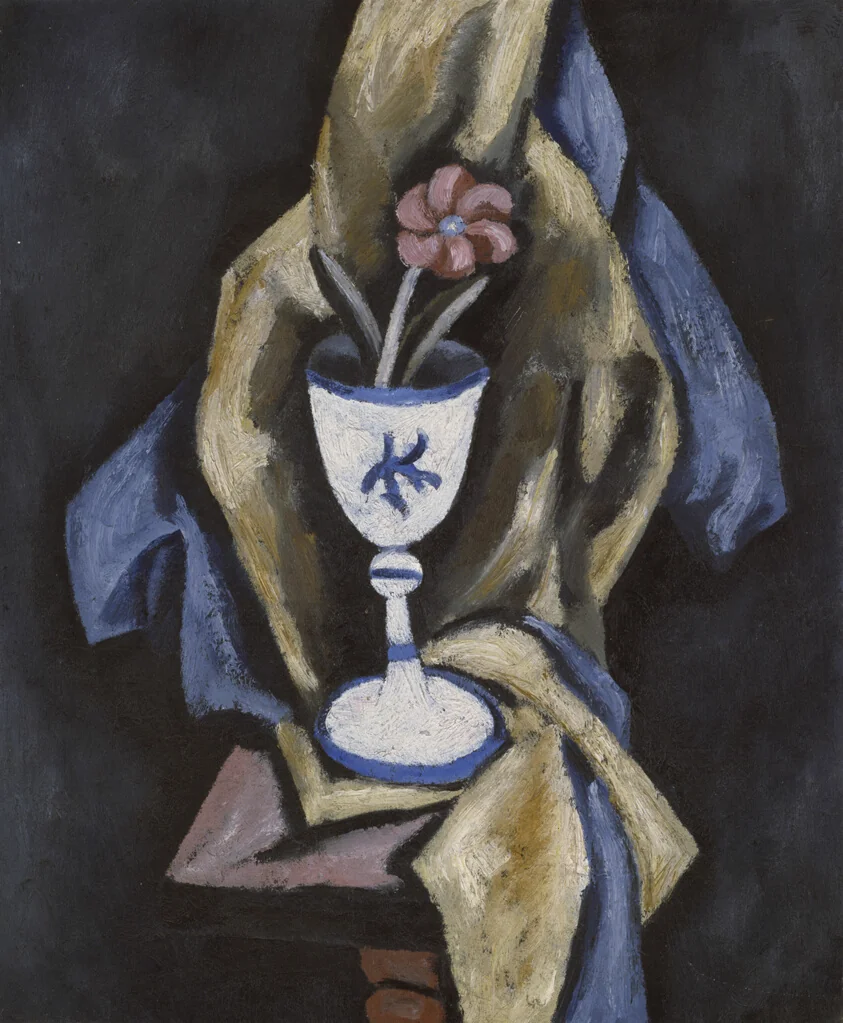
Marsden Hartley turned to still-life painting throughout his career, restlessly using the genre as a means of aesthetic experimentation as he worked out new ideas, styles, and motifs. During the 1910s, influenced by the works of Paul Cézanne, Henri Matisse, and Pablo Picasso, he produced numerous compositions, including Still Life No. 15, a spare arrangement of a white goblet holding a lone pink flower against a backdrop of cream and blue fabric. Unlike many works by Hartley from this period, which emphasize the two-dimensionality of his canvases, here he conveyed a sense of the shallow dark space behind the arrangement on its skewed tabletop. Using a dry, brushy style, Hartley suggested the volumetric presence of the objects through the shading that accentuates the form of the goblet and the deep folds of the fabric.
Accession Number
65930
Medium
Oil on composition board
Dimensions
59.4 × 49.5 cm (23 3/8 × 19 1/2 in.)
Classification
oil on panel
Credit Line
Alfred Stieglitz Collection