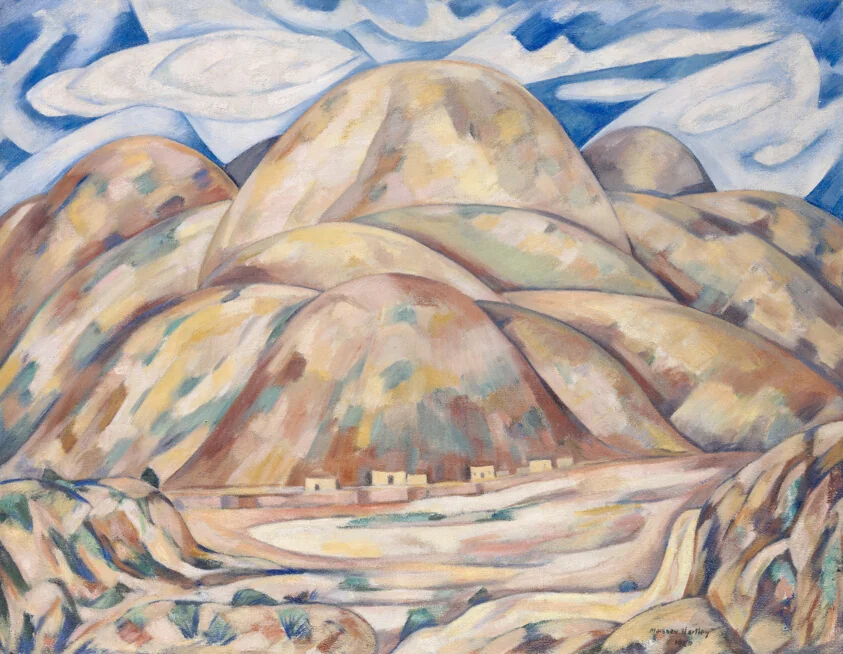
Landscape No. 3, Cash Entry Mines, New Mexico

Description

In Landscape No. 3, Cash Entry Mines, New Mexico, Marsden Hartley used short brushstrokes, patches of pigment, and abstracted cloud forms to portray soaring mountains under a vibrant sky, intentionally minimizing the industrial mines that are the subject of this composition. The artist had spent eighteen months in New Mexico from 1918 until he returned to New York in 1919, but he continued to paint the Southwest from memory for several years, increasingly exaggerating the dramatic terrain and brilliant hues as time passed. For Hartley, as for so many artists who visited the Southwest, the remembered landscape became a vehicle for modernist exploration of color and shape.

Provenance

Alfred Stieglitz Collection, New York; bequeathed through Georgia O'Keeffe to the Art Institute of Chicago, 1949.

Landscape No. 3, Cash Entry Mines, New Mexico

Marsden Hartley

1920

Accession Number

65937

Medium

Oil on canvas

Dimensions

70.6 × 90.8 cm (27 3/4 × 35 3/4 in.)

Classification

Painting

Museum

The Art Institute of Chicago

Chicago, United States

Credit Line

Alfred Stieglitz Collection
Background & Context

Background Story

"Landscape No. 3, Cash Entry Mines, New Mexico" is a 1920 oil on canvas by Marsden Hartley that captures the American modernist painter in his most topographically specific and coloristically intense Southwestern mode, the image showing a mining landscape in New Mexico rendered with the same attention to geological form and spiritual presence that characterized his most powerful regional works. The composition is a medium-large canvas—70.6 × 90.8 centimeters—showing a mining landscape with the oil on canvas creating a surface of extraordinary topographical precision and chromatic intensity. The 1920 date places this work in the period of Hartley's most intensive production of Southwestern landscapes and his exploration of the American desert as a subject for modernist expression. Art historians have connected this painting to the broader tradition of the mining landscape in American art, from the paintings of the Hudson River School to the works of the contemporary period, noting that Hartley's treatment is more focused on the geological form and the spiritual presence, the transformation of industrial landscape into natural vision, than the social documentation or the environmental commentary of these other traditions.

Cultural Impact

This 1920 oil canvas made New Mexico mining landscape topographically intense through medium-large 70cm geological precision chromatic intensity and spiritual desert presence, using Southwestern production to transform industrial terrain into natural visionary form beyond Hudson River social environmental commentary.

Why It Matters

It matters because Hartley painted a mine in the desert and made the canvas feel like it was holding the scar and beauty of human ambition in one breath—proving that even a hole in the ground could be sacred if the paint was honest enough.