Provenance
Joseph Winterbotham, Jr. (1878–1954), Chicago and Burlington, Vt., by 1936 [Chicago 1936]; bequeathed to the Art Institute, 1954.
Accession Number
80628
Medium
Graphite on tan wove paper
Dimensions
22.6 × 31.1 cm (8 15/16 × 12 1/4 in.)
Classification
graphite
Credit Line
Bequest of Joseph Winterbotham
Background & Context
Background Story
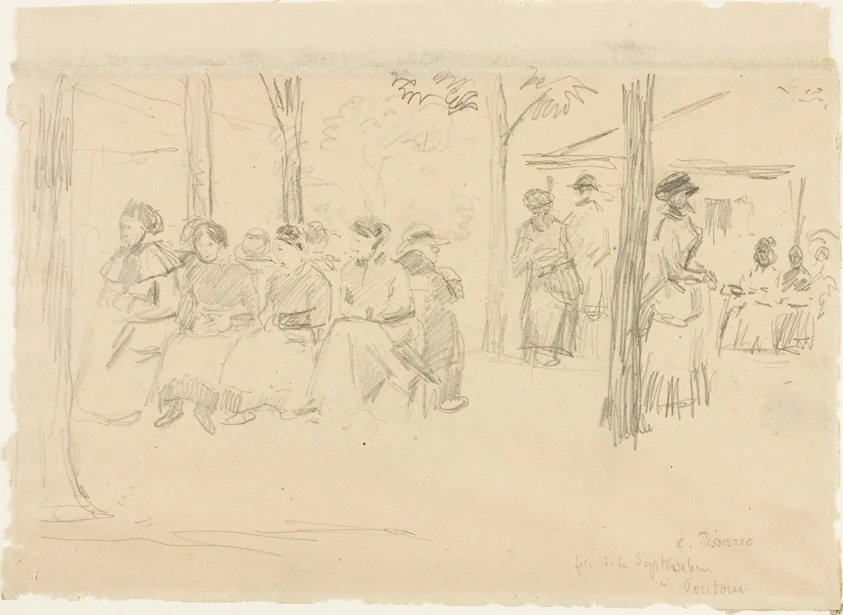
Camille Pissarro's "Fête at Pontoise" (c. 1872) is a graphite drawing on tan wove paper depicting a festive celebration in the town where Pissarro lived for many years. Pontoise, northwest of Paris, was the center of Pissarro's activity in the 1870s, and he painted and drew its streets, fields, and inhabitants extensively. This drawing shows a fair or festival, with crowds of people, perhaps booths or tents, and the characteristic buildings of Pontoise in the background. The subject is unusual for Pissarro, who more often depicted rural landscapes and quiet scenes of daily life than festive gatherings. The graphite technique is lively and spontaneous, with rapid strokes capturing the movement and energy of the crowd. This drawing offers a rare glimpse of Pissarro recording the social life of the town, showing that his interest in human activity extended beyond the dignity of agricultural labor to include the communal pleasures of celebration.
Cultural Impact
Pissarro's drawings of town life in Pontoise document the social fabric of a small French town in the late 19th century, expanding our understanding of his range as an artist.
Why It Matters
This lively drawing of a town festival shows a less familiar side of Pissarro—the observer of urban festivity and communal celebration, captured with the same sensitivity he brought to rural landscapes.