Provenance
Dr. Gottlieb Friedrich von Reber (1880–1959), Lausanne, by 1927 [Schürer 1927]; probably sold to A. E. von Saher, by 1936 [The Hague 1936; van Adrichem 1993, 153]. Alfred Richet (1893–1992), Paris, until c. 1960 [Daix and Boudaille 1967, and email from Pierre-Jean Furet, June 15, 2001; copy in curatorial file]. Edward F. W. James (1907–1984), London, by 1960 [London 1960]. Mary and Leigh Block, Chicago, by 1967 [Daix and Boudaille 1967]; given to the Art Institute, 1981.
Accession Number
61612
Medium
Oil on canvas
Dimensions
100.6 × 81 cm (39 5/8 × 31 7/8 in.)
Classification
Painting
Credit Line
Gift of Mary and Leigh Block
Background & Context
Background Story
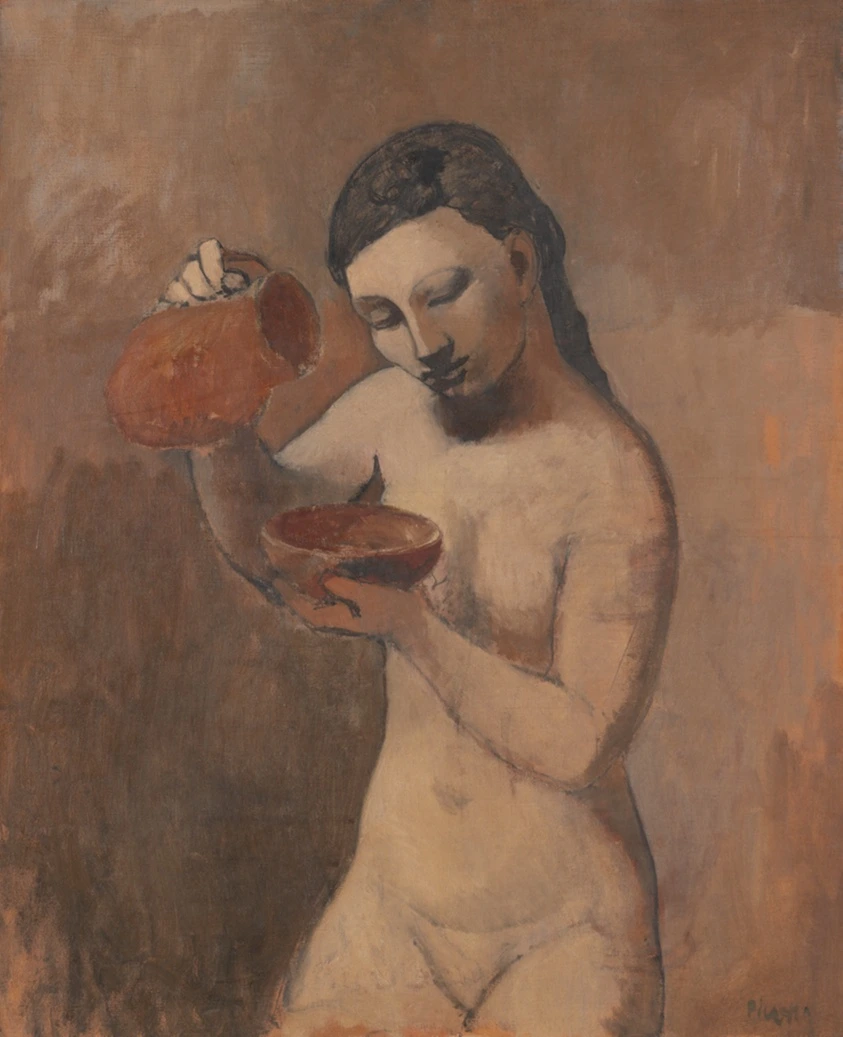
Painted in the summer of 1906, "Nude with a Pitcher" belongs to the same primitivist transformation as its companion piece, exhibiting the flattened anatomy and mask-like features that would culminate in "Les Demoiselles d'Avignon." The figure is shown standing in a three-quarter pose, her left hand resting on a classical pitcher that anchors the composition with a vertical axis while the body twists slightly toward the viewer. The pitcher itself is significant: it functions as a reference to the classical tradition of the baigneuse and the odalisque, from Ingres's "Turkish Bath" to Cézanne's bathers, while the figure's deformed proportions announce that this classical inheritance is being dismantled rather than honored. The palette is warm and earthy, dominated by terracotta, ochre, and olive green that suggest Mediterranean sunlight and Iberian soil. Picasso's brushwork shows the influence of Cézanne's constructive stroke, building the figure through patches of color rather than contour lines, yet the overall effect is more archaic than Cézanne's analytic naturalism. The nude's face is particularly striking: the features have been reduced to essential planes, the eyes are heavy-lidded and almond-shaped, and the mouth is a narrow slit that suggests severity rather than sensuality. This facial type appears repeatedly in Picasso's 1906–1907 output and has been traced to his encounters with Iberian stone sculpture in the Louvre and African masks in Parisian ethnographic collections. The painting thus records a crucial moment in the history of cultural appropriation, when European modernism began borrowing from non-Western sources with consequences that are still debated today.
Cultural Impact
This painting documented modernism's crucial appropriation of non-Western sculptural forms, connecting Picasso's primitivism to the African and Iberian sources in Parisian museums.
Why It Matters
It matters as a classical nude turning into something ancient and unfamiliar—proof that Picasso was already looking at Africa while Europe was still looking at Rome.