Description
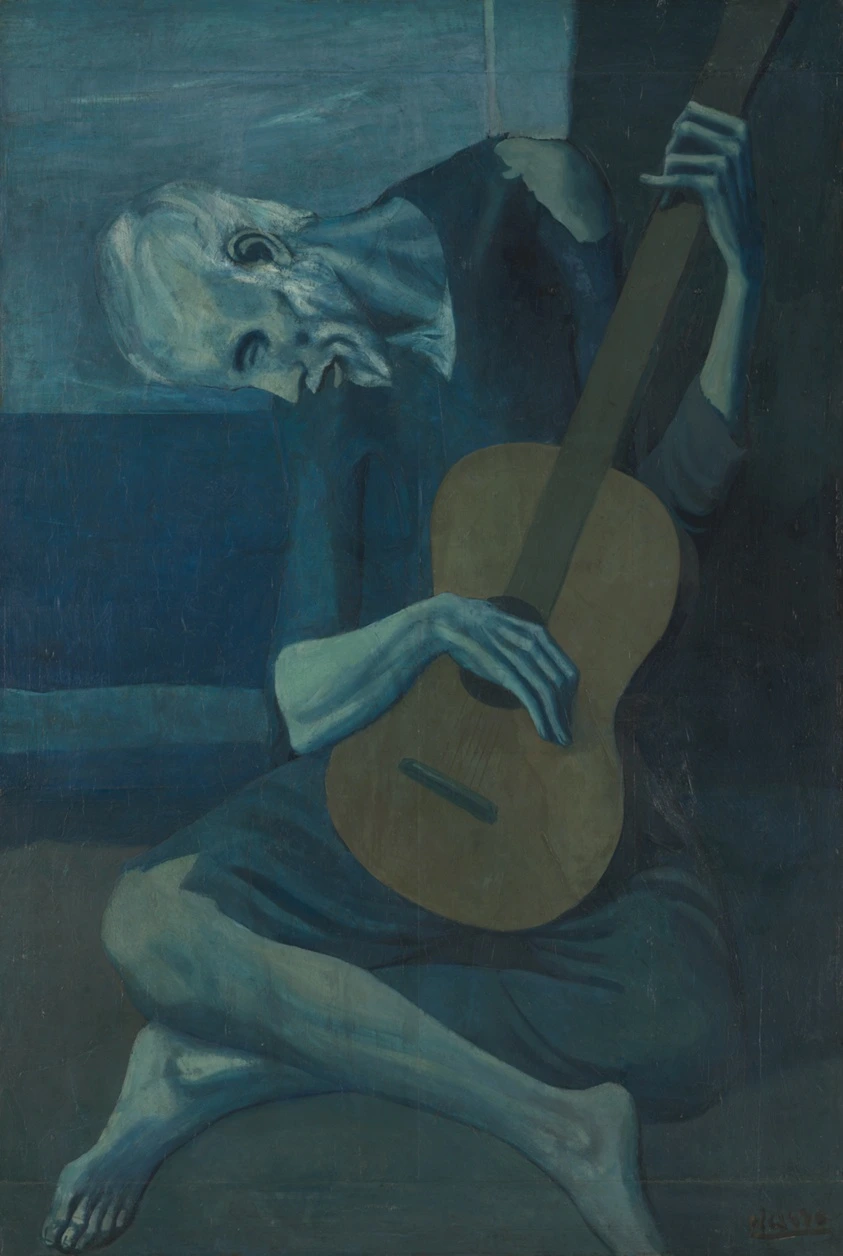
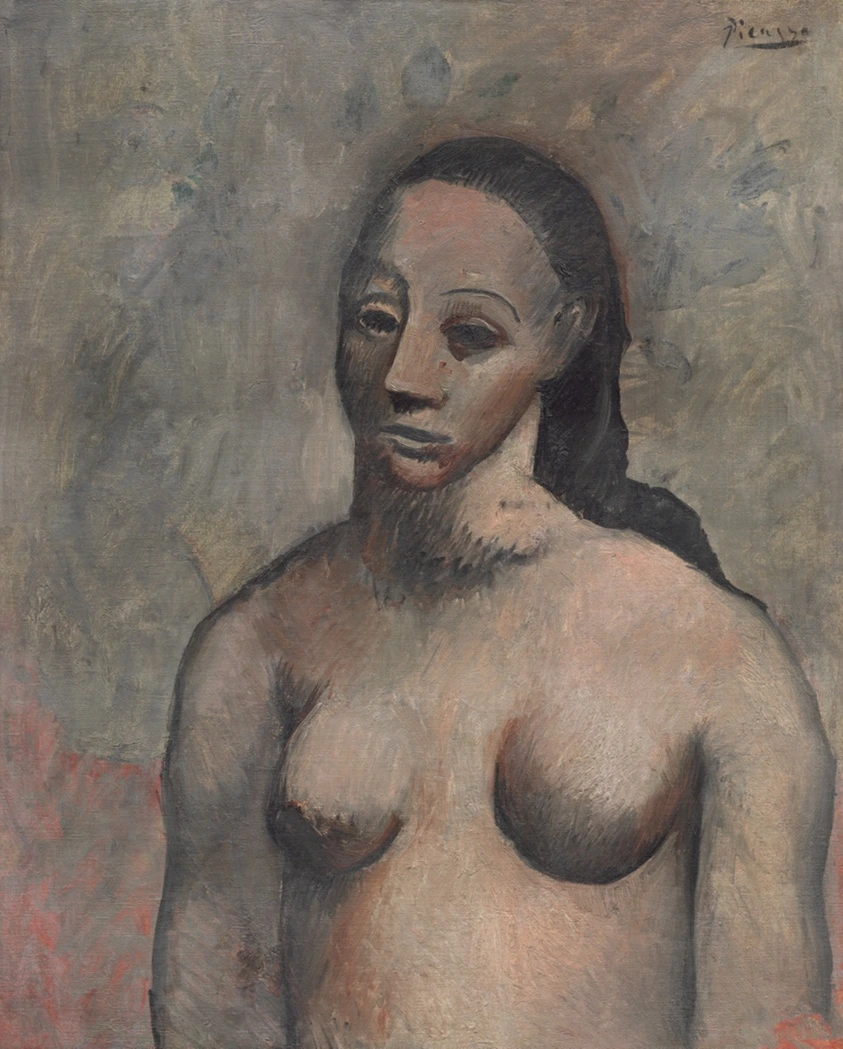
From 1904 through 1906, Pablo Picasso moved away from the melancholic subjects of his Blue Period to the more optimistic themes of his Rose Period. In the summer of 1906, the artist traveled to the Catalan village of Gósol; upon his return to Paris that autumn, he painted Half-Length Female Nude. In stark contrast to the gaunt visage of The Old Guitarist, the angular, masklike qualities of the figure’s face reveal Picasso’s growing interest in ancient Iberian sculpture and non-Western art. In this way, the work anticipates his breakthrough to Cubism in 1907.
Provenance
Paul Guillaume (1891–1934), Paris, by June 1929 [Sarraut 1930]. Valentine-Dudensing Gallery, New York, by 1936; sold to Walter P. Chrysler, Jr. (1909–1988), New York and Warrenton, Va., by Oct. 1937 [Detroit 1937; letter from William Mayglothling, Sept. 24, 1975; copy in curatorial file]; sold, Sotheby Parke–Bernet, New York, Mar, 22, 1945, Chrysler sale, lot 97, to Jacques Helft, Paris and Buenos Aires [this and the following, according to letter from Jacques Helft, Oct. 29, 1975; copy in curatorial file]; on consignment to Allen Loeb, Paris, c. 1946–1955. Floren Schoenborn (1903–1995) and Samuel A. Marx (1885–1964), Chicago and New York, from 1955 [New York 1966]; given to the Art Institute, 1959.
Accession Number
11294
Medium
Oil on canvas
Dimensions
Canvas: 80.3 × 64.1 cm (31 5/8 × 25 1/4 in.); Panel: 81.6 × 65.4 cm (32 1/8 × 25 3/4 in.)
Classification
Painting
Credit Line
Gift of Florene May Schoenborn and Samuel A. Marx
Background & Context
Background Story
This autumn 1906 canvas represents a decisive threshold in Picasso's development: the moment when his Rose Period elegance began to fracture under the pressure of Iberian and African sculptural influences. The half-length nude is rendered with flattened planes and simplified features that anticipate the radical break of "Les Demoiselles d'Avignon" (1907) by only a few months. The face—probably modeled after Fernande Olivier—has begun to assume the mask-like quality that would define Picasso's primitivist phase, with eyes enlarged to almond shapes and the nose reduced to a triangular wedge. Yet the body retains enough anatomical accuracy to register the distortion as violent rather than decorative: the breasts are asymmetrical, the shoulders slope at unequal angles, and the skin is modeled with warm ochre that suggests flesh rather than wood or stone. This tension between observed reality and formal deformation is what makes the canvas historically crucial; it is a painting in the process of becoming something else, a photograph of artistic evolution in real time. The medium of oil on canvas mounted on panel was unusual for Picasso and suggests that he was treating the work with particular care, perhaps aware of its transitional significance. The painting also documents the social context of the Bateau-Lavoir, the Montmartre tenement where Picasso lived among poets, anarchists, and dealers who were all searching for a visual language adequate to the twentieth century. In the broader narrative of modern art, this canvas stands as a hinge between nineteenth-century naturalism and the anti-naturalist revolutions that followed.
Cultural Impact
This transitional canvas captured the exact moment when Picasso's Rose Period fractured into primitivism, serving as a hinge between nineteenth-century naturalism and twentieth-century revolution.
Why It Matters
It matters as the last breath before the explosion—the painting Picasso made just before he broke the face of European art in 1907.