The Adoration of the Eucharist

Description

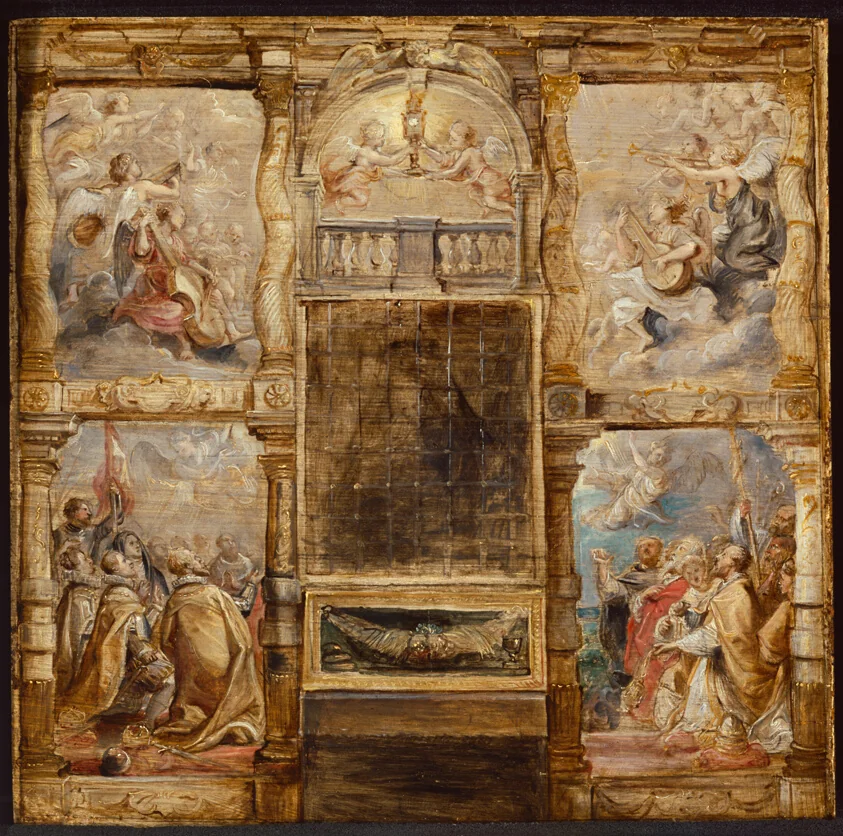
Peter Paul Rubens designed this elaborate oil sketch as part of a tapestry series intended for the Convent of Las Descalzas Reales in Madrid. Rubens created two tiers of celebrants—the heavenly on the upper level and the earthly on the lower level—adoring the Eucharist, an important sacrament in the Roman Catholic Church, which is lifted by two angels beneath a central arch. The series’ patron, Spanish archduchess Isabella Clara Eugenia, is represented in a nun’s habit at the lower left to signify her piety and reinforce her status as an important patron of the arts in the ruling Habsburg family.

Provenance

Probably in the collection of the artist, Antwerp, until his death in 1640 and then included in a large lot of oil sketches in his estate sale, 1642 [Jeffrey M. Muller, “Oil-Sketches in Rubens’s Collection,” Burlington Magazine 117 (1975), pp. 374-75, and Held 1980, p. 11, argue that the oil sketches were disposed of in this way]. Probably Jean van Lancker, Antwerp; his estate sale, Antwerp, 23 May, 1769 and following days, lot 72, “Une belle Esquisse, un Sanctuaire au milieu de 4 petites pieces jointes ensemble, Rubens, B[ois], 13 x 12. Canon Pierre André Joseph Knyff, Antwerp (died 1784), his estate sale, Antwerp, J. Grange, 18 July 1785 and following days, lot 74, “Un Autel enrichi d’ornemens & de colonnes, sur lequel est, représentée l’Adoration de l’Eucharistie: à droite, on voit le Pape à genoux, qui offre de l’encens; il est accompagné de Diàcres, de Prêtres & de beaucoup d’autres figures; à gauches sont l’Empereur, un Roi, des Princes, & plusieurs autres personnes, qui adorent le Saint Sacrement, au-dessus duquel on apperçoit un grand nombre d’Anges qui jouent des instrumens. Dans cette belle esquisse bien terminée et bien coloriée, l’on remarque beaucoup de finesse & de vérité. 11 ½ x 11 3/4 . B[ois]”, to Giraud, according to annotated catalogue in the RKD, The Hague]. Dowdeswell Galleries, London, by 1914, when sold to Martin A. Ryerson [an invoice from Dowdeswell to Ryerson is dated June 23, 1914]; Martin A. Ryerson, Chicago (1856–1932), from 1914; by descent to his wife Carrie Hutchinson Ryerson (1859–1937), Chicago, 1932 [Last Will and Testament of Martin A. Ryerson, Died August 11, 1932, copy in Institutional Archives, Art Institute of Chicago]; bequeathed to the Art Institute of Chicago, 1937.
The Adoration of the Eucharist

Peter Paul Rubens

c. 1626

Accession Number

25790

Medium

Oil on panel

Dimensions

31.5 × 32 cm (12 1/2 × 12 1/2 in.); Framed: 47.6 × 47.6 × 7 cm (18 3/4 × 18 3/4 × 2 3/4 in.)

Classification

oil on panel

Museum

The Art Institute of Chicago

Chicago, United States

Credit Line

Mr. and Mrs. Martin A. Ryerson Collection

Background & Context

Background Story

"The Adoration of the Eucharist" is a small devotional panel from around 1626, painted during the period when Rubens was increasingly turning to religious subjects as he sought spiritual reconciliation with the Catholic Church and withdrawal from the worldly ambitions of his diplomatic career. The composition shows the Eucharistic host elevated above a gathering of saints, angels, and earthly worshippers, the central miracle of the Mass rendered with the intimate scale and devotional intensity of a private altarpiece. The palette is warmer and more restrained than in Rubens's large public commissions: golds, deep reds, and creamy flesh tones create an atmosphere of reverent contemplation rather than theatrical spectacle. The figures are arranged in a pyramidal composition that recalls Raphael's "Madonna of the Baldacchino" but infuses the classical stability with Baroque emotional warmth. Rubens's mastery of oil on panel is particularly evident in the small scale: the enamel-like surface, the precision of facial expression, and the luminous depth of the shadows all testify to a hand that had painted thousands of figures and could now achieve perfection with apparent ease. The panel also reflects Rubens's personal piety in his final years: after surviving the siege of Antwerp and the vicissitudes of Habsburg diplomacy, he turned increasingly to the solace of religious practice. Art historians have compared this work to the late devotional images of Titian and the aged Velázquez, though Rubens's treatment is more exuberant, less austere than these Mediterranean models. The painting's provenance is notable: it probably belonged to a private collector or convent, intended for intimate contemplation rather than public display.

Cultural Impact

This late devotional panel channeled Titian and Velázquez through Baroque exuberance, documenting Rubens's spiritual withdrawal from diplomatic ambition into intimate Eucharistic contemplation.

Why It Matters

It matters because Rubens painted bread as if it were heaven—proving that even the busiest man in Europe needed to kneel sometimes.