Description
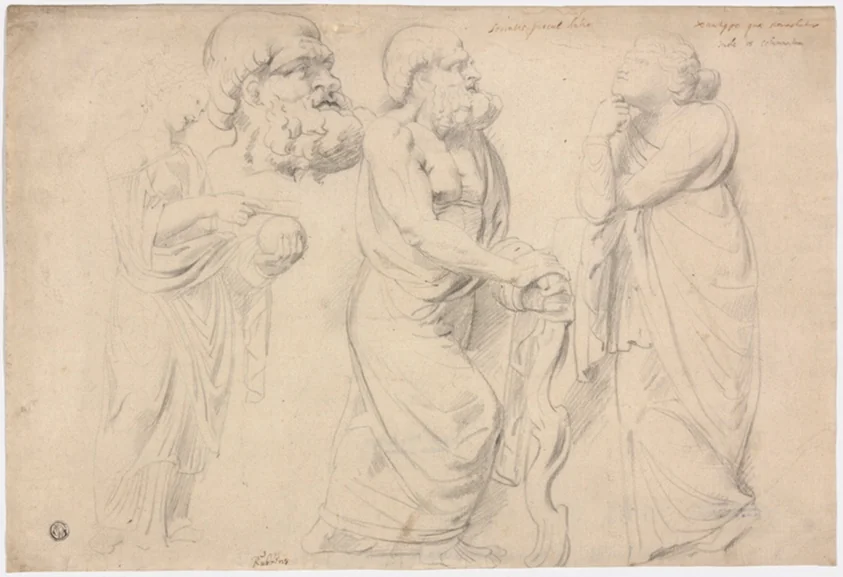
Using chalk and a loose sheet of paper, Peter Paul Rubens depicted three figures from a sarcophagus likely seen in Roman collector Ciriaco Mattei’s garden. Rubens visited the Eternal City twice during his stay in Italy (1600–08).
Chalk was more portable than ink and therefore an easier medium in which to directly record the remnants of Classical antiquity. Rubens used it to convey the contours of specific sculptural elements as well as the shadows created by their volumes. In comparing this drawing to its source, one can appreciate how selectively Rubens extracted the figures from their architectural surround.
Provenance
Dr. Christian David Ginsburg (1831–1914), Palmer’s Green, England [stamp (Lugt 1145), verso, lower left, in black]; sold, Sotheby’s, London, July 20–23, 1915, lot 34, to William F. E. Gurley (1854–1943), Chicago [stamp (Lugt 5308), recto, lower left, in black and inscription verso, lower left, in graphite]; given to the Art Institute of Chicago for the Leonora Hall Gurley Memorial Collection, 1922 [stamp (Lugt 1230b), verso, lower center, in black].
Accession Number
84207
Medium
Black chalk on cream laid paper
Dimensions
28.5 × 42 cm (11 1/4 × 16 9/16 in.)
Classification
graphite
Credit Line
The Leonora Hall Gurley Memorial Collection
Background & Context
Background Story
This 1602–03 drawing of a Roman sarcophagus is one of the most important documents of Rubens's early study of classical antiquity, executed in black chalk on cream laid paper during the first of his extended stays in Rome. The composition shows a detailed record of the sculptural relief on a Roman funerary monument, with particular attention to the muscular anatomy and dramatic gesture of the figures carved in stone. Rubens's chalk handling is already extraordinary: broad, confident strokes establish the main forms while finer lines work out the anatomical detail, creating a drawing that serves simultaneously as documentary record and aesthetic interpretation. The study of sarcophagi was central to Renaissance and Baroque artistic education: these ancient monuments provided models for figure composition, drapery treatment, and narrative arrangement that painters could adapt to contemporary subjects. Rubens's particular interest in battle sarcophagi—monuments showing combat between Romans and barbarians—reflects his early ambition to paint large-scale historical scenes with the same physical dynamism that ancient sculptors had achieved in marble. The cream laid paper support was standard for Italian draftsmen of the period, its warm tone providing a middle value that made white highlighting unnecessary. Art historians have connected this drawing to specific paintings from Rubens's Italian period, particularly his early hunting and battle scenes where the influence of antique relief is unmistakable. The sheet also demonstrates Rubens's working method: he drew extensively in museums and churches, filling sketchbooks with classical studies that he would later mine for motifs in his studio compositions.
Cultural Impact
This early Roman chalk study documented Rubens's classical apprenticeship, translating sarcophagus relief into dynamic draftsmanship that would fuel his later battle and hunting compositions.
Why It Matters
It matters because Rubens spent hours copying dead stone so he could later make paint move—proving that ancient marble could teach a Flemish hand to dance.