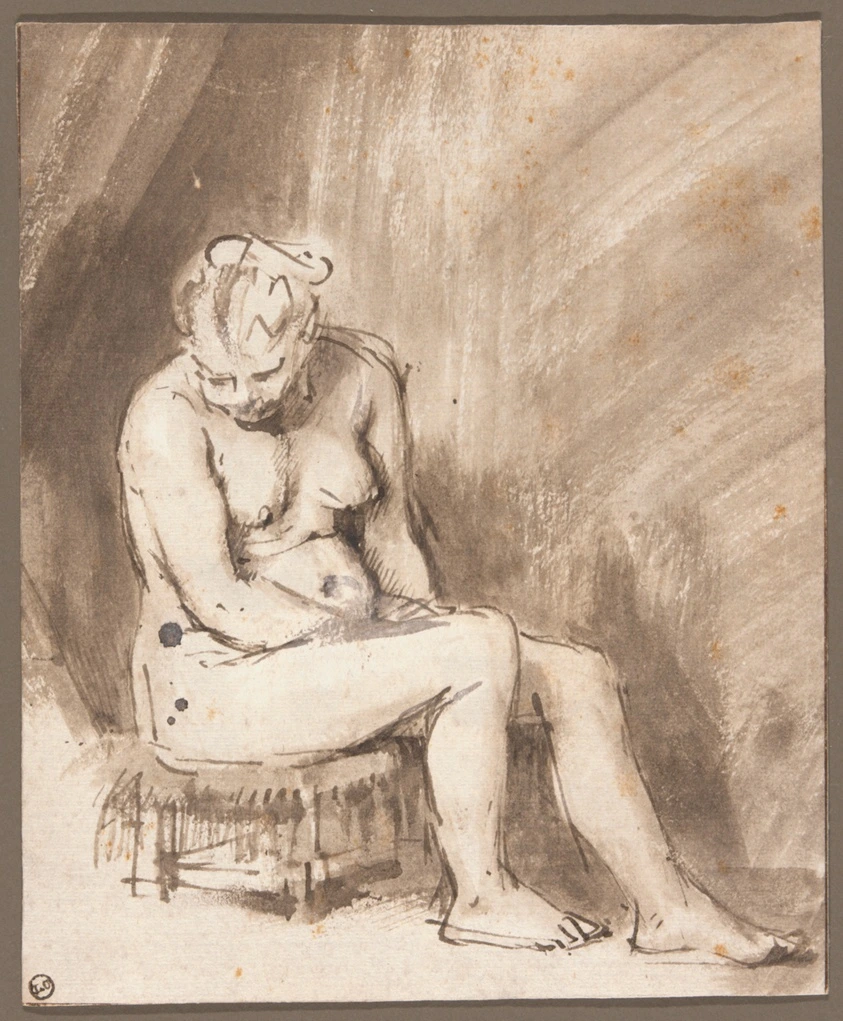
Seated Female Nude

Description

For Rembrandt van Rijn, simple honesty of vision and sureness of line were far more important than the classical glorification of the nude. He focused on this subject only during certain phases of his career, and very few of the resulting studies, which he used to prepare biblical or mythological representations, survive today. This strong form is a late work, and one of only four extant drawings of the female nude attributed to Rembrandt with certainty. Unlike the almost scientific realism of his earlier nudes, his late studies are less detailed and more painterly. He attained a maximum of expression with a minimum of means. Rendered with a swift treatment by brush and the blunt reed pen favored by the artist in his late years, this ample figure projects a forceful presence. Her face is generalized, and her feelings are suggested through her contemplative pose. Her simple shape and external immobility seem to increase the viewer’s sense of her inner vitality. In Seated Female Nude, Rembrandt’s penstrokes and brushwork are integrated with the utmost lightness and perfection; the pen stresses structural features, while the brush provides a transparent, atmospheric tone linking figure and space.

Provenance

Louis Corot (c. 1840–c. 1930), Nimes [stamp (Lugt 1718), recto, lower left, in black]; sold to Richard (an art dealer), Paris, in 1924 [Lugt 1718]. Alfred Strölin (1871–1954) and/or his son Alfred Strölin (1912–1974), Paris and Lausanne, by 1935 [Benesch 1935]; sold to the Art Institute of Chicago, 1953.

Seated Female Nude

Rembrandt van Rijn

1660/62

Accession Number

90536

Medium

Pen and brown ink and brush and brown wash, with subtractive highlights (scraping) and touches of opaque white watercolor corrections, on ivory laid paper, laid down on cream laid card

Dimensions

Primary/secondary supports: 21.2 × 17.5 cm (8 3/8 × 6 15/16 in.)

Classification

pen and ink drawings

Museum

The Art Institute of Chicago

Chicago, United States

Credit Line

Clarence Buckingham Collection

Background & Context

Background Story

Rembrandt van Rijns Seated Female Nude from 1660-62 is a pen and brown ink and brush and wash drawing with subtractive highlights and opaque white watercolor corrections on ivory laid paper that exemplifies the Dutch masters approach to the nude figure in his late work, when the linear precision of his earlier drawings gave way to a broader, more atmospheric style in which the figure emerges from the tonal field of wash and graphite. The seated nude, depicted from a slightly elevated viewpoint that exposes the full length of her body, is rendered with the unidealized physical specificity that distinguishes Rembrandts approach to the female nude from the more conventionally beautiful formulations of his Italian contemporaries. The years 1660-62 bracket the period of Rembrandts most accomplished drawings, when he was producing works of extraordinary tonal richness and psychological depth despite the personal and financial difficulties that had reduced him from the most successful painter in Amsterdam to a resident of a modest rented house. The subtractive highlights, created by scraping away the ink and wash to reveal the white paper beneath, demonstrate Rembrandts willingness to work against the grain of the medium, removing material rather than adding it to create the effect of light falling on the figures body. The opaque white watercolor corrections, visible in several areas of the drawing, reveal the working process of an artist who was constantly revising and refining his compositions, a process that Rembrandt made visible rather than concealing.

Cultural Impact

Rembrandts late drawings are among the most accomplished works in the history of Western draftsmanship, and their influence on the practice of drawing extends from his contemporaries through the academic tradition to the present. The Seated Female Nude demonstrates the unidealized approach to the figure and the tonal sophistication that make his late drawings models of the draftsmans art.

Why It Matters

A 1660-62 pen and ink and wash drawing by Rembrandt of a seated female nude with subtractive highlights and white watercolor corrections, exemplifying the unidealized physical specificity and tonal richness of his late work with visible evidence of the revision process that defines his approach.