Provenance
Paul Rosenberg (1881–1959), Paris [email from Ilda Francois, Paul Rosenberg Archives, Sept. 7, 2011; photocopy in curatorial file]; confiscated by the Einsatzstab Reichsleiter Rosenberg (ERR), German Embassy, Paris [this and the following according to Cultural Plunder by the Einsatzstab Reichsleiter Rosenberg: Database of Art Objects at the Jeu de Paume, Paul Rosenberg Collection, ERR inventory no. PR 32; photocopy in curatorial file]; transferred to the Musée du Louvre, Paris, Nov. 1940; transferred to Jeu de Paume, Paris, Sept. 5, 1941; exchanged with Gustav Rochlitz (Apr. 3, 1889–1972) on behalf of Hermann Göring (Jan. 12, 1893–Oct. 15, 1946), Paris, from Nov. 27, 1942 [Office of Strategic Services, Art Looting Investigation Unit, APO 413, “Consolidated Interrogation Report No. 1: Activity of the Einsatzstab Rosenberg in France,” p. 43, National Archives; photocopy in curatorial file]. Paul Pétridès (1901–1993), Paris, by Nov. 1943 [Lejard 1943]. Gustav Rochlitz, by July 1944; Hermann Göring, Baden Baden, from July 1944. Restituted to Paul Rosenberg, New York [Yeide 2009]; sold to Chauncey McCormick (Dec. 7, 1884–Sept. 8, 1954) and Marion Deering McCormick (June 5, 1886–Jan. 12, 1965), Chicago, by May 15, 1947; probably by descent to their son, Brooks McCormick (Feb. 23, 1917–Aug. 15, 2006), Chicago and Warrenville, IL, by Jan. 12, 1965–Aug. 15, 2006; by descent to Brooks McCormick Estate, Aug. 15, 2006; bequeathed to the Art Institute of Chicago, Sept. 10, 2007.
Accession Number
191565
Medium
Oil on canvas
Dimensions
65.5 × 51 cm (25 3/4 × 20 1/16 in.)
Classification
Painting
Credit Line
Brooks McCormick Estate
Background & Context
Background Story
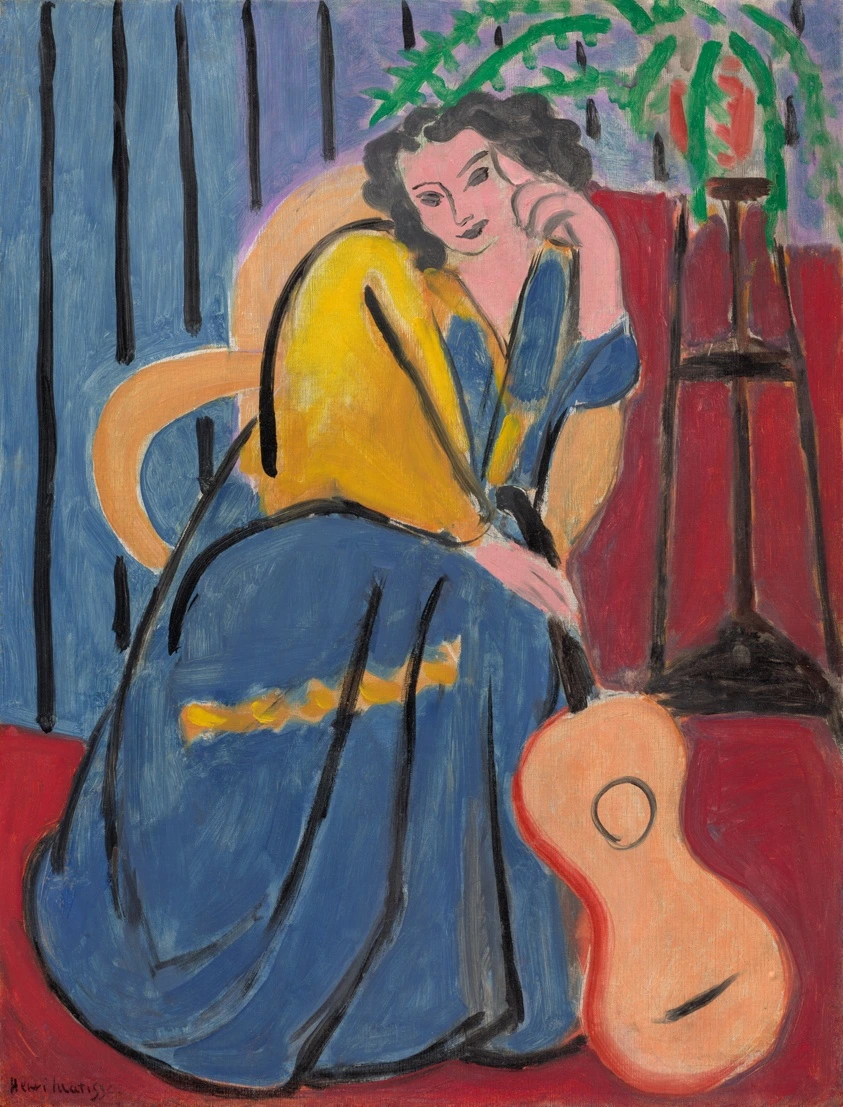
"Girl in Yellow and Blue with Guitar" is a 1939 oil on canvas by Henri Matisse that captures the French master in his most coloristically bold and compositionally simplified late mode, the image showing a girl with a guitar rendered with the same flat, unmodulated color and elegant arabesque that characterized his most powerful works of the late 1930s and 1940s. The composition is a medium-sized canvas—65.5 × 51 centimeters—showing a girl with a guitar with the oil on canvas creating a surface of extraordinary chromatic clarity and compositional boldness. The yellow and blue create a visual rhythm of complementary contrasts that suggests both the musical harmony of the guitar and the decorative exuberance of Matisse's late style. The 1939 date places this work in the period of Matisse's most intensive production of interior scenes and his exploration of color as the primary subject of painting. Art historians have connected this painting to the broader tradition of the interior in French art, from the paintings of Bonnard to the decorative arts of the period, noting that Matisse's treatment is more focused on the coloristic harmony and the compositional boldness, the transformation of observed reality into chromatic poetry, than the psychological depth or the naturalistic observation of these other traditions.
Cultural Impact
This 1939 oil canvas made girl-guitar coloristically bold through medium 65cm flat yellow-blue complementary rhythm and late-style decorative arabesque, using intensive interior-scene period to transform observed reality into chromatic musical poetry beyond Bonnard psychological naturalistic depth.
Why It Matters
It matters because Matisse painted a girl with a guitar and made the canvas feel like it was singing in colors that don't exist in nature—proving that even a room could be a concert if the yellow was bright enough.