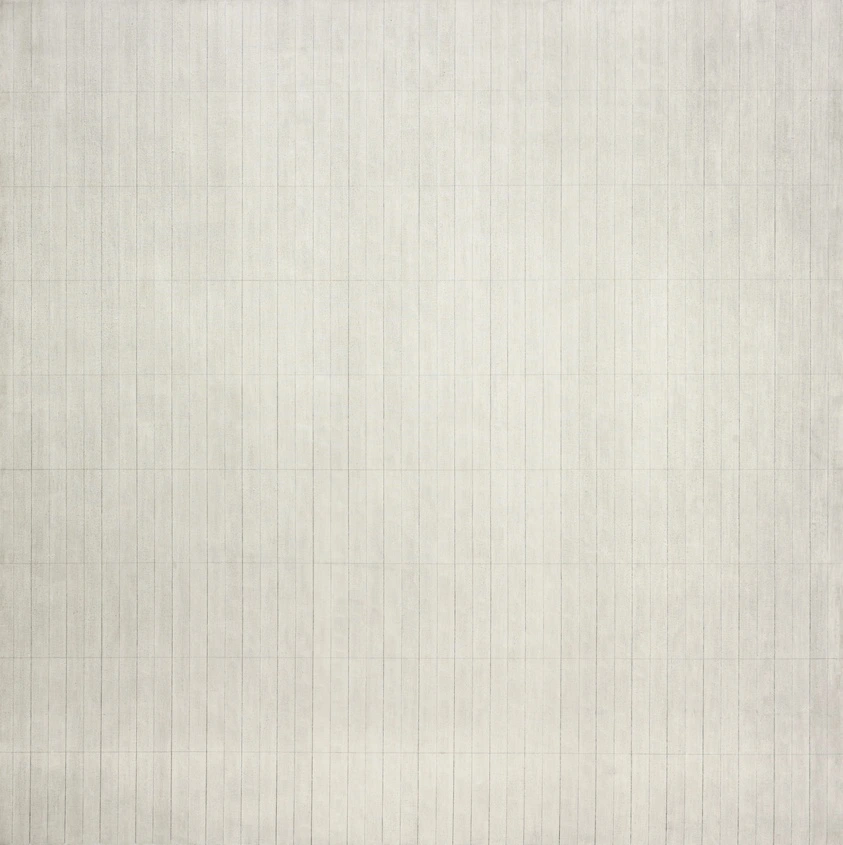
Description
Early in her career, Agnes Martin identified with her contemporaries Barnett Newman and Ad Reinhardt, sharing with them an interest in monochromatic color schemes, geometric forms, and spiritual or emotional content. In the 1960s Martin stopped making art and moved to rural New Mexico. When she resumed painting in 1974, her consistent vocabulary of grids and lines began to reflect her surround-ings. Untitled #12—part of a series of I5 square canvases painted in 1977—is a hand-drawn graphite grid on a muted gray ground that quietly invites a slow study of gradation and light.
Accession Number
89403
Medium
India ink, graphite, and gesso on canvas
Dimensions
182.9 × 182.9 cm (72 × 72 in.)
Classification
Painting
Credit Line
Mr. and Mrs. Frank G. Logan Purchase Prize Fund
Background & Context
Background Story
Agnes Martin's Untitled #12 from 1977 embodies the artist's decades-long pursuit of expressing joy, innocence, and the beauty of the natural world through the most reduced formal means possible. The painting consists of a pale gesso ground traversed by delicate horizontal and vertical lines drawn in graphite and india ink, creating a grid that hovers between structure and dissolution. Martin insisted she was not a minimalist—she described her work as abstract expressionist, concerned with emotional rather than intellectual content. The grid, for Martin, represented not rigidity but freedom from representation, a way of evoking the experience of landscape and light without depicting either. She lived for decades in the high desert of New Mexico, and the subtle color shifts and horizontal bands of her paintings have often been linked to the vast horizons and luminous skies of the American Southwest. Untitled #12 was made during a key period when Martin had returned to painting after a several-year hiatus and was refining the grid format with increasing subtlety, her lines becoming ever more delicate, her surfaces ever more luminous, as though painting were a form of meditation made visible.
Cultural Impact
Martin's grids became one of the most recognized—and often misunderstood—forms in 20th-century abstraction. Her insistence on emotional content over formal analysis influenced generations of artists who sought spiritual meaning in abstract art, from the Pattern and Decoration movement to contemporary practitioners of meditative painting.
Why It Matters
A quintessential Agnes Martin grid painting that transforms geometric structure into a vehicle for emotional expression, demonstrating the artist's conviction that abstraction can evoke joy and transcendence more directly than representation.
![Saint Bernard and Saint Catherine of Alexandria with the Virgin of the Annunciation [right panel]](https://api.nga.gov/iiif/e6890364-4d99-4684-a62b-5060ee3c3446/full/400,/0/default.jpg)