Two Women's Torsos

Description

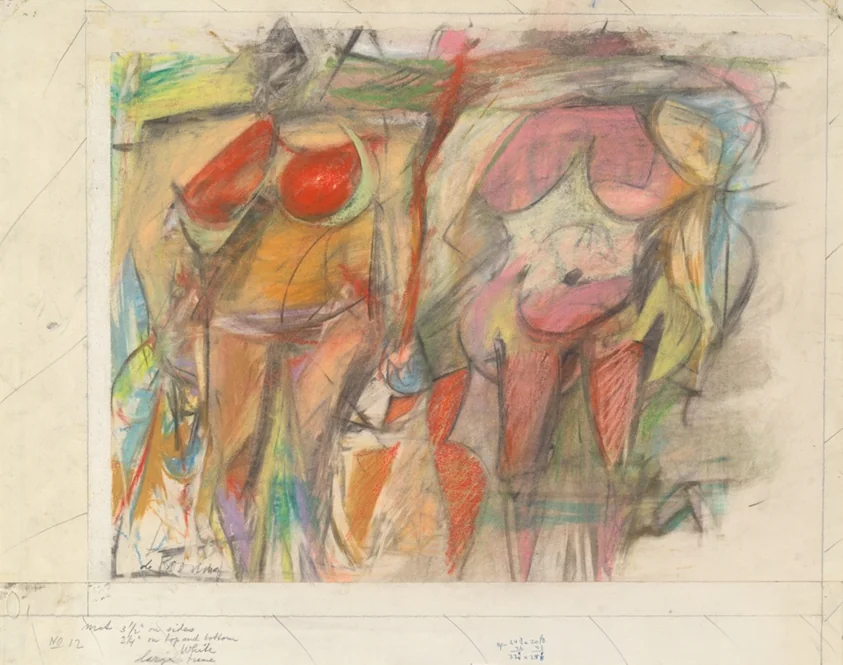
A pioneer of Abstract Expressionism, Willem de Kooning experimented with the human form throughout his career, which reached its apex in the early 1950s with his celebrated Woman series. Two Women’s Torsos was created during an intense campaign in which the artist focused on drawings related to his Woman paintings, which were exhibited together with this and other drawings at the Sidney Janis Gallery, New York, in 1953.

De Kooning’s drawings are admired for their number and variety as well as for the artist’s expressive technique, exemplified here by his gestural use of pastel in concert with charcoal. This drawing’s velvety texture and almost violently animated surface are characteristic of the approximately one hundred sheets that remain from his intense work on the woman theme in 1952 and 1953. Also typical of de Kooning’s art is the way in which Two Women’s Torsos references aspects of related paintings but stands alone as an independent work. As the artist tried to jettison traditional modes of composition, he used drawing as a primary vehicle for the sequential development of his most important early body of work.

Provenance

Sold by Sidney Janis Gallery, New York, to the Art Institute of Chicago, 1955.

Two Women's Torsos

Willem de Kooning

1952

Accession Number

83889

Medium

Pastel and charcoal on ivory wove paper

Dimensions

47.9 × 61 cm (18 7/8 × 24 1/16 in.)

Classification

pastel

Museum

The Art Institute of Chicago

Chicago, United States

Credit Line

John H. Wrenn Memorial Collection

Background & Context

Background Story

"Two Women's Torsos" is a 1952 pastel and charcoal on ivory wove paper by Willem de Kooning that captures the Dutch-American Abstract Expressionist in his most figuratively engaged and violently sensual mode, the image showing women's torsos rendered with the same aggressive distortion and chromatic intensity that characterized his controversial "Women" series. The composition is a medium-sized drawing—47.9 × 61 centimeters—showing two women's torsos with the pastel and charcoal creating a surface of extraordinary tactile immediacy and psychological intensity. The pastel allows for both the soft, sensuous modeling of flesh and the aggressive, slashing marks of emotional expression, the technique suggesting both the physical reality of the female body and the psychological violence of the artist's gaze. The 1952 date places this work in the heart of de Kooning's "Women" series period, when he was producing the paintings and drawings that established his reputation as the most controversial and influential figurative painter of the Abstract Expressionist generation. Art historians have connected this drawing to the broader tradition of the female nude in modern art, from the paintings of Picasso to the sculptures of de Kooning himself, noting that de Kooning's treatment is more focused on the aggressive gesture and the psychological intensity, the transformation of the female form into emotional battleground, than the anatomical accuracy or the aesthetic idealization of these other traditions.

Cultural Impact

This 1952 pastel charcoal made women's torsos aggressively sensual through medium 47cm soft flesh-modeling pastel and slashing charcoal emotional violence on ivory-paper tactile immediacy, using Women-series heart-period to transform female form into psychological emotional battleground beyond Picasso anatomical idealization.

Why It Matters

It matters because de Kooning drew two women and made the paper feel like it was being grabbed by a storm of desire and paint—proving that even a torso could be a battlefield if the pastel was fierce enough.