Accession Number
1977.57.1
Medium
tempera on wood
Dimensions
overall: 94.5 x 122 cm (37 3/16 x 48 1/16 in.) | framed: 114.9 x 142.6 x 2.5 cm (45 1/4 x 56 1/8 x 1 in.)
Classification
Painting
Credit Line
Gift of Dr. Margaret I. Handy
Tags
Painting Contemporary (after 1950) Tempera American
Background & Context
Background Story
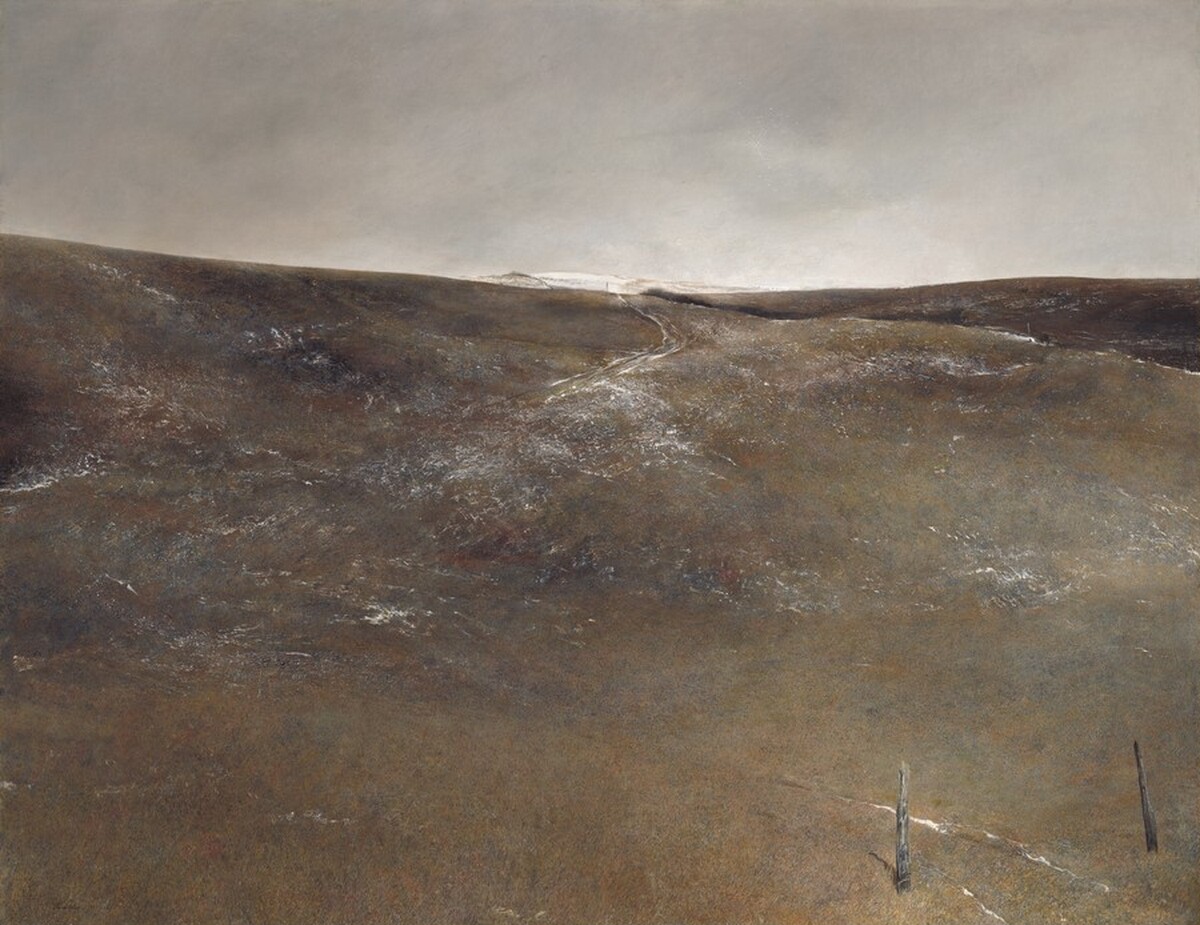
Andrew Wyeth painted Snow Flurries in 1953, depicting the landscape around his home in Chadds Ford, Pennsylvania, as the first flurries of winter drift across an autumn field. The painting is quintessential Wyeth: a view of the American countryside rendered with photographic precision, yet charged with an emotional intensity that transcends mere representation.
Wyeth worked in egg tempera, a medieval medium he revived and made his own. The technique requires painstaking application of thin, opaque layers, building up a surface of extraordinary density and luminosity. Snow Flurries exploits this quality to the full: the dry, brittle grasses of the field are rendered stalk by stalk, the distant trees etched against a sky that is not merely gray but alive with the complex atmospheric effects of an approaching storm.
The painting's mood is one of suspended transition - the moment when autumn yields to winter, when the landscape is neither one season nor the other. This liminal quality is central to Wyeth's art: he painted the American countryside not as pastoral idyll but as a place of psychological and seasonal thresholds, where change is always imminent and nothing is ever fully settled.
Cultural Impact
Wyeth's work divided critical opinion throughout his career: some saw him as the greatest realist painter of his generation, others as a sentimental illustrator. Time has vindicated the view that his best work achieves a psychological depth comparable to Hopper's - a specifically American vision of landscape as a mirror for inner states.
Why It Matters
Snow Flurries captures the quintessential Wyeth moment: the instant of transition, the threshold between seasons, the point where observation becomes meditation. It is proof that the most apparently simple landscape can carry the weight of the deepest human feelings.