Madawaska—Acadian Light-Heavy

Description

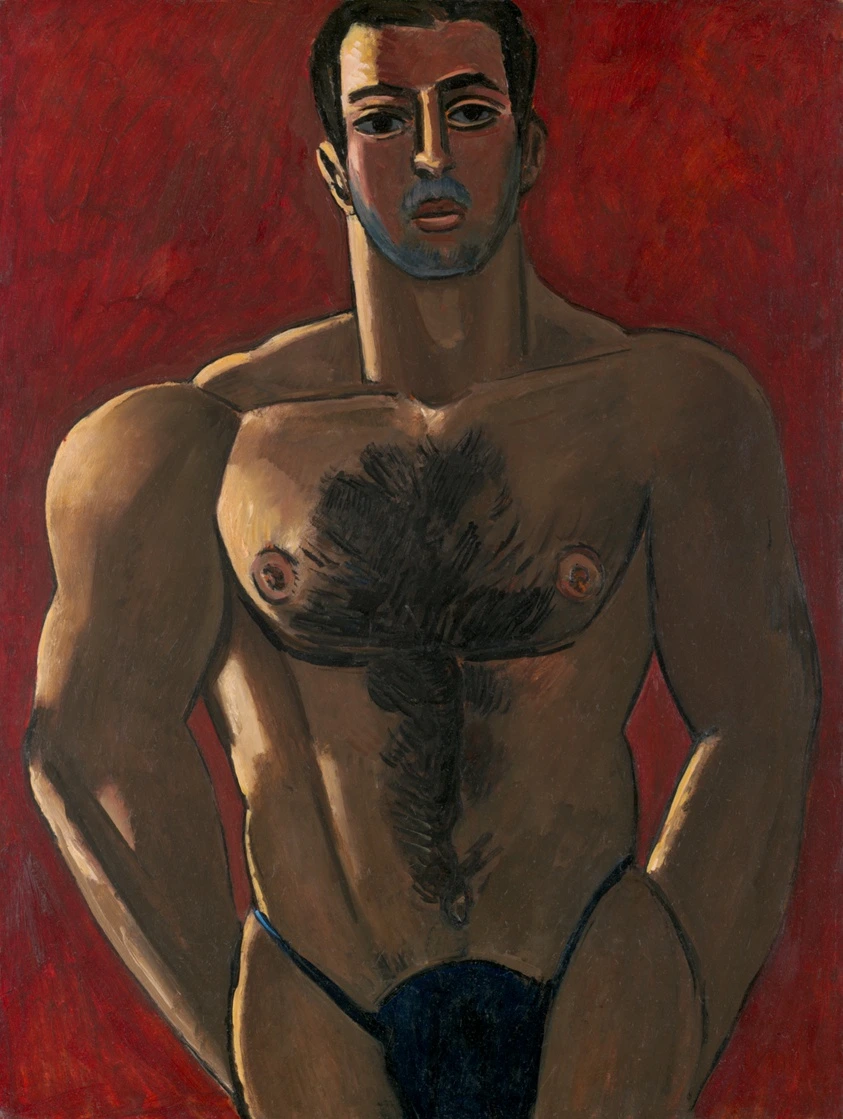
“I have for the first time since 1922 a real live model a magnificent young feller. . . . His body is so fine and dear I could work almost without end from him.” So wrote Marsden Hartley about Lionel Daigle, a French- Canadian boxer from the town of Madawaska, Maine, who modeled for a series of paintings by the artist. A Maine native himself, Hartley drew upon local types at this time to create a mythic view of the state’s inhabitants as rugged individualists. Hartley delighted in painting the man’s body, which allowed him to express his own sexuality. He emphasized Daigle’s strong physique, exaggerating his anatomy and originally painting him nude (subsequently adding the brief covering). Ironically, critics in the 1940s applauded the work as a display of heteronormative masculinity.

Provenance

Estate of the artist (no. 94); sold to Eva Lee Gallery, Grand Neck, NY, 1960; Alan Gallery, New York, by 1962; sold to A. James Speyer (1913–1986), Chicago, 1962; bequeathed to the Art Institute of Chicago, 1987.

Madawaska—Acadian Light-Heavy

Marsden Hartley

1940

Accession Number

70028

Medium

Oil on hardboard

Dimensions

101.6 × 76.2 cm (40 × 30 in.)

Classification

Painting

Museum

The Art Institute of Chicago

Chicago, United States

Credit Line

Bequest of A. James Speyer
Background & Context

Background Story

"Madawaska—Acadian Light-Heavy" is a 1940 oil on hardboard by Marsden Hartley that captures the American modernist painter in his most coloristically bold and regionally specific late mode, the image showing a scene from Madawaska, Maine rendered with the same flattened forms and vibrant colors that characterized his most powerful late works. The composition is a medium-large work—101.6 × 76.2 centimeters—showing the Acadian region with the oil on hardboard creating a surface of extraordinary coloristic intensity and regional pride. The hardboard support provides a smooth, stable ground that enhances the precision of the brushwork and the intensity of the color. The 1940 date places this work in the period of Hartley's return to Maine and his productive late period, when he was producing the paintings that celebrated the land and people of his native state. Art historians have connected this painting to the broader tradition of the regional landscape in American art, from the paintings of the Regionalists to the works of the period, noting that Hartley's treatment is more focused on the flattened forms and the coloristic boldness, the transformation of observed reality into regional celebration, than the topographical accuracy or the social documentation of these other traditions.

Cultural Impact

This 1940 oil hardboard made Acadia regionally bold through medium-large 101cm flattened vibrant color and stable regional pride, using productive late Maine period to transform native state landscape into regional celebration beyond Regionalist topographical social documentation.

Why It Matters

It matters because Hartley painted a Maine valley and made the hardboard feel like it was singing a folk song in colors that don't apologize for being loud—proving that even a hometown could be a festival if the paint was proud enough.