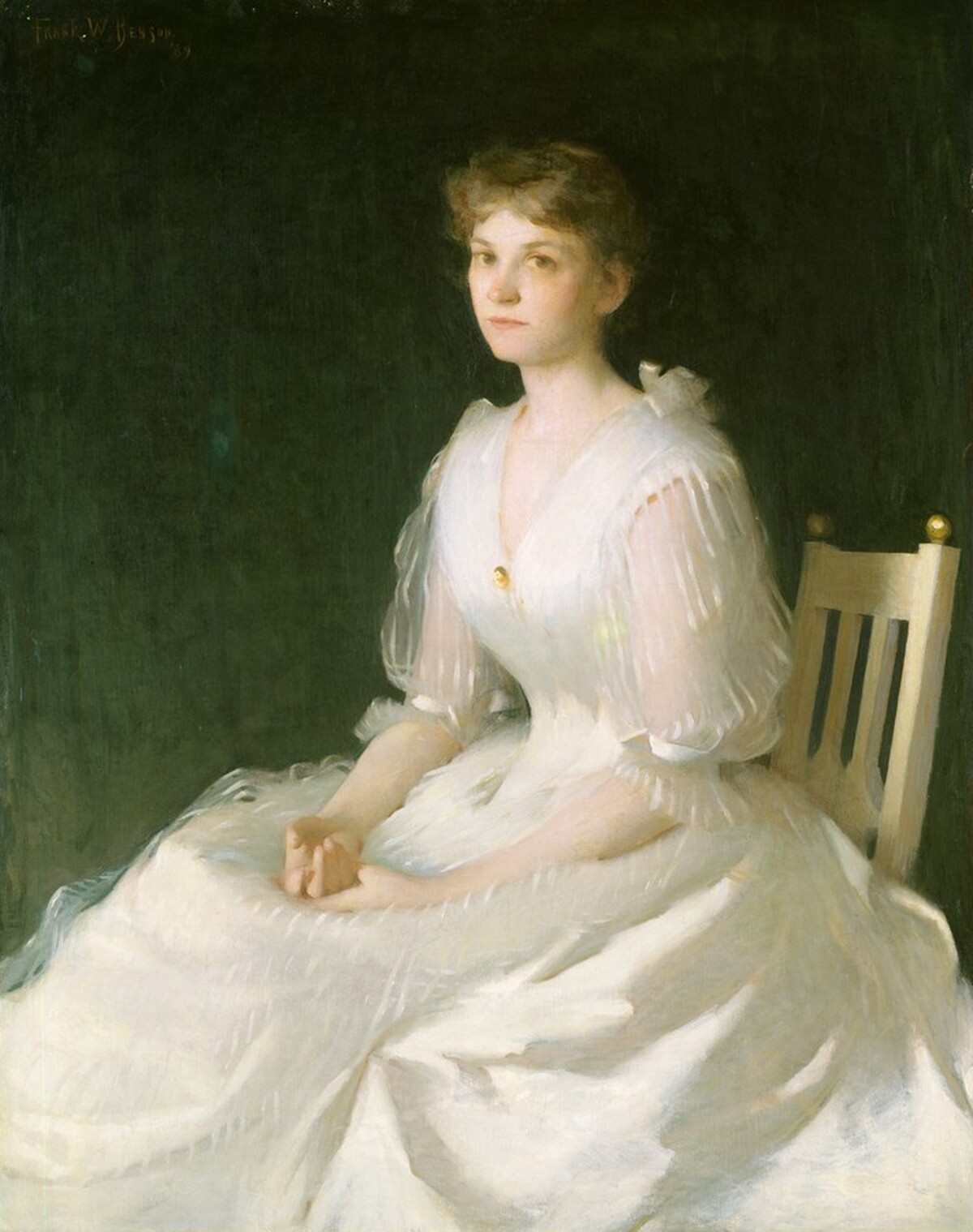
Provenance
The artist and his wife, Ellen Perry Peirson Benson, to 1951; Ellen Perry Peirson Benson [1860-1954], Salem, Massachusetts; her estate, 1954-1956; her daughter, Elisabeth Benson Rogers [Mrs. C.M.A. Rogers], Alabama, by 1956 or before; her sister, Sylvia Benson Lawson [Mrs. Ralph Lawson], Salem, Massachusetts, by 1976; bequest 1977 to NGA.
Accession Number
1977.4.1
Medium
oil on canvas
Dimensions
overall: 122.6 x 97.2 cm (48 1/4 x 38 1/4 in.) | framed: 134.6 x 109.2 x 4.4 cm (53 x 43 x 1 3/4 in.)
Classification
Painting
Credit Line
Gift of Sylvia Benson Lawson
Tags
Painting Impressionist & Modern (1851–1900) Oil Painting Canvas American
Background & Context
Background Story
Frank Weston Benson (1862-1951) was an American painter associated with the Boston School, known for his portraits, landscapes, and wildfowl paintings that combine Impressionist technique with sporting subjects. Portrait in White from 1889 is an early work, painted when Benson was just 27 and still developing the style that would make him one of Boston's most celebrated painters. The portrait demonstrates Benson's ability to render white fabric with the subtlety and luminosity that would become his signature—a skill that he would bring to full development in his later portraits of women in white dresses, which are among the most admired works in American Impressionism.
Cultural Impact
Benson's early portraits demonstrate the development of the style that would make him the leading portrait painter of the Boston School. Portrait in White shows the young artist already in command of the Impressionist technique of rendering light on white fabric—a skill that would reach its full development in his later portraits of women in white dresses that fill the canvas with reflected light and tonal subtlety.
Why It Matters
Portrait in White is young Benson finding his signature: white fabric rendered with the subtlety and luminosity that would make his later portraits of women in white dresses among the most admired works in American Impressionism. The 1889 portrait shows the skill already in place, waiting for the style that would bring it to full development.