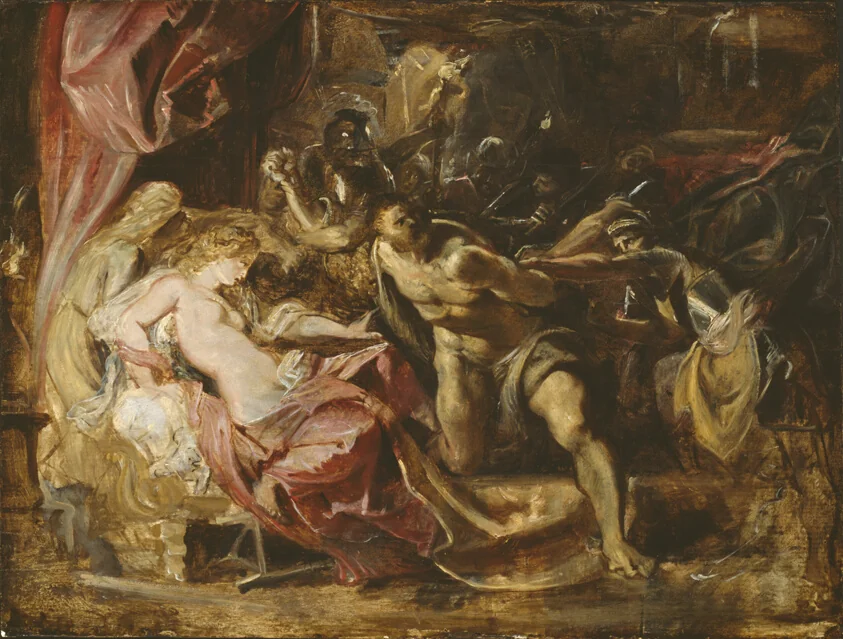
The Capture of Samson

Description

This panel, made as a sketch for a larger painting commissioned by the mayor of Antwerp, Nicolas Rockox, demonstrates the influence of the ancient and modern art Peter Paul Rubens studied in Italy. The subject comes from a story in the Hebrew Bible in which the mighty Samson awakes to find that his lover, Delilah, has cut off his hair, the source of his strength. Rubens drew from ancient Roman sculpture for Samson’s contorted pose as he is captured by soldiers, while the strong contrast of light and dark recalls the work of 16th-century Italian painter Tintoretto—for example, Tarquin and Lucretia.

Provenance

Probably in the collection of the artist, Antwerp, until his death in 1640 and then included in a large lot of oil sketches in his estate sale, 1642 [Jeffrey M. Muller, “Oil-Sketches in Rubens’s Collection,” Burlington Magazine 117 (1975), pp. 374-75, and Held 1980, p. 11, argue that the oil sketches were disposed of in this way]. Frank T. Sabin Gallery, London, by 1914 [Arundel Club 1914, no. 14]; sold through W.R. Valentiner to the Art Institute, November 1923 [as by Van Dyck, according to a letter of August 1, 1923 from Valentiner to Robert Harshe in Art Institute archives and receipt from Sabin dated November 5, 1923, copies in curatorial file].

The Capture of Samson

Peter Paul Rubens

1609–10

Accession Number

8953

Medium

Oil on panel

Dimensions

50.4 × 66.4 cm (19 3/4 × 26 1/8 in.); Framed: 73.3 × 89.5 × 12.1 cm (28 7/8 × 35 1/4 × 4 3/4 in.)

Classification

oil on panel

Museum

The Art Institute of Chicago

Chicago, United States

Credit Line

Robert A. Waller Memorial Fund

Background & Context

Background Story

"The Capture of Samson" is an early masterpiece from Rubens's Italian period (1600–1608), painted shortly after his arrival in Rome and his first exposure to the antiquities and Renaissance masters that would transform his style. The panel depicts the moment when Delilah summons the Philistines to capture the sleeping Samson, his hair—the source of his strength—already cut and lying on the ground beside the treacherous woman. The composition is a tour de force of Baroque dynamism: figures twist and strain in exaggerated poses that recall the ancient sculptures Rubens was drawing in the Vatican galleries, while the color is warmer and more saturated than in his Flemish predecessors. The treatment of the female nude is particularly significant; Delilah is rendered with the full corpulence that would become Rubens's signature, her pale flesh contrasting with the darker tones of the soldiers and the shadowed interior. This early work already demonstrates the synthesis that would define his mature style: Italian grandeur of form combined with Flemish attention to surface texture and coloristic harmony. The panel also reveals Rubens's engagement with the print culture of his time; the subject was popular in sixteenth-century Netherlandish engraving, and Rubens's composition may respond to specific prototypes by Lucas van Leyden or Maerten van Heemskerck. The violence of the scene is handled with characteristic Rubensian exuberance rather than moral judgment; the artist seems to delight in the physical struggle for its own sake, setting aside the biblical moral to explore the possibilities of painted movement.

Cultural Impact

This early panel announced Rubens's mature synthesis of Italian monumental form and Flemish color, transforming a biblical betrayal into a celebration of physical dynamism.

Why It Matters

It matters because a haircut became a wrestling match—Rubens proving that even Bible stories could be about bodies in motion.