Description
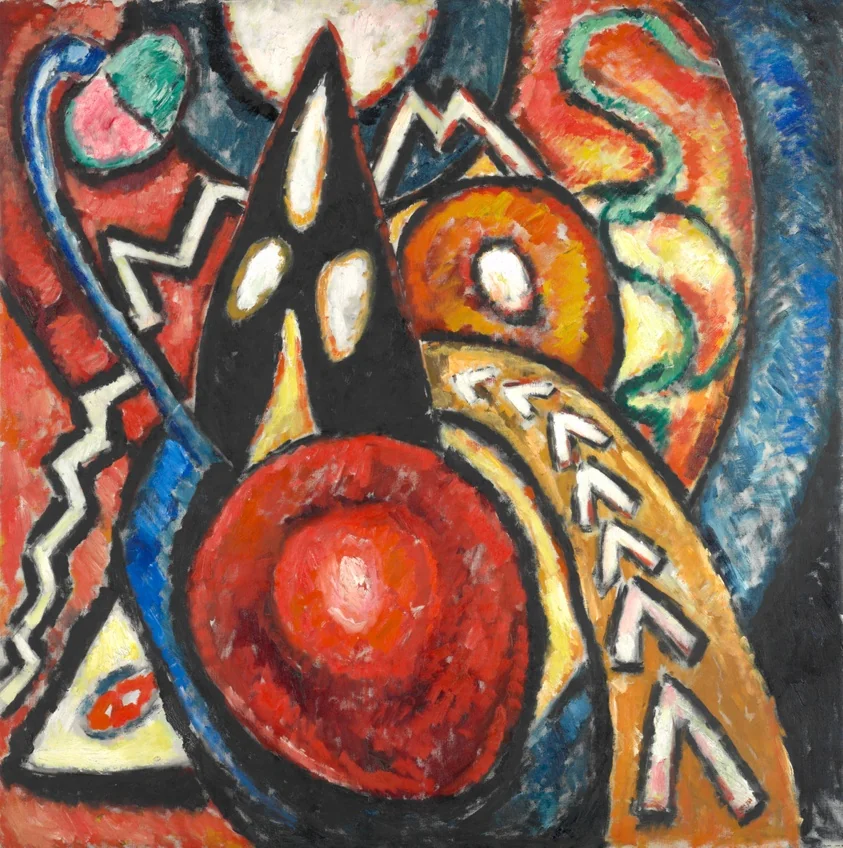
Unlike many other American artists, Marsden Hartley was more drawn to German Expressionism than to French modernism, and executed this painting in Berlin. Made on the eve of World War I, Movements possesses a turbulent energy that sparks associations with both the vibrancy of modern Berlin and movements of music. Like the Russian Expressionist painter Vasily Kandinsky, Hartley sought to make his work more like music, which he admired for its nonnarrative nature and its potential to be purely spiritual or separate from material reality.
Provenance
Alfred Stieglitz Collection, New York City; bequeathed through Georgia O'Keeffe to the Art Institute of Chicago, 1949.
Accession Number
65916
Medium
Oil on canvas
Dimensions
119.5 × 119 cm (47 × 46 7/8 in.)
Classification
oil on canvas
Credit Line
Alfred Stieglitz Collection
Background & Context
Background Story
Marsden Hartley's Movement (1913) is an oil on canvas from the period when Hartley was most strongly influenced by German Expressionism and abstract art. The title Movement suggests the dynamic energy of the composition, which likely features abstract forms that evoke movement and rhythm. Hartley's works from this period are among his most radical, showing the influence of Kandinsky and the Blue Rider group. The palette is vibrant, the forms are abstract and energetic.
Cultural Impact
Hartley's abstract works of 1913 represent his engagement with the most advanced European modernist movements.
Why It Matters
This abstract composition captures the energy of movement, Hartley's vibrant colors and dynamic forms showing the influence of German Expressionism.