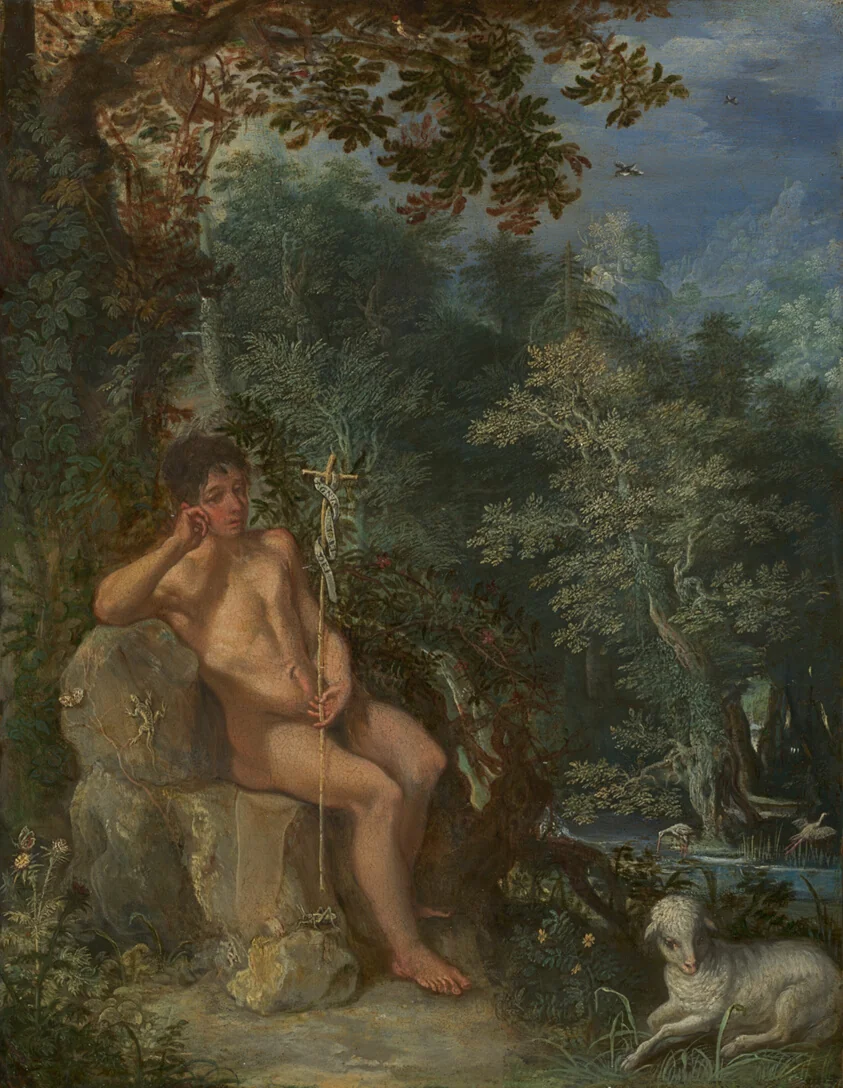
Saint John the Baptist in the Wilderness

Description

Adam Elsheimer’s small paintings on copper show his remarkable ability to create imaginary, highly composed landscapes. On his arrival in Rome in 1600, Elsheimer was inspired by the city’s antique monuments and its extraordinary artistic environment. In this work, the wooded landscape teeming with wildlife is indebted to painting from Northern Europe, while the youthful saint echoes ancient Greek and Roman sculpture in a pose that reveals both his active mind and his physical strength. Though Elsheimer died in Rome at a relatively young age, his painting profoundly influenced his fellow artists, including Peter Paul Rubens.

Saint John the Baptist in the Wilderness

Adam Elsheimer

c. 1605

Accession Number

213758

Medium

Oil on copper

Dimensions

21 × 16.3 cm (8 1/4 × 6 3/8 in.); Framed: 33 × 26.7 × 2.5 cm (13 × 10 1/2 × 1 in.)

Classification

Painting

Museum

The Art Institute of Chicago

Chicago, United States

Credit Line

Lacy Armour Fund, Chester D. Tripp Estate Fund, European Painting General Sales Proceeds, Mrs. Albert Beveridge Fund, Rhoades Foundation


Background & Context

Background Story

Adam Elsheimer's "Saint John the Baptist in the Wilderness" (c. 1605) is a small but luminous oil on copper painting that exemplifies the artist's revolutionary approach to landscape and religious narrative. Elsheimer (1578–1610) was a German painter who spent most of his brief career in Rome, where he became a central figure in the vibrant community of Northern European artists. Despite his short life—he died at 32—his influence was enormous, particularly on Rembrandt and Claude Lorrain. This painting shows John the Baptist as a solitary figure in a densely wooded landscape, his traditional attributes (the lamb, the cross-shaped staff) subtly integrated into the natural setting. Elsheimer's technique is extraordinary: working on copper allowed him to achieve remarkable detail and a jewel-like luminosity. The painting measures only about 20 cm across, yet it contains a universe of observed natural detail—every leaf, every rock formation, every gradation of light is rendered with miniaturist precision. The composition leads the eye from the dark foreground through middle-ground clearings to a distant, luminous horizon, a spatial device that would become central to landscape painting.

Cultural Impact

Elsheimer's combination of meticulous natural observation with poetic atmosphere made him a crucial precursor to the great age of landscape painting in the 17th century, influencing Claude, Rembrandt, and generations of Northern European artists.

Why It Matters

This small copper panel contains the seeds of modern landscape painting: the integration of human figures into a natural world rendered with scientific precision and spiritual depth, all within a format small enough to hold in one's palm.