Description
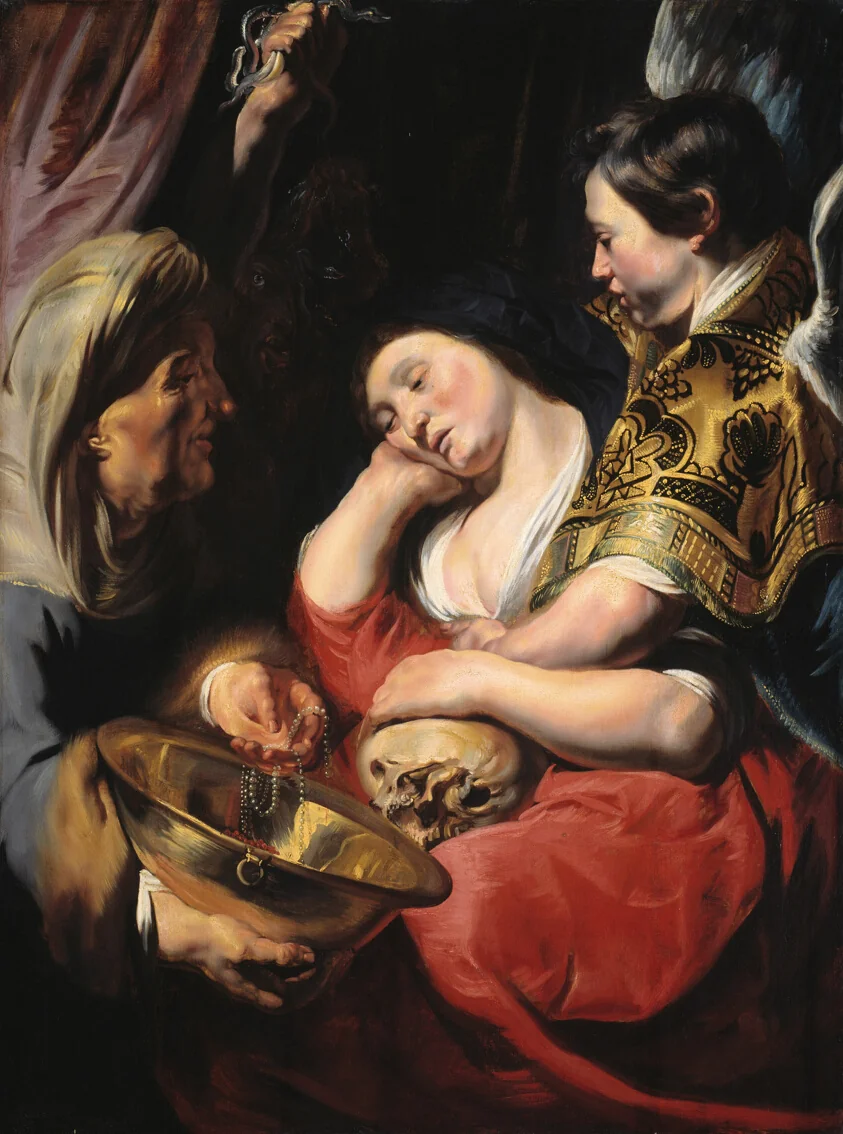
In this half-length biblical painting, an aged woman offering tempting jewels—possibly the proprietor of a brothel—and an angel bestowing spiritual guidance battle for the soul of Mary Magdalene. A ghoulish demon emerges from the shadows in the background with a fistful of snakes, a menacing symbol of evil. Jacob Jordaens had already developed his own rich realism, with earthy figures and naturalistic shadows, by the time he executed this early work, probably for an upper-class home in his native Antwerp.
Provenance
Private collection, Brussels, 1928 [see Brussels 1928, no. 34]. Édouard Napoléon César Edmond Mortier, duc de Trévise (died 1946), Paris [according to Jaffé in Ottawa 1968; it was not part of his sale in Paris, May 19, 1938]. Sold, Palais des Beaux Arts, Brussels, March 12, 1951, no. 57. Morris I. Kaplan (died 1966), Chicago; offered for sale, Sotheby's , London, June 12, 1968, no. 56, bought in; heirs of Morris I. Kaplan (on loan to the Art Institute of Chicago since 1969); sold to the Art Institute, 1991.
Accession Number
111613
Medium
Oil on panel
Dimensions
126.2 × 96.8 cm (49 11/16 × 38 1/4 in.); Framed: 155.6 × 130.2 × 12.7 cm (61 1/4 × 51 1/4 × 5 in.)
Classification
oil on panel
Credit Line
Charles H. and Mary F. S. Worcester Collection; anonymous gift in honor of Kate and Morris Kaplan
Background & Context
Background Story
"The Temptation of the Magdalene" is a c. 1616 oil on panel by Jacob Jordaens that captures the Flemish Baroque master in his most dramatically narrative and morally complex mode, the image showing Mary Magdalene tempted by worldly vanities with the same robust physicality and rich coloration that characterized the entire Flemish tradition. The composition is a large panel—126.2 × 96.8 centimeters—showing the Magdalene in a luxurious interior with the temptations of the flesh rendered with the thick, tactile brushwork and the warm, saturated palette that suggest both the physical reality of the worldly pleasures and the spiritual danger of the moral narrative. The oil on panel creates a surface of extraordinary depth and luminosity, the wood support enhancing the warmth and richness of the colors. The c. 1616 date places this work in the period of Jordaens's early maturity, when he was producing the paintings that established his reputation as the leading successor to Rubens in the Flemish Baroque tradition. Art historians have connected this painting to the broader tradition of the Magdalene in Baroque art, from the paintings of Titian to the sculptures of Bernini, noting that Jordaens's treatment is more focused on the robust physicality and the moral drama, the transformation of sacred narrative into vivid human theater, than the spiritual ecstasy or the idealized beauty of these other traditions.
Cultural Impact
This c. 1616 oil panel made Magdalene temptation robustly theatrical through large 126cm thick tactile brushwork warm saturated palette and wood-support luminous depth, using early Flemish maturity to transform sacred narrative into vivid moral human theater beyond Titian spiritual ecstasy.
Why It Matters
It matters because Jordaens painted a woman being tempted and made the panel feel like it was whispering warnings about vanity—proving that even a sin could be beautiful if the color was warm enough.