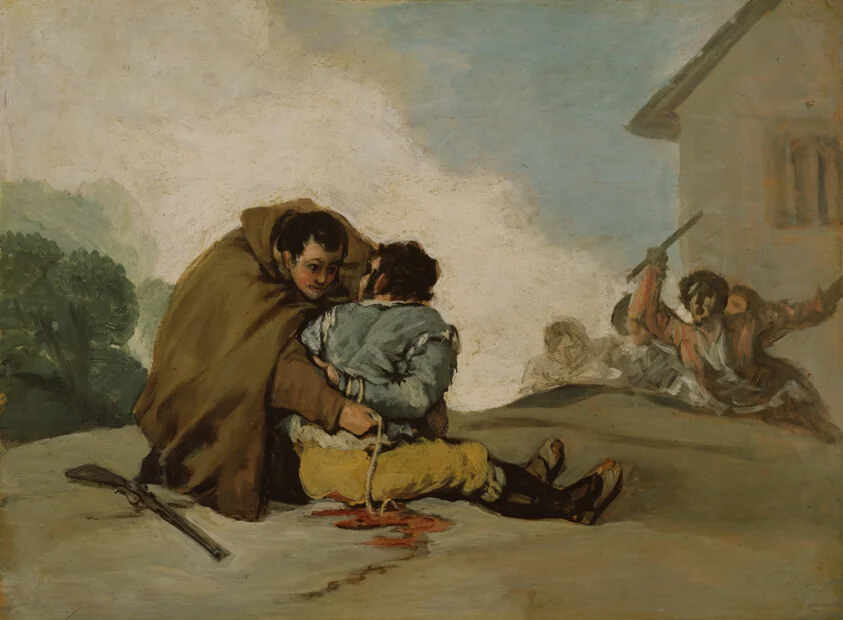
Friar Pedro Binds El Maragato with a Rope

Description

In small, lively paintings made for his own pleasure or for a few discerning patrons, Francisco de Goya explored satirical and popular aspects of Spanish life. This series was inspired by a contemporary event, the capture of notorious criminal El Maragato by Friar Pedro de Saldivia in 1806. After escaping from prison, El Maragato spent two months stealing food, guns, and money before trying to take Friar Pedro and other innocent people hostage. The friar outsmarted the bandit, however, seizing his gun, shooting him in the thigh as he tried to flee, and finally tying him up. This story was extremely popular in the early 19th century and Spanish artists memorialized it in images, poems, and songs.

Provenance

One of a series of six small paintings in an inventory of Goya’s collection, Madrid, taken in 1812 for the division of property between the artist and his son Javier following the death of the artist's wife; the group of small paintings marked X8 being allotted to the son: "Seis quadros del Maragato señalados con el número ocho, en 700 [reales]" (the inventory mark has been removed from the painting and is no longer visible) [see Gassier and Wilson 1971]; presumably Javier Goya after 1812. Lafitte collection, Madrid; sale, Paris, Hôtel Drouot, March 7, 1861, bought in together with other paintings from the series for 590 francs [see Hippolyte Mireur, Dictionnaire des ventes (Paris, 1914), vol. 3, p. 360 and Despartment Fitz-Gerald 1928-1950]. Julius Böhler, Munich by 1911; sold to Martin Ryerson (died 1932), Chicago in May 1911 [see purchase receipt dated May 13, 1911]; bequeathed to the Art Institute, 1933.

Friar Pedro Binds El Maragato with a Rope

Francisco José de Goya y Lucientes

c. 1806

Accession Number

16365

Medium

Oil on panel

Dimensions

29.2 × 38.5 cm (11 1/2 × 15 5/8 in.); Framed: 41.6 × 51.2 × 6.4 cm (16 3/8 × 20 1/8 × 2 1/2 in.)

Classification

Painting

Museum

The Art Institute of Chicago

Chicago, United States

Credit Line

Mr. and Mrs. Martin A. Ryerson Collection

Background & Context

Background Story

The final scene of the Friar Pedro series, painted around 1806, shows the aftermath of capture: the monk kneels to bind the defeated bandit with a rope, the struggle giving way to a strange intimacy between captor and captive. The composition is quieter than the preceding panels, its horizontal format and lower center of gravity conveying the exhaustion that follows violence. Pedro's white habit spreads across the foreground like a benediction, while El Maragato lies passive in a posture that recalls deposition scenes from Christian art. This possible subtext—the criminal as a fallen Christ figure restrained by religious authority—adds a layer of theological ambiguity that complicates the apparent moral triumph. Goya's treatment of the bound hands is particularly sensitive, the rope rendered with the same precision he devoted to royal jewelry, suggesting that restraint itself is a form of power worth recording. The background continues the earthy palette of the series, with the Spanish meseta stretching toward a distant horizon that promises continuation beyond the frame. Together, the six panels constitute one of the most important narrative sequences in European art before Rodin's Gates of Hell, demonstrating that painting could tell stories across time as effectively as literature or theater. The survival of this final panel is especially important, as it provides the moral resolution that popular audiences demanded and that Goya was willing to supply, at least in his early career.

Cultural Impact

This concluding panel resolves narrative violence with moral ambiguity, revealing Goya's early interest in the psychology of power and submission that would define his mature work.

Why It Matters

It matters as the end of a story—where victory looks suspiciously like mercy, and a bandit becomes almost holy in defeat.