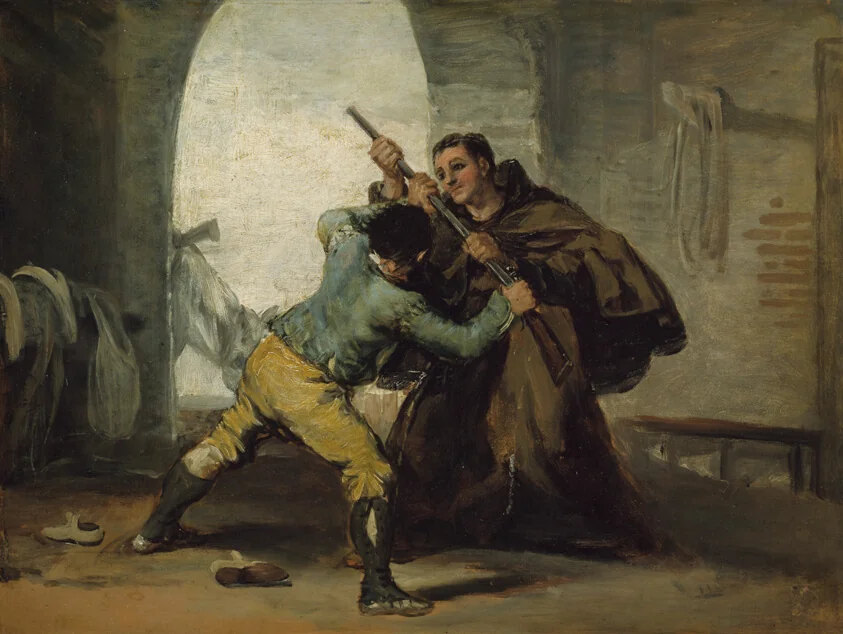
Friar Pedro Wrests the Gun from El Maragato

Description

In small, lively paintings made for his own pleasure or for a few discerning patrons, Francisco de Goya explored satirical and popular aspects of Spanish life. This series was inspired by a contemporary event, the capture of notorious criminal El Maragato by Friar Pedro de Saldivia in 1806. After escaping from prison, El Maragato spent two months stealing food, guns, and money before trying to take Friar Pedro and other innocent people hostage. The friar outsmarted the bandit, however, seizing his gun, shooting him in the thigh as he tried to flee, and finally tying him up. This story was extremely popular in the early 19th century and Spanish artists memorialized it in images, poems, and songs.

Provenance

One of a series of six small paintings in an inventory of Goya’s collection, Madrid, taken in 1812 for the division of property between the artist and his son Javier following the death of the artist's wife; the group of small paintings marked X8 being allotted to the son: "Seis quadros del Maragato señalados con el número ocho, en 700 [reales]" (the inventory mark has been removed from the painting and is no longer visible) [see Gassier and Wilson 1971]; presumably Javier Goya after 1812. Lafitte collection, Madrid; sale, Paris, Hôtel Drouot, March 7, 1861, bought in together with other paintings from the series for 590 francs [see Hippolyte Mireur, Dictionnaire des ventes (Paris, 1914), vol. 3, p. 360 and Despartment Fitz-Gerald 1928-1950]. Julius Böhler, Munich by 1911; sold to Martin Ryerson (died 1932), Chicago in May 1911 [see purchase receipt dated May 13, 1911]; bequeathed to the Art Institute, 1933.

Friar Pedro Wrests the Gun from El Maragato

Francisco José de Goya y Lucientes

c. 1806

Accession Number

16355

Medium

Oil on panel

Dimensions

29.2 × 38.5 cm (11 1/2 × 15 3/8 in.); Framed: 41.9 × 51.1 × 6.4 cm (16 1/2 × 20 1/8 × 2 1/2 in.)

Classification

Painting

Museum

The Art Institute of Chicago

Chicago, United States

Credit Line

Mr. and Mrs. Martin A. Ryerson Collection

Background & Context

Background Story

This oil panel, painted around 1806, belongs to a six-part narrative series depicting the capture of the bandit El Maragato by the Augustinian friar Pedro de Zaldivia. The story was a popular Spanish folk legend: the monk, traveling through the countryside, encounters the notorious outlaw and, despite being unarmed, manages to disarm and subdue him through courage and resourcefulness. Goya's treatment transforms the popular print tradition into high art, using the small panel format to create an intimate yet dramatic sequence comparable to cinema storyboards. In this first scene, Friar Pedro seizes the bandit's musket, the composition frozen at the moment of maximum tension as the two figures struggle in the foreground while a terrified horse rears behind them. The palette is earthy and restrained—browns, ochres, and muted greens suggesting the dusty Spanish meseta—while the brushwork combines the precision of Goya's tapestry cartoons with the urgency of his later war scenes. The series also reflects Goya's interest in the moral possibilities of violence: the monk's triumph is not physical domination but the defeat of criminality by virtue, a theme that would acquire bitter irony when Goya witnessed the Napoleonic invasion and the collapse of Spanish order. These panels are among the least known of Goya's major works, rarely reproduced in general surveys, yet they demonstrate his narrative genius and his ability to make moral drama visible through gesture and spatial tension.

Cultural Impact

This narrative panel transforms Spanish folk legend into visual cinema, demonstrating Goya's storytelling genius and prefiguring sequential art formats from comic strips to film storyboards.

Why It Matters

It matters as a monk versus bandit—Goya proving that moral courage could be as visually thrilling as military heroism.