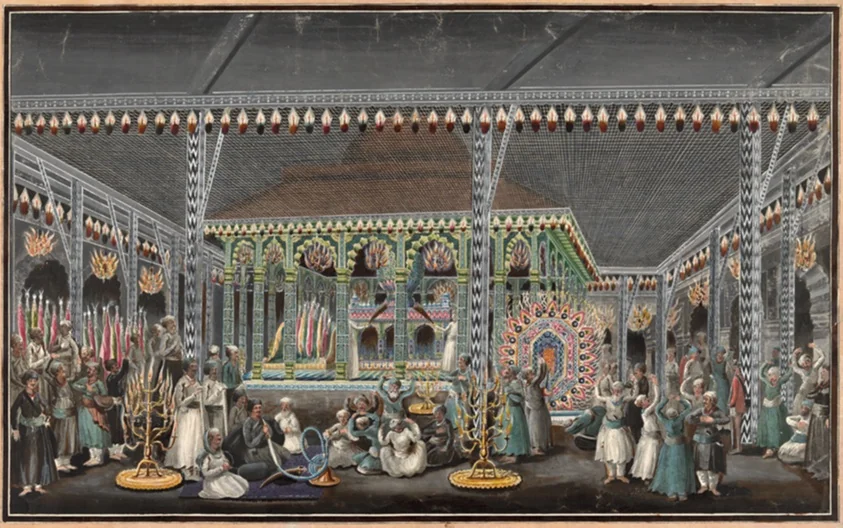
The Nawab Attending the Muharram Festival in the Imambara at Murshidabad
1795–1810
Accession Number
240347
Medium
Watercolor on watermarked paper
Dimensions
Folio: 50 × 77 cm (19 11/16 × 30 5/16 in.); Painting: 42.8 × 59.5 cm (16 13/16 × 23 7/16 in.)
Classification
Painting
Credit Line
Chicago Collectors Circle and Asian Art Discretionary funds
Background & Context
Background Story
This vibrant watercolor depicts a Nawab of Bengal attending the Muharram festival—an important Shia Islamic commemoration of the martyrdom of Imam Hussein—at the grand Imambara complex in Murshidabad, then the capital of Bengal under Nawab rule. The painting captures the elaborate procession with its towering tazia (replica shrines) being carried through the streets, surrounded by rows of mourners and flag-bearers. The Imambara itself looms in the background, its Mughal-inspired architecture rendered in meticulous detail with domes, arched gateways, and minarets. The artist employs the refined technique of Company School painting, blending traditional Indian miniature conventions with European perspective and naturalistic color that British patrons demanded. The composition draws the eye from the foreground figures across the processional route toward the architectural backdrop, creating a sweeping panorama of public ceremony. Murshidabad was one of the last great centers of Indo-Islamic court culture before British colonial rule fully eclipsed native governance, and this painting serves as both celebration and documentation of a cultural tradition that continued even as political power shifted.
Cultural Impact
This painting is a rare visual document of Muharram observances in late Mughal Bengal, preserving details of architectural spaces, ceremonial practices, and courtly dress that photography would not capture for another half-century. The Company School genre it represents marks a pivotal moment when Indian artists adapted their traditions to new patronage structures, creating a hybrid visual language that influenced colonial-era art across the subcontinent.
Why It Matters
A significant Company School painting documenting Indo-Islamic ceremonial life in late 18th-century Bengal, bridging Mughal artistic tradition and European pictorial conventions during a period of political transformation.
![Saint Bernard and Saint Catherine of Alexandria with the Virgin of the Annunciation [right panel]](https://api.nga.gov/iiif/e6890364-4d99-4684-a62b-5060ee3c3446/full/400,/0/default.jpg)