Provenance
Paul Rosenberg (1881–1959), Paris. Valentine Gallery, New York, by Jan. 1931 [New York 1931]. Lefevre Gallery, London, by June 1931 [London 1931]. Galerie Georges Petit, Paris, 1932 [Paris 1932]. W. Rees Jeffreys, Wivelsfield Green, Sussex, England, by 1936 [London 1936]. Lefevre Gallery, London, 1953 [London 1953]. Sold through Zwemmer Gallery, London, to the Art Institute, 1955.
Accession Number
109278
Medium
Oil on panel
Dimensions
66 × 49.2 cm (26 × 19 3/8 in.)
Classification
Painting
Credit Line
Gift of Florene May Schoenborn and Samuel A. Marx; Wilson L. Mead Fund
Background & Context
Background Story
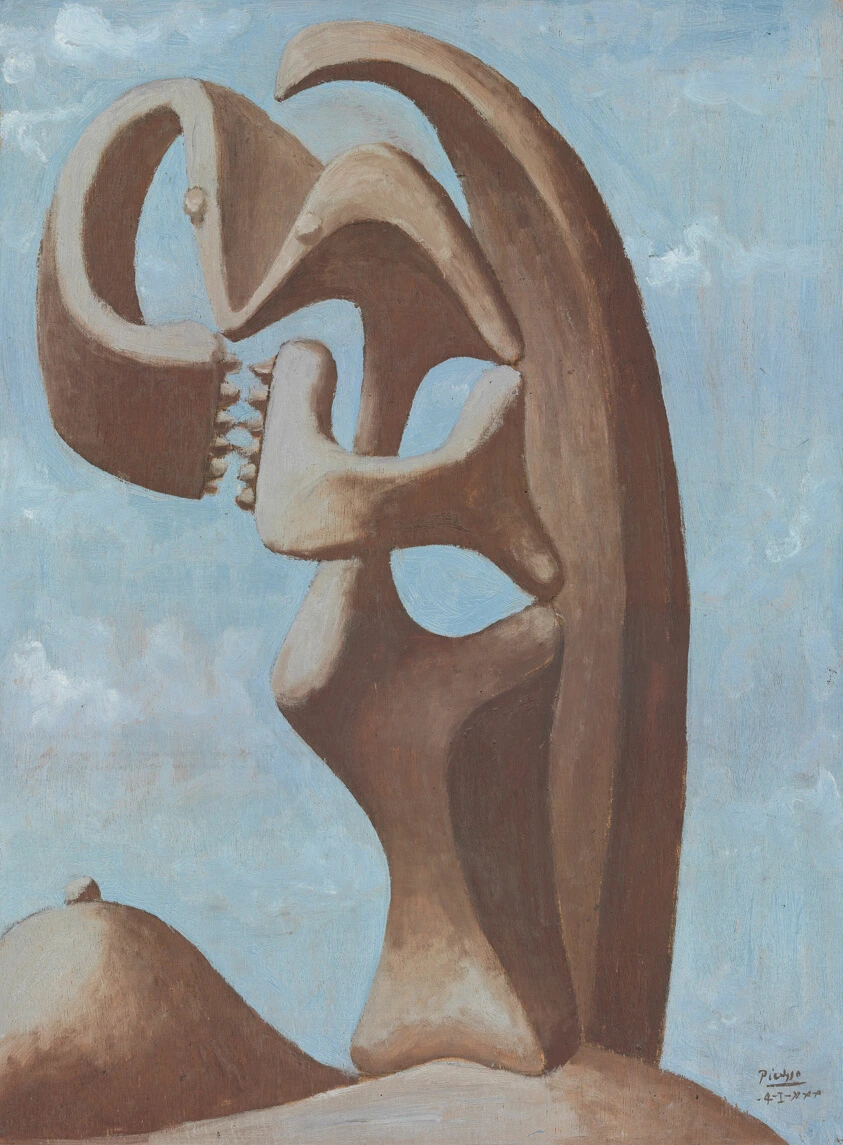
Dated January 4, 1930, this oil on panel belongs to a crucial moment in Picasso's career when he was exploring the boundary between abstraction and representation under the influence of Surrealism and his secret relationship with Marie-Thérèse Walter. The canvas is divided between a lower region of fluid, biomorphic shapes in warm ochre and pink, and an upper zone of pale blue and white that evokes a sky veiled by cirrus clouds. This bipartite structure recalls the horizon line in classical landscape painting while dissolving its components into non-representational color fields. The panel format—small and intimate compared to his monumental canvases—suggests that this was a private experiment rather than a public statement, a laboratory for ideas that would later inform larger compositions. The paint handling is extraordinarily sensuous, with thin veils of color layered to create optical depth without perspectival illusion. Art historians have connected this work to the contemporary development of abstract Surrealism by Miró and Arp, though Picasso's abstraction always retained a root in observed reality that his Catalan colleague was willing to abandon. The date is significant: January 1930 places the work just before Picasso's first Museum of Modern Art retrospective in New York, when he was simultaneously consolidating his reputation and escaping its constraints. The painting also documents the physical pleasure that Picasso took in oil paint itself—the smell, the texture, the resistance of the panel—at a moment when many avant-garde artists were turning to industrial materials and photomechanical reproduction.
Cultural Impact
This panel bridged Surrealist biomorphism and Color Field abstraction, revealing Picasso's private experiments with pure paint at a moment of international consolidation.
Why It Matters
It matters as proof that even Picasso needed to play in private—making a sky out of color to see what might happen below.