Provenance
The artist [1857-1934]; his wife, Gertrude Mauran Vail, until 1948; on deposit with the National Collection of Fine Arts (now National Museum of American Art), Washington, D.C., 1948-1973; gift 1973 to NGA.
Accession Number
1973.1.1
Medium
oil on canvas
Dimensions
overall: 82 x 92.6 cm (32 5/16 x 36 7/16 in.) | framed: 100 x 111.1 cm (39 3/8 x 43 3/4 in.)
Classification
Painting
Credit Line
Gift of Gertrude Mauran Vail
Tags
Painting Early Modern (1901–1950) Oil Painting Canvas American
Background & Context
Background Story
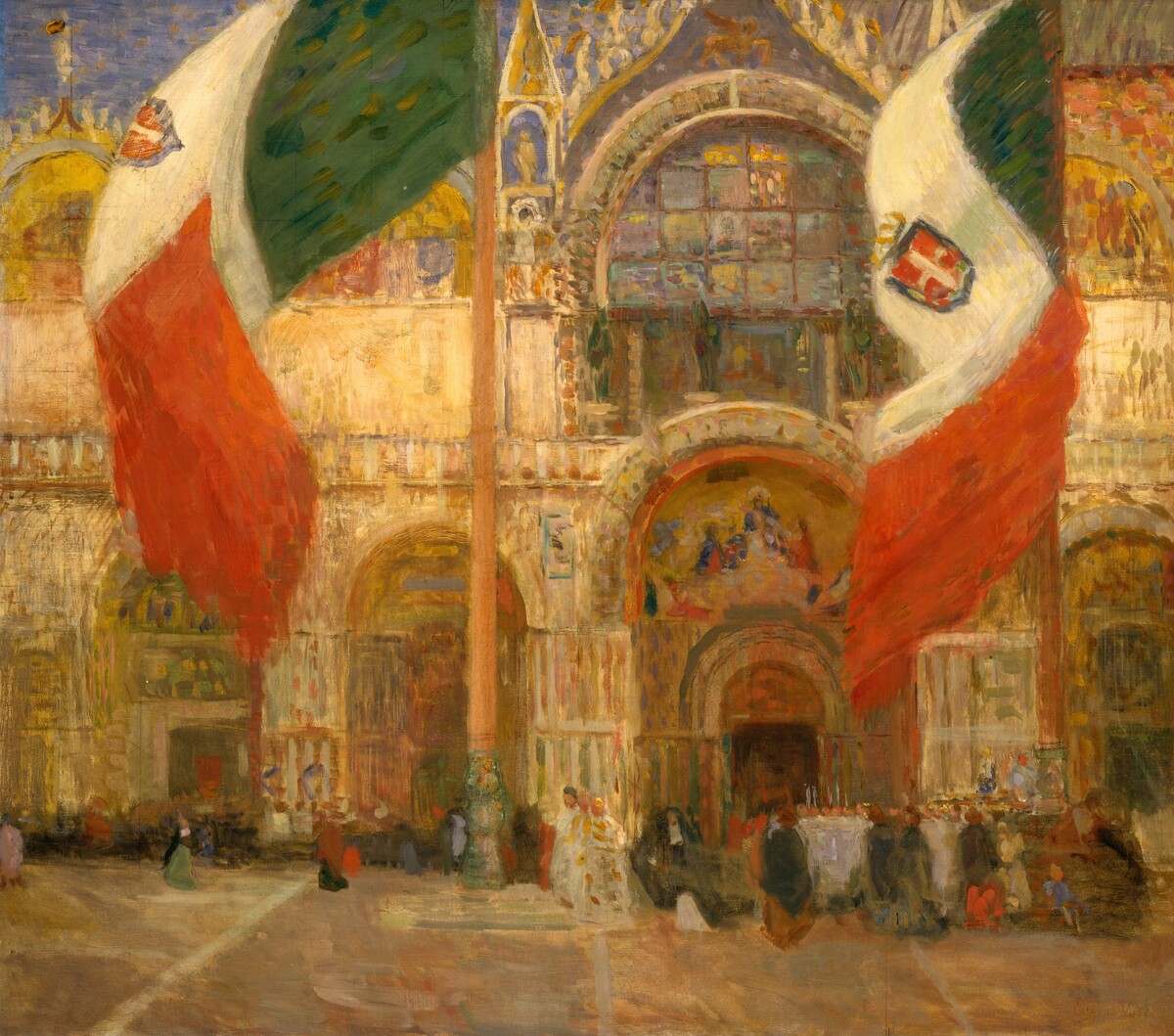
Eugène Vail (1857-1934) was a French-American painter known for his atmospheric scenes of European cities, particularly Venice, rendered in the Impressionist-influenced manner that combines atmospheric effect with architectural precision. The Flags, Saint Mark's, Venice - Fete Day from c. 1903 depicts the Piazza San Marco on a feast day with flags and crowds in the atmospheric manner that distinguishes Vail's Venetian scenes. The c. 1903 date places this in Vail's most productive period, when he was producing the Venetian scenes for which he is best known, and the feast day subject allows him to combine architectural precision with the atmospheric effect of light on the piazza and its decorations.
Cultural Impact
The Flags, Saint Mark's, Venice - Fete Day is important in Vail's oeuvre because it demonstrates the atmospheric effect and architectural precision that distinguish his best Venetian scenes. The feast day subject—flags, crowds, and light on the Piazza San Marco—allows Vail to combine the Impressionist atmospheric effect with the topographical precision of architectural painting, creating a type of Venetian scene that is simultaneously atmospheric and topographically accurate.
Why It Matters
The Flags, Saint Mark's, Venice - Fete Day is Vail's atmospheric Venetian scene at its best: the Piazza San Marco on a feast day with flags, crowds, and light rendered with the combination of atmospheric effect and architectural precision that distinguishes his work. The c. 1903 painting combines Impressionist atmosphere with topographical accuracy.