Provenance
Possibly (Galerie Pierre, Paris);[1] Mary Callery [1903-1977], Boulogne-sur-Seine and New York, by 1939.[2] Carlo Frua de Angeli [1895-1969], Milan, by 1959;[3] his estate; purchased May 1972 by (Galerie Beyeler, Basel);[4] purchased 5 October 1972 by NGA.
[1] Speculation that the painting was originally in Gertrude Stein's collection in Paris appears to be incorrect, despite the presence of a label on the back of the painting with the name "Mlle Toklas" and an address she shared with Stein on it. See the letter, 27 September 1972, from Margaret Potter, former curator at the Museum of Modern Art, to NGA curator John Bullard; in NGA curatorial files, as well as the 1977 statement of Daniel-Henry Kahnweiler quoted in Anne Carnegie Edgerton, "Picasso's 'Nude Woman' of 1910," _The Burlington Magazine_ (July 1980).
The appendix of Edgerton's article also discusses a letter from Pierre Loeb dated 22 March 1939 that concerns payment for a "Nu époque cubiste." Informed about this letter in 1977 by Mary Callery's niece and executrix, Edgerton speculates that it probably refers to the NGA painting.
[2] The American sculptor Mary Callery lent the painting to a Picasso exhibition in New York in 1939, and all of the published references during her ownership give her name as "Mrs. Meric Callery." She was married twice, to Frederic R. Coudert, Jr., from June 1923 to May 1931, and for two years, beginning in May 1934, to the Italian industrialist and collector Carlo Frua de Angeli (she was his second wife).
[3] The painting is identified as in a private collection in Milan in John Golding, _Cubism: A History and an Analysis_, New York, 1959: 87, pl. 9b, which was likely that of Frua de Angeli. The collector lent the painting to a 1960 exhibition in London. He and Mary Callery were married for two years, 1934 to 1936, and it is possible he acquired the painting directly from her.
[4] Letter, 9 December 1974, Ernst Beyeler to J. Carter Brown, in NGA curatorial files.
Accession Number
1972.46.1
Medium
oil on canvas
Dimensions
overall: 187.3 x 61 cm (73 3/4 x 24 in.) | framed: 215.3 x 88.9 x 6.9 cm (84 3/4 x 35 x 2 11/16 in.)
Classification
Painting
Credit Line
Ailsa Mellon Bruce Fund
Tags
Painting Early Modern (1901–1950) Oil Painting Canvas Spanish
Background & Context
Background Story
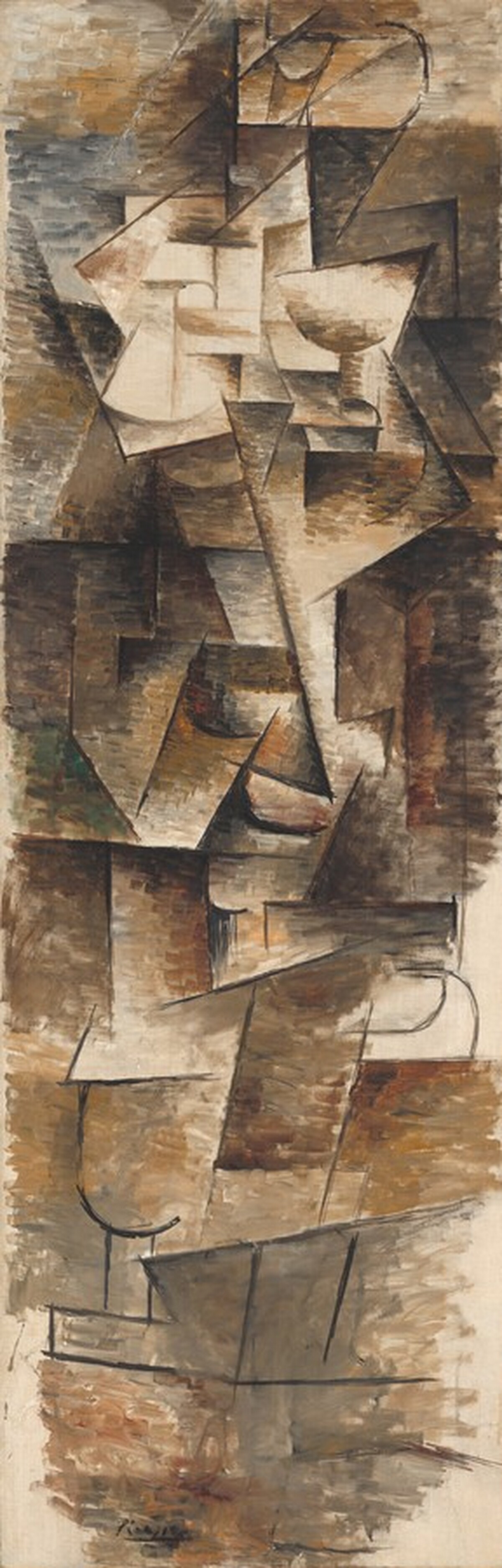
Painted in 1910, Nude Woman is a quintessential work of Analytical Cubism - the revolutionary style Picasso and Georges Braque developed between 1909 and 1912. The painting reduces the human figure to a shimmering architecture of faceted planes, angled facets, and muted grays and browns. The body is not depicted but suggested - emerging from and dissolving back into the geometric structure of the canvas.
Analytical Cubism broke with 500 years of Western representational tradition. Instead of depicting a single viewpoint, Picasso fractured the figure into multiple interlocking planes suggesting simultaneous views from different angles.
The nude - one of the oldest subjects in Western art - was the ultimate test case for Cubism's radical claims. If even the human body could be dismantled and reconstituted as pure form, then nothing in visual experience was immune to Cubist transformation.
Cultural Impact
Analytical Cubism fundamentally reconfigured how artists understood representation. By demonstrating that the human figure could be reduced to intersecting planes without losing identity, Picasso opened the door to abstraction. Every subsequent modernist treatment of the human body, from Futurism to De Kooning, exists in Cubism's shadow.
Why It Matters
Nude Woman documents the moment when Picasso's Cubism reached its most radical phase - the point at which the figure nearly disappears into pure structure. It asks: how far can you fragment a human body before it ceases to be recognizable as one?