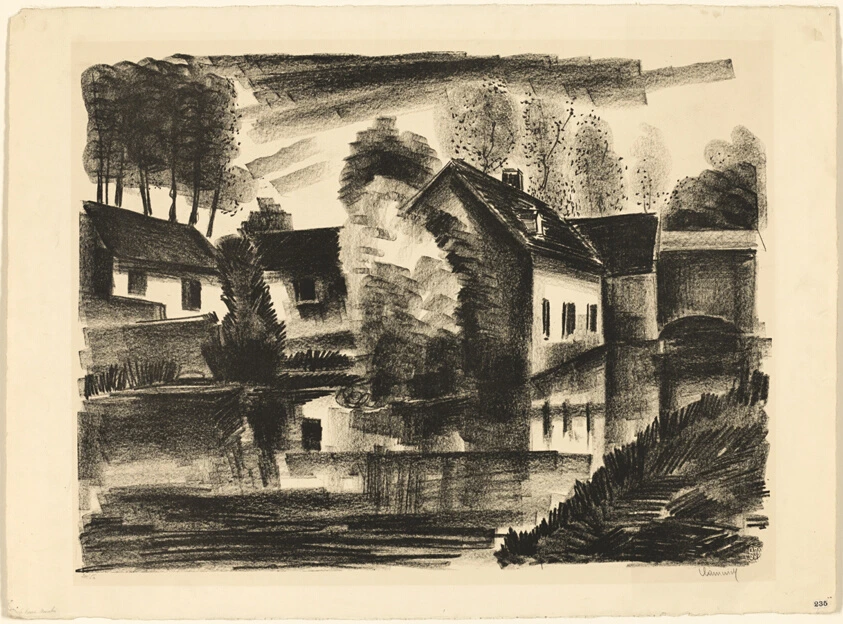
Houses at Chatou

Description

In reviewing the 1905 Salon d’Automne, an alternative exhibition to the official Salon, one critic likened the work of Maurice de Vlaminck, Henri Matisse, and André Derain to that of wild beasts (fauves in French). Although not intended as a criticism, others used the name to attack this new direction in avant-garde art. The Fauves were not a formally unified group, but their style was nevertheless distinct, characterized by their use of vibrant, unmixed paint and rough, spontaneous brushwork. The thick application, explosive color, and subject of Houses at Chatou—possibly one of the works included in the 1905 Salon—reveal the importance of the work of Vincent van Gogh to the Fauves.

Provenance

Galerie Bing et Cie, Paris, by May 1927 [Salmon 1927]. Ambroise Vollard, Paris, by Nov. 1934 to at least 1946 [Vauxcelles 1934 and Baschet 1946]. Galerie Bing et Cie, Paris, by 1950 [this and the following according to letter from Sidney Janis Gallery, July 1976, in curatorial file]; sold to Sidney Janis Gallery, New York, 1950; sold to Mr. and Mrs. Maurice E. Culberg, Chicago; given to the Art Institute of Chicago, 1951.

Houses at Chatou

Maurice de Vlaminck

c. 1905

Accession Number

74699

Medium

Oil on canvas

Dimensions

81.3 × 101.6 cm (32 × 40 in.)

Classification

oil on canvas

Museum

The Art Institute of Chicago

Chicago, United States

Credit Line

Gift of Mr. and Mrs. Maurice E. Culberg

Background & Context

Background Story

Maurice de Vlaminck's Houses at Chatou (c. 1905) is an oil on canvas from the height of the Fauvist movement. Vlaminck (1876-1958) was a French painter and a leading figure in Fauvism, along with Matisse and Derain. This painting shows houses in the town of Chatou on the Seine, rendered with the explosive colors and bold brushwork characteristic of Fauvism. The palette is intense, the handling vigorous, the composition dynamic.

Cultural Impact

Vlaminck was a leading Fauvist painter, and his landscapes of Chatou are among the most radical works of the movement.

Why It Matters

This Fauvist landscape of houses at Chatou captures the explosive energy of the movement with intense colors and bold brushwork.