Accession Number
111667
Medium
Oil on canvas
Dimensions
26.8 × 45 cm (10 9/16 × 17 3/4 in.); Framed: 35.6 × 53.7 × 7 cm (14 × 21 1/8 × 2 3/4 in.)
Classification
oil on canvas
Credit Line
Simeon B. Williams Fund
Background & Context
Background Story
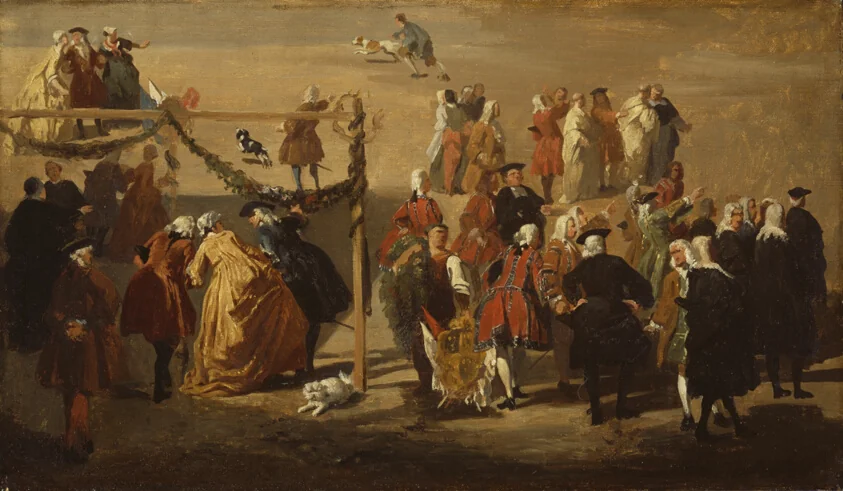
Giovanni Paolo Panini's "Festival in Piazza Navona" (1729) is an oil on canvas that captures one of the most famous celebrations in 18th-century Rome. Piazza Navona, with its Baroque fountains and churches, was the site of popular festivals, particularly the "Festival of the River" when the square was flooded to create a lake for mock naval battles. Panini's painting shows the piazza filled with crowds, carriages, and festivities, the architecture of the square providing a magnificent backdrop. Panini (1691–1765) was the leading painter of Roman views and festivals in the 18th century, known for his detailed, lively depictions of the city's monuments and public life. This painting combines topographical accuracy with the energy of a public celebration, the figures animated and numerous, the architecture rendered with precision. The palette is bright and festive, the composition organized to lead the eye through the square and its activities. This painting is both a document of Roman social history and a work of art that captures the spirit of 18th-century Roman life at its most joyous.
Cultural Impact
Panini's festival paintings are among the most vivid records of 18th-century Roman public life, capturing the energy and spectacle of the city's celebrations with extraordinary detail and liveliness.
Why It Matters
This painting of a festival in Piazza Navona captures the joyous energy of 18th-century Roman public life, the crowded square and festive atmosphere rendered with Panini's characteristic blend of topographical accuracy and celebratory spirit.


