Provenance
With Macbeth Gallery, New York, by 1910 [Inventory Records, box 111, folder 26, Macbeth Gallery Records, Archives of American Art, Smithsonian Institution, Washington, DC]; sold to the Art Institute of Chicago, 1910.
Accession Number
64491
Medium
Oil on canvas
Dimensions
66.4 × 101.9 cm (26 1/8 × 40 1/8 in.)
Classification
Painting
Credit Line
Friends of American Art Collection
Background & Context
Background Story
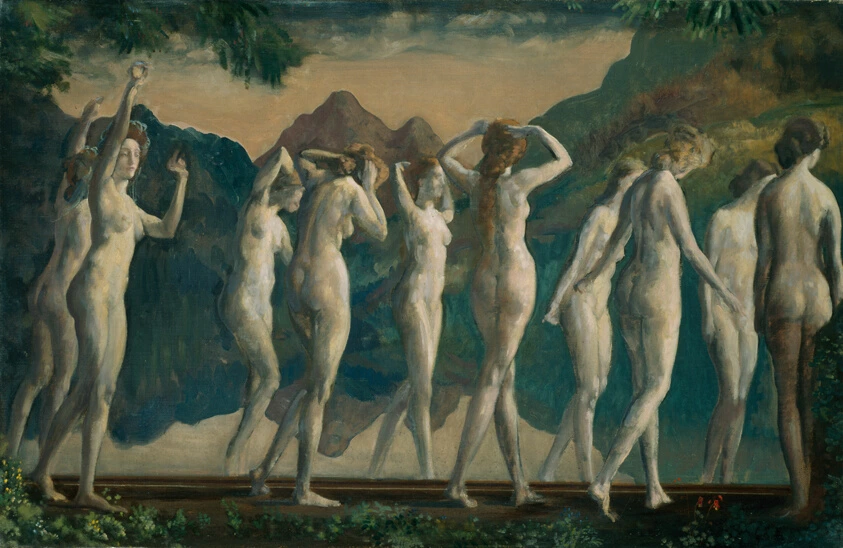
Arthur B. Davies's "Maya, Mirror of Illusions" (c. 1910) is an oil on canvas that exemplifies the artist's symbolist and mystical tendencies. The title references the Hindu concept of Maya—the illusory, phenomenal world that conceals ultimate reality. Davies (1862–1928) was deeply interested in Eastern philosophy, classical mythology, and theosophy, and his work often explores themes of illusion, transcendence, and the hidden order beneath surface appearances. This painting shows a dreamlike scene with figures—perhaps including Maya herself, personified as a woman or goddess—in a misty, golden landscape. The figures are elongated and idealized, the colors are soft and atmospheric, the overall effect is of a vision half-seen. Davies's style in this period combines elements of Symbolism, Art Nouveau, and the tonalism of Whistler and Inness. As the organizer of the 1913 Armory Show, Davies was crucial to the introduction of modernism to America, yet his own work remained deeply rooted in the poetic and the mystical.
Cultural Impact
Davies's exploration of Eastern philosophy and mystical themes in his painting anticipated the interest in non-Western spirituality that would become a significant undercurrent in 20th-century modernism.
Why It Matters
This mystical painting captures Davies's unique vision, where Hindu philosophy, classical mythology, and Whistlerian atmosphere combine to create a dreamlike image of the veil of illusion that conceals ultimate reality.


