Provenance
Count Johann Nepomuk Wilczek (d. 1922), Burg Kreuzenstein, near Vienna [in a letter of 31 March, 1947, Abris Silberman stated to Art Institute director Daniel Catton Rich that he had acquired the picture “about twenty-five years ago” from the Wilczek collection; letter in AIC archives]; Kunsthandlung Silbermann, Vienna, about 1922; sold to Dr. Oskar Bondy (d. 1944), Vienna and New York; his widow Elisabeth Soinig Bondy until shortly before March 1947 [in a letter of 5 March, 1947 Abris Silberman stated, “We have re-acquired [the triptych] from Mrs. Bondy recently”; letter in Art Institute archives; the painting was not among the objects sealed in the Bondy’s Vienna apartment in 1938; for this list see Sophie Lillie, Was einmal war: Handbuch der enteigneten Kunstsammlungen Wiens, Vienna, 2003, pp. 218-44]; A. and E. Silberman, New York, 1947; acquired by the Art Institute with de-accession funds, 1947.
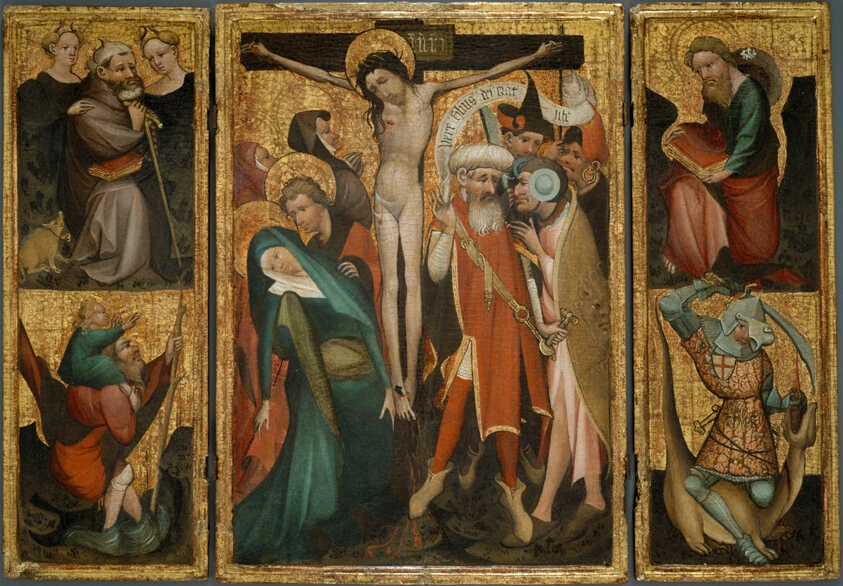
Triptych of the Crucifixion with Saints Anthony, Christopher, James and George
c. 1400
Accession Number
90071
Medium
Tempera and oil (?) on panel
Dimensions
Framed overall: 56.8 × 86 cm (22 3/8 × 33 7/8 in.); Left wing: 56.6 × 20.6 cm (22 1/4 × 8 1/8 in.); Center: 56.7 × 40.4 cm (22 5/16 × 16 7/8 in.); Right wing: 56.8 × 20 cm (22 3/8 × 7 7/8 in.)
Classification
Painting
Credit Line
Mr. and Mrs. Martin A. Ryerson Collection
Background & Context
Background Story
The Triptych of the Crucifixion with Saints Anthony, Christopher, James and George from around 1400 is a tempera and oil painting on panel that exemplifies the International Gothic style of Netherlandish painting in the period before the van Eyck revolution of the early 15th century, when the conventions of medieval religious art were beginning to give way to the naturalistic innovations that would define the Northern Renaissance. The triptych format, with its central panel depicting the Crucifixion and its side panels showing the four saints who serve as intercessors and patrons, is the characteristic format of Northern European altarpieces, in which the central narrative is flanked by figures who connect the divine story to the human community that commissioned the work. The saints Anthony, Christopher, James, and George represent different aspects of Christian virtue and protection: Anthony the hermit and patron of those suffering from skin diseases; Christopher the patron of travelers; James the apostle and patron of pilgrims; and George the dragon-slayer and patron of soldiers. The date of around 1400 places this triptych in the period when Netherlandish painting was transitioning from the flat gold backgrounds and schematic figures of the medieval tradition to the spatial depth and naturalistic detail that would characterize the work of the van Eyck brothers and their followers. The tempera and oil medium on panel, which combines the traditional egg tempera with the new oil technique that would revolutionize Northern European painting, demonstrates the experimental approach to medium that characterizes this transitional period.
Cultural Impact
The Triptych of the Crucifixion is an important document of the International Gothic style in Netherlandish painting, demonstrating the conventions of medieval religious art at the moment before the van Eyck revolution transformed Northern European painting. The combination of tempera and oil on panel shows the experimental approach to medium that characterizes the transitional period of around 1400.
Why It Matters
A triptych from around 1400 in tempera and oil on panel depicting the Crucifixion with Saints Anthony, Christopher, James, and George, exemplifying the International Gothic style of Netherlandish painting at the transition from medieval convention to Northern Renaissance naturalism.