Nude under a Pine Tree

Description

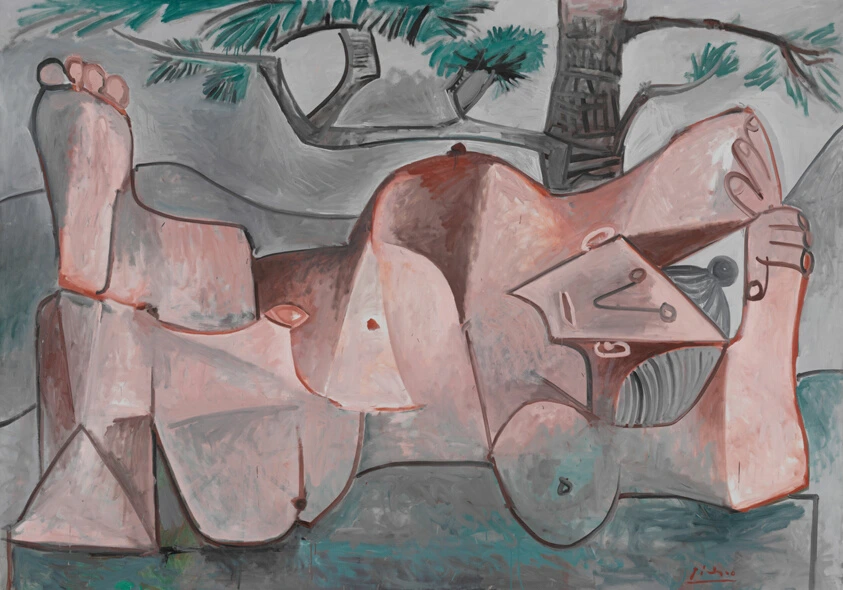
For many artists living amid the destruction and rebuilding of postwar Europe, artworks of the past offered a sense of continuity and order. In Nude under a Pine Tree, Pablo Picasso looked to the long tradition of figurative painting, including the female nudes of Francisco de Goya. In contrast to his predecessors, however, Picasso placed the monumental figure on rocky terrain, rather than on a plush chaise. He also used bold, modernist forms that reference his own earlier artistic styles: the flattened face, segmented legs and torso, and multiple viewpoints recall some of his Cubist works, and the color palette evokes his classical style of the 1920s.

Provenance

Galerie Louise Leiris, Paris, by 1961 [letter from B. Leonovich, Museum of Art, Moscow, to Carole Herman, Apr. 14, 1967; copy in curatorial file]; sold to the Art Institute, 1965.

Nude under a Pine Tree

Pablo Picasso

January 20, 1959

Accession Number

23968

Medium

Oil on canvas

Dimensions

194 × 279.5 cm (76 3/8 × 110 1/8 in.)

Classification

Painting

Museum

The Art Institute of Chicago

Chicago, United States

Credit Line

Bequest of Grant J. Pick
Background & Context

Background Story

Painted on January 20, 1959, "Nude under a Pine Tree" is one of the monumental late canvases in which Picasso revisited the grand themes of European painting—mythology, landscape, and the female body—with the furious energy of an artist who knows he is running out of time. The canvas measures nearly two meters by two and three-quarters, placing it among the largest works of his postwar period and signaling his ambition to compete with the historical masters he had spent decades studying. The figure sprawls across a landscape that simultaneously evokes the Mediterranean coast near his villa La Californie and the imagined Arcadias of Poussin and Claude. The pine tree functions as a classical attribute, its dark verticality contrasting with the pale, elongated body beneath. Picasso's brushwork in this period became increasingly free and almost violently expressive, with broad strokes of unmodulated color that recall the late Titian canvases he admired. The distortion of the female form—enormous eyes, multiplied breasts, fractured limbs—has been read as both erotic celebration and anxious confrontation with mortality. The painting also reflects Picasso's obsession with artistic inheritance: by appropriating the nude-in-landscape motif, he was claiming his place in a lineage stretching from Giorgione through Cézanne to Matisse. Critics have debated whether the work is a triumph of sustained creativity or evidence of declining powers; the canvas itself suggests that for Picasso, the question was irrelevant—he painted until the end because stopping was unthinkable.

Cultural Impact

This monumental late canvas asserted Picasso's claim to the European tradition of mythological landscape, proving that age had not diminished his ambition to rival Titian and Poussin.

Why It Matters

It matters because at seventy-seven, Picasso painted a nude larger than most living rooms—refusing to let age shrink his vision.