Provenance
Francisco “Paco” Durrio (1868–1940), Paris, between 1893 and 1895 [González de Durana, Alzuri, and Amezaga, Francisco Durrio (1868–1940): Sobre las huellas de Gauguin, exh. cat. (Museo de Bellas Artes de Bilbao, 2013), pp. 195–98, 208, no. 4]. Emily Crane Chadbourne (1871–1964), Chicago and London, by 1910 [Robins, “‘Manet and the Post-Impressionists’: A Checklist of Exhibits,” Burlington Magazine, 152, no. 1293 (Dec. 2010), pp. 787–88.]; given to the Art Institute of Chicago, 1922.
Accession Number
5513
Medium
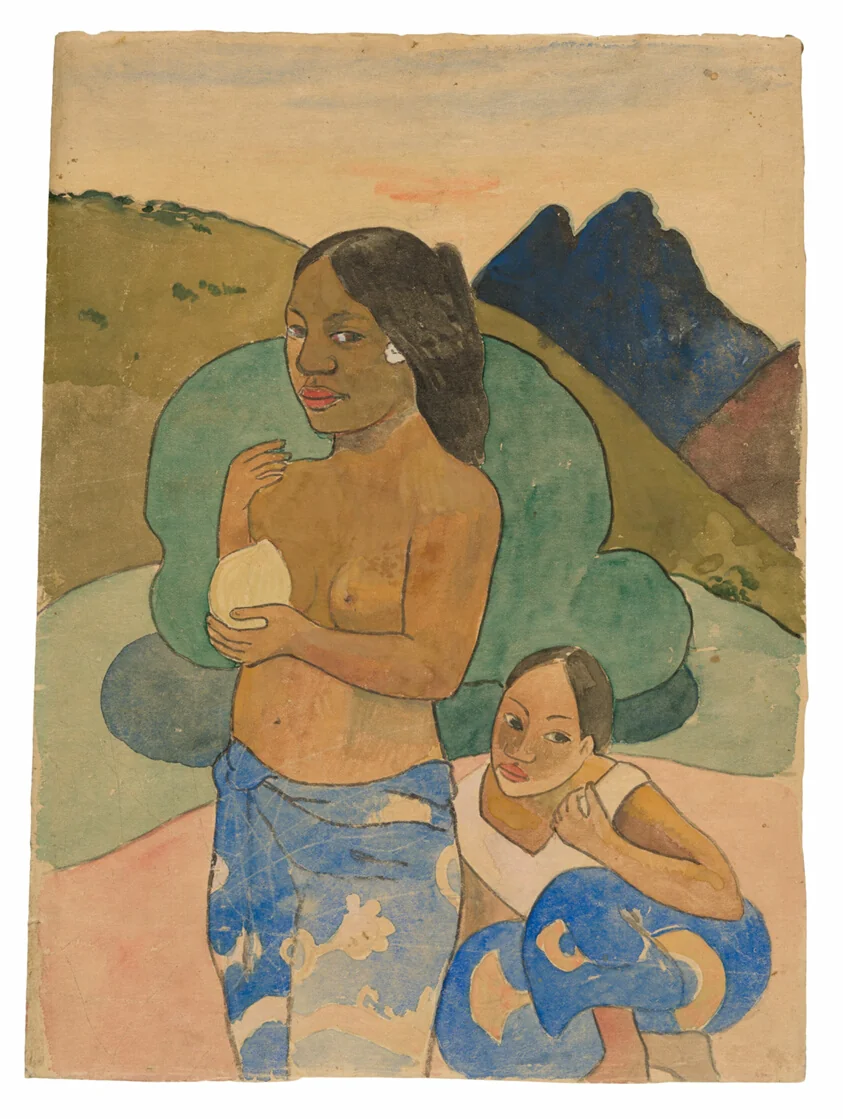
Monotype matrix in watercolor and gouache, with brush and green ink, over traces of graphite, on cream Japanese paper, laid down on tan wove paper (partially removed)
Dimensions
32.2 × 23.8 cm (12 11/16 × 9 3/8 in.)
Classification
watercolor
Credit Line
Gift of Emily Crane Chadbourne
Background & Context
Background Story
"Two Tahitian Women in a Landscape" is a c. 1892 monotype matrix in watercolor and gouache by Paul Gauguin that demonstrates the French Post-Impressionist master's extraordinary technical experimentation and his commitment to the unique print as a vehicle for artistic expression, the image showing two women in a tropical setting rendered with the combination of watercolor, gouache, and brush and green ink on cream Japanese paper that creates a surface of extraordinary delicacy and chromatic richness. The composition is a medium-sized work—32.2 × 23.8 centimeters—showing two female figures in a landscape with the simplified forms and the bold colors that suggest both the physical reality of the Tahitian environment and the dreamlike quality of the artist's imagination. The monotype technique creates a unique image that suggests both the spontaneity of the sketch and the permanence of the finished work, the single impression becoming a meditation on the themes of femininity, nature, and the exotic. Art historians have connected this work to the broader tradition of the monotype in modern art, from the experiments of Degas to the prints of the twentieth century, noting that Gauguin's treatment is more focused on the coloristic harmony and the symbolic suggestion, the transformation of the print medium into a vehicle for painterly expression, than the graphic precision or the reproductive function of these other traditions.
Cultural Impact
This c. 1892 monotype made two Tahitian women uniquely painterly through medium 32cm watercolor-gouache green-ink chromatic richness on cream Japanese paper, using single-impression spontaneity-permanence to transform print medium into feminine nature exotic meditation beyond Degas graphic reproductive precision.
Why It Matters
It matters because Gauguin made a one-of-a-kind print of two women and made the paper feel like it was still warm from his hand—proving that even a copy could be original if the watercolor was free enough.