Provenance
Alfred Dussueil (1878–1927), Paris [Wildenstein 1991 and Durand-Ruel Archives]. Sold by Henri Cottereau, Paris, to Carter H. Harrison (1860–1953), Chicago, winter 1927–28 [Carter H. Harrison, “A brief statement of where and how I acquired the various items in the collection of drawings I have given to the Art Institute. . . . ,” Oct. 18, 1934]; given to the Art Institute of Chicago, 1933.
Accession Number
15818
Medium
Graphite on tan wove paper
Dimensions
13 × 8.5 cm (5 1/8 × 3 3/8 in.)
Classification
graphite
Credit Line
Mr. and Mrs. Carter H. Harrison Collection
Background & Context
Background Story
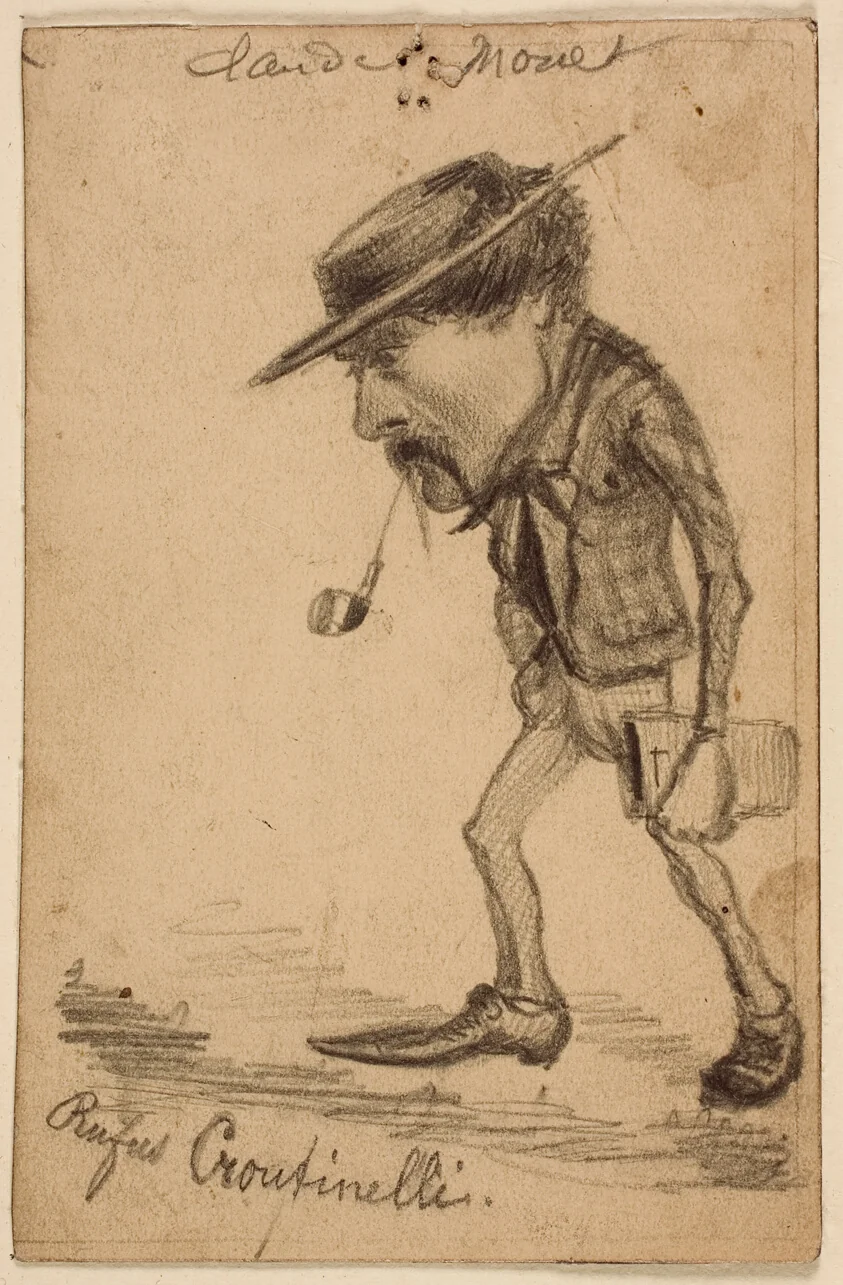
Claude Monet's "Caricature of Henri Cassinelli ('Rufus Croutinelli')" (c. 1858) is a graphite drawing on tan wove paper with an elaborate invented nickname that suggests the young artist's playful approach to caricature. "Rufus Croutinelli" (Latin-sounding, vaguely absurd) indicates that Monet was not simply recording names but actively participating in the creation of comic personae. Henri Cassinelli was a resident of Le Havre, one of the local characters that the teenage Monet observed and satirized. The drawing is executed with the confident economy that characterizes all of Monet's early caricatures—a few lines suffice to capture the essential features and character of the subject. The tan wove paper provides a warm, slightly textured ground. The invented Latin nickname adds a layer of humor that goes beyond visual caricature into verbal wordplay, showing the young artist's wit and his comfort with the comic tradition that stretched from Rabelais to Daumier.
Cultural Impact
Monet's caricatures with invented names and nicknames demonstrate his participation in the rich tradition of French comic art, showing the humor and wit that would later inform his more serious work.
Why It Matters
This caricature of "Rufus Croutinelli" captures the young Monet's playful spirit, the invented name and exaggerated features showing an artist who took his subjects seriously enough to observe them closely but lightly enough to laugh at them.