Provenance
Possibly sold by Mme. Strindberg to W. Marchant, after 1910 [MacDonald 1995]. Charles Deering (1852–1927), Chicago; by descent to his daughters, Mrs. Chauncey McCormick (née Marion Deering; 1886–1965), Chicago and Mrs. Richard Ely Danielson (née Barbara Deering; 1885–1957), Chicago; given to the Art Institute of Chicago, 1927.
Accession Number
50768
Medium
Charcoal on cream laid paper
Dimensions
17.5 × 11.2 cm (6 15/16 × 4 7/16 in.)
Classification
charcoal
Credit Line
The Charles Deering Collection
Background & Context
Background Story
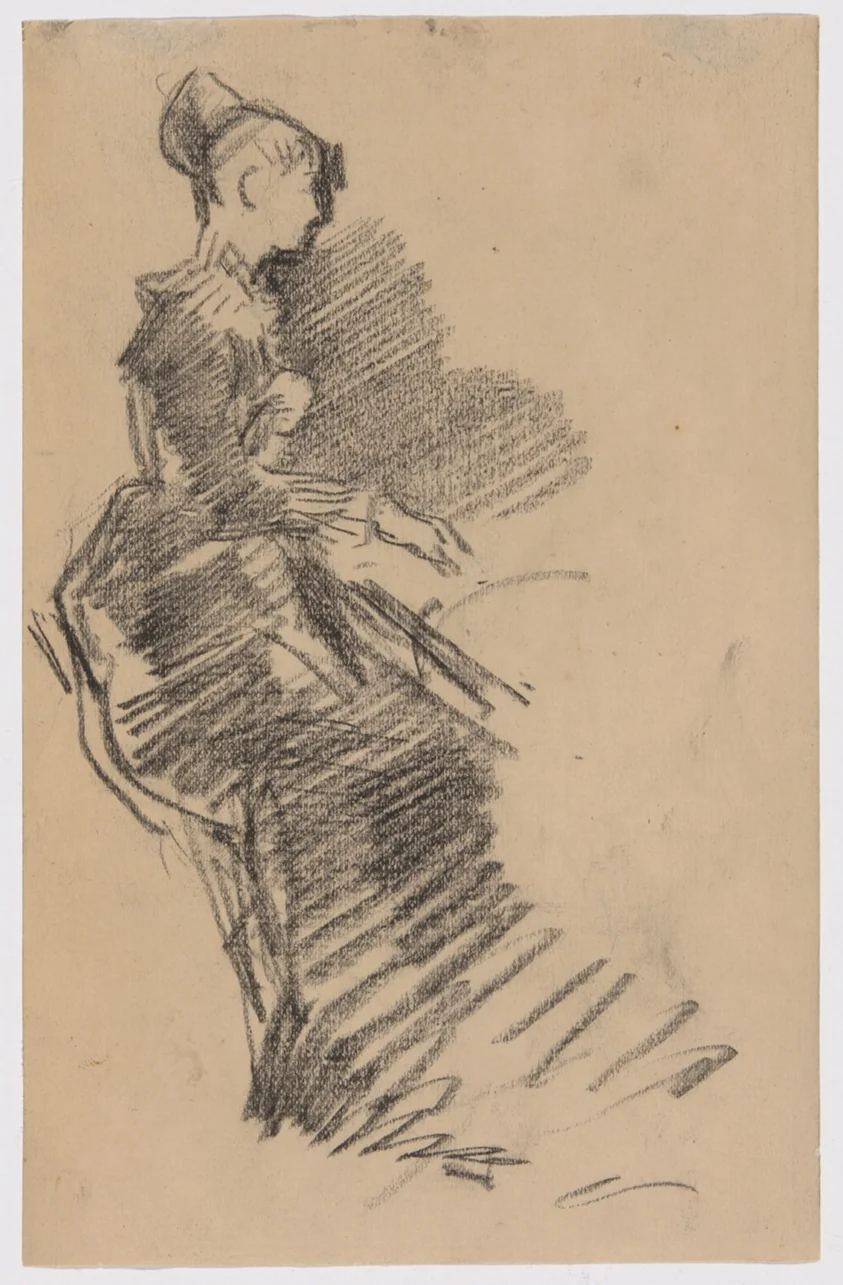
James McNeill Whistler's At the Piano (1873/75) is a charcoal drawing on cream laid paper depicting a figure at a piano, likely a woman playing or a musical scene. Music was a recurring theme in Whistler's work, and he often used musical terms for his paintings, such as Nocturnes, Arrangements, and Harmonies. This drawing shows the intimate setting of the domestic music room, the figure of the pianist absorbed in the music. The charcoal medium allows for soft, atmospheric effects that are well suited to the mood of the subject. The cream laid paper provides a warm ground. Whistler's handling of the charcoal is sensitive and restrained, building the forms through subtle modulations of tone rather than strong contrasts. This drawing belongs to the period when Whistler was developing the refined, tonal style that would culminate in his famous Nocturnes, and it shows his sensitivity to the quiet poetry of everyday life.
Cultural Impact
Whistler's musical subjects reflect his belief in the close relationship between painting and music, a central principle of his aesthetic philosophy of Art for Art's Sake.
Why It Matters
This charcoal drawing of a figure at the piano captures the quiet intimacy of domestic music-making, Whistler's sensitive handling of tone creating a mood of serene concentration.